Gujarat and Maharashtra Diwali 2026: Dates, Traditions, Food and Travel Guide
Gujarat and Maharashtra Diwali 2026: day-by-day dates, Chopda Pujan, Gujarati New Year, Abhyanga Snan, Diwali Padwa, Bhaubeej, Faral and travel tips.
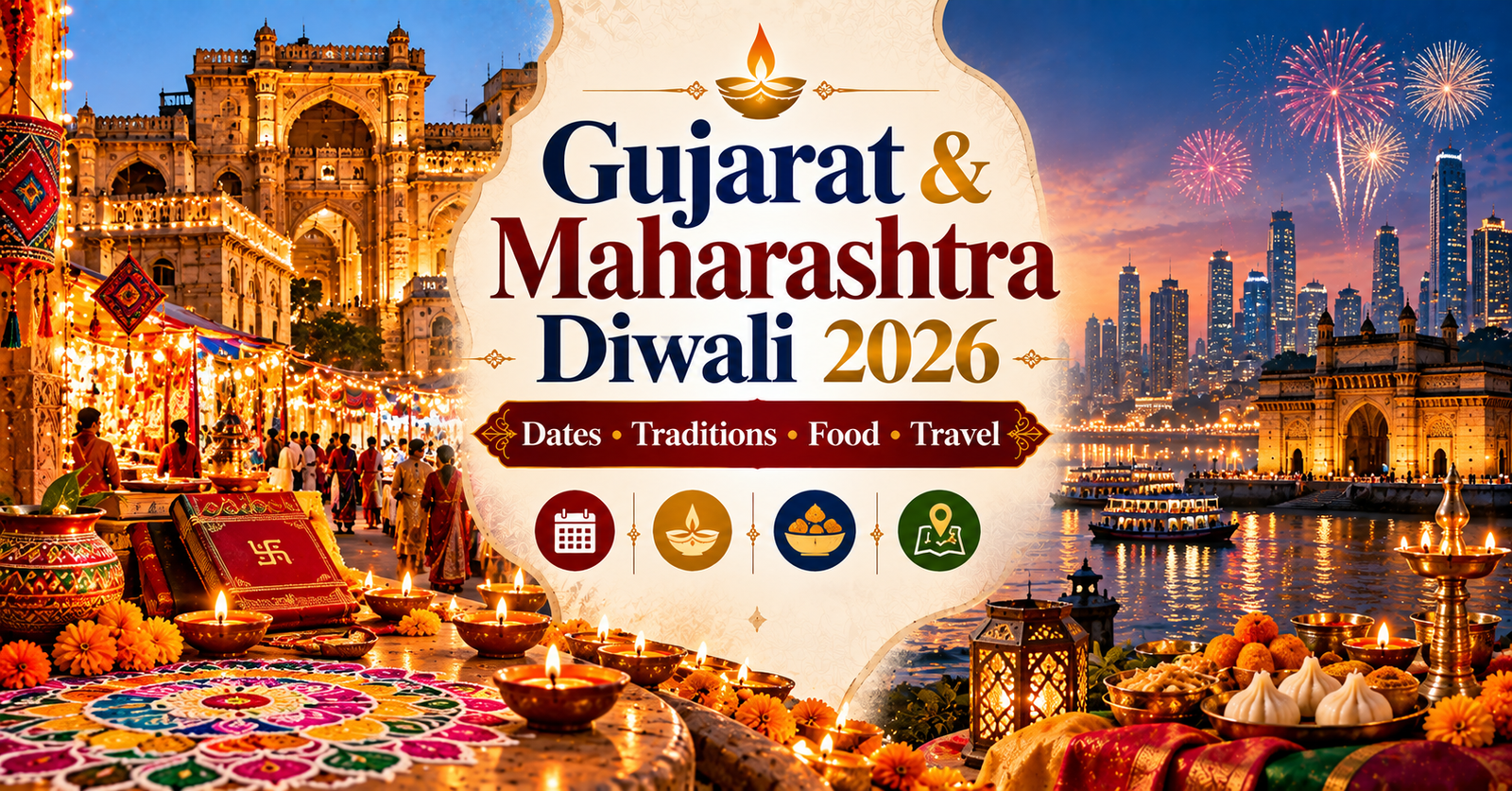
Quick answer: Gujarat Diwali 2026 and Maharashtra Diwali 2026 share the same main date. Diwali falls on Sunday, 8 November 2026 in both Gujarat and Maharashtra, but the two states celebrate it very differently. In Gujarat the festival runs from Vagh Baras on 5 November to Labh Pancham on 14 November, with Chopda Pujan on Diwali night and the Gujarati New Year (Bestu Varas) on 10 November. In Maharashtra it runs from Vasu Baras on 5 November to Bhaubeej on 11 November, with the pre-dawn Abhyanga Snan, Diwali Faral and Diwali Padwa. This guide covers the dates, rituals, food and the best places to see each, plus travel tips if you are planning a trip.
In This Guide
- Gujarat Diwali 2026 and Maharashtra Diwali 2026 dates
- Diwali in Gujarat: day by day
- Gujarati Diwali food
- Ahmedabad, Surat and Vadodara at Diwali
- Diwali in Maharashtra: day by day
- Diwali Faral: Marathi Diwali food
- Mumbai, Pune and Nashik at Diwali
- Gujarat and Maharashtra compared
- Diwali Padwa: one day, two meanings
- Travelling during Diwali: practical tips
- From Gujarat or Maharashtra to Ayodhya for Deepotsav
- FAQs
Gujarat Diwali 2026 and Maharashtra Diwali 2026: Dates
| Date (2026) | Day | Gujarat | Maharashtra |
|---|---|---|---|
| 5 November | Thursday | Vagh Baras | Vasu Baras |
| 6 November | Friday | Dhanteras | Dhantrayodashi |
| 7 November | Saturday | Kali Chaudas | Narak Chaturdashi (Abhyanga Snan) |
| 8 November | Sunday | Diwali and Chopda Pujan | Lakshmi Pujan |
| 9 November | Monday | Gap day in the 2026 calendar | Gap day in the 2026 calendar |
| 10 November | Tuesday | Bestu Varas (Gujarati New Year) | Diwali Padwa (Bali Pratipada) |
| 11 November | Wednesday | Bhai Beej | Bhaubeej |
| 14 November | Saturday | Labh Pancham | Not observed as a major day |
These dates follow the tithi at sunrise in India. In 2026 the Amavasya runs into the morning of 9 November, which is why Pratipada, and with it the Gujarati New Year and Diwali Padwa, falls on 10 November. Puja muhurat differs by city, so check a local panchang for exact timings. For the full five-day calendar and Lakshmi Puja timings, see our Diwali 2026 guide.
Diwali in Gujarat: Day by Day
Gujarat Diwali 2026 runs for ten days, from Vagh Baras to Labh Pancham. Diwali in Gujarat is as much about a fresh start as about lights. For trading families it closes one financial year and opens the next, and that idea runs through every day of the festival.
Vagh Baras (5 November)
The festival opens with the worship of cows and calves, a day linked with gratitude for the animals that sustain a farming household. In many homes this is also when the cleaning and painting of the house is finished and the first rangoli goes up at the door.
Dhanteras (6 November)
Families buy gold, silver or new utensils, and businesses prepare for the coming accounts. In the evening, lamps are lit at the entrance.
Kali Chaudas (7 November)
Kali Chaudas is associated with removing negativity from the home. Many families perform special prayers in the evening, and the house is lit fully for the first time.
Diwali and Chopda Pujan (8 November)
On Diwali evening, traders and shop owners perform Chopda Pujan, the worship of new account books, together with Goddess Lakshmi. The first page of the new book is marked with auspicious symbols. At home, every window and doorway is lined with diyas, and families visit relatives with sweets.
Bestu Varas: the Gujarati New Year (10 November)
Bestu Varas begins Vikram Samvat 2083. People wear new clothes, visit temples early in the morning and go from house to house greeting family and neighbours with "Saal Mubarak" or "Nutan Varshabhinandan". Many temples, especially Haveli and Swaminarayan temples, offer an Annakut, a large display of food offerings, on this day.
Bhai Beej (11 November)
Sisters invite their brothers for a meal and pray for their well-being, and brothers give gifts in return.
Labh Pancham (14 November)
Labh Pancham is traditionally the day shops and businesses reopen after the Diwali break, and new ledgers are formally started with the words "Shubh" and "Labh". In many towns, markets stay largely shut between Bestu Varas and Labh Pancham.
Gujarati Diwali Food
Gujarati homes start preparing Diwali snacks days in advance, and a box of homemade nasta is the standard gift for visitors.
| Item | What it is |
|---|---|
| Mathiya | Thin, crisp discs made from moth bean flour, lightly spiced |
| Chorafali | Light, puffed strips made from gram and urad flour, dusted with spice |
| Ghughra | Sweet pastries stuffed with semolina, dry fruit and sugar |
| Farsi puri | Flaky, salted puris that keep for weeks |
| Mohanthal | Rich gram-flour fudge flavoured with cardamom and saffron |
| Sukhdi | A simple sweet of wheat flour, ghee and jaggery |
Ahmedabad, Surat and Vadodara at Diwali
- Ahmedabad: the old city markets and the lanes around Manek Chowk stay busy with shoppers until late in the days before Diwali. The pols, the old neighbourhoods of the walled city, are at their most atmospheric when lit with diyas.
- Surat: the textile and diamond trades take their Diwali vacation, and many units reopen around Labh Pancham. The city is quieter for business but full of family visits.
- Vadodara: the Mandvi market area is the centre of festive shopping, and the city's old neighbourhoods light up for the New Year.
Travel tip for Gujarat: because many shops and smaller restaurants close from Bestu Varas to Labh Pancham, book hotels with meals included and confirm opening days for any sights you plan to visit.
Diwali in Maharashtra: Day by Day
Maharashtra Diwali 2026 runs for seven days, from Vasu Baras to Bhaubeej. Marathi Diwali, often called Marathi Deepavali, is known for its early mornings, its lanterns and the plates of Faral that fill every home.
Vasu Baras (5 November)
Like Vagh Baras in Gujarat, Vasu Baras honours cows and calves. It marks the start of the festival in Maharashtra.
Dhantrayodashi (6 November)
Families buy gold, silver or new utensils, and lamps are lit in the evening.
Narak Chaturdashi and Abhyanga Snan (7 November)
The most distinctive Maharashtrian ritual. Before sunrise, the family takes an Abhyanga Snan: an oil massage followed by a bath with utane, a fragrant paste of herbs and flours. In many homes a small bitter fruit is traditionally crushed underfoot, symbolising the defeat of Narakasura. Firecrackers and the first plate of Faral follow.
Lakshmi Pujan (8 November)
Lakshmi Pujan is performed at home and in shops in the evening. Houses are lit with diyas and the akash kandil, a paper lantern hung outside every home.
Diwali Padwa (10 November)
Also called Bali Pratipada. The wife performs aukshan, an aarti, for her husband, and he gives her a gift. It is one of the three and a half most auspicious days of the Marathi calendar, so many people buy property, vehicles or gold on Padwa.
Bhaubeej (11 November)
Sisters perform aukshan for their brothers and pray for their long life; brothers give gifts in return.
Killa and Diwali Pahat
Two more Maharashtrian traditions make the season special. Children build killa, small mud forts modelled on the hill forts of the Maratha era, decorated with toy soldiers. And in many cities, Diwali Pahat, early-morning music concerts, are held on the festival days. Diwali is also the season of Diwali ank, the special Diwali issues published by Marathi magazines.
Diwali Faral: Marathi Diwali Food
Diwali Faral is the plate of homemade snacks and sweets shared with every guest who visits during the festival. Making it together is part of the celebration.
| Item | What it is |
|---|---|
| Chakli | Crisp, spiral-shaped savoury made from a spiced multi-grain flour |
| Chivda | A savoury mix of flattened rice or puffed rice with peanuts and curry leaves |
| Karanji | Half-moon pastries filled with coconut, sugar and dry fruit |
| Shankarpali | Sweet, diamond-shaped fried biscuits |
| Besan ladoo | Gram-flour ladoos roasted in ghee |
| Anarsa | A sweet of rice flour and jaggery, coated with poppy seeds |
Mumbai, Pune and Nashik at Diwali
- Mumbai: Dadar market is the place for kandils, diyas and Faral ingredients in the days before Diwali. In the evenings, the city's waterfront and residential societies are lit up.
- Pune: known for its Diwali Pahat concerts, held early in the morning at venues across the city during the festival days.
- Nashik: pilgrims light diyas and take a holy dip at Ramkund on the Godavari, and visit the Kalaram Temple.
Travel tip for Maharashtra: trains and buses out of Mumbai and Pune are packed in the days before Diwali and after Bhaubeej, as families travel home. Book early and avoid travelling on 6 and 7 November and on 11 and 12 November if you can.
Gujarat and Maharashtra Compared
| Point | Gujarat | Maharashtra |
|---|---|---|
| First day | Vagh Baras | Vasu Baras |
| Signature ritual | Chopda Pujan on Diwali night | Abhyanga Snan before dawn |
| 10 November | Gujarati New Year (Bestu Varas) | Diwali Padwa (Bali Pratipada) |
| Last day | Labh Pancham (14 November) | Bhaubeej (11 November) |
| Festive food | Mathiya, chorafali, ghughra, mohanthal | Faral: chakli, chivda, karanji, ladoo |
| Greeting | Saal Mubarak | Diwalichya hardik shubhechha |
| Unique custom | Annakut at temples on New Year | Killa (mud forts) and Diwali Pahat |
Diwali Padwa: One Day, Two Meanings
Diwali Padwa, the first day of the bright half of Kartik, is celebrated in both states on 10 November 2026, but it means something different in each:
- In Gujarat it is Bestu Varas, the start of the new year, with temple visits and New Year greetings.
- In Maharashtra it is Padwa or Bali Pratipada, celebrating the bond between husband and wife.
In other parts of India the same day is observed as Govardhan Puja and Annakut.
Travelling During Diwali: Practical Tips
- Book transport early. Trains, flights and buses across western India fill up weeks in advance.
- Expect closures. In Gujarat many shops close from Bestu Varas to Labh Pancham. In Maharashtra, most businesses close on Lakshmi Pujan and Padwa.
- Choose hotels with meals. Smaller restaurants may shut on the main days.
- Plan sightseeing for the gap day. In 2026, Monday 9 November is a quieter day between Diwali and the New Year.
- Carry cash. Many small vendors at markets and fairs take only cash or UPI.
- Respect private rituals. Chopda Pujan and aukshan are family moments; ask before taking photos.
Looking at Diwali celebrations in other states? Read our guides to the best places to celebrate Diwali, Rajasthan, Kolkata and Amritsar.
From Gujarat or Maharashtra to Ayodhya for Deepotsav
Many families from Gujarat and Maharashtra now spend part of the Diwali season in Ayodhya, where Deepotsav lights the Saryu ghats with lakhs of diyas on the evening of 7 November 2026, the day before Diwali. It is possible to see Deepotsav and still be home for Lakshmi Pujan or the New Year:
| Day | Plan |
|---|---|
| 6 November | Fly to Ayodhya. Ahmedabad and Navi Mumbai have had direct flights to Ayodhya; otherwise connect through Delhi. |
| 7 November | Ram Mandir darshan in the morning; Deepotsav on the Saryu in the evening |
| 8 November | Early flight home for Lakshmi Pujan, or stay for Diwali in Ayodhya |
Ram Mandir darshan is free, and passes are issued only by the temple Trust. Hotels and flights for Deepotsav fill up early. See our Ayodhya Deepotsav 2026 guide and Diwali tour package guide for details.
Your Travel Partner is based in Ayodhya and arranges cabs and tour packages across India, including Gujarat and Maharashtra. We can handle the airport pickup, a cab for the Deepotsav day and a hotel near the ghats, or a full tour package. The plan and price are shared in writing before you book. Call or WhatsApp +91 78811 55800.
Frequently Asked Questions
1. When is Diwali in Gujarat and Maharashtra in 2026?
Diwali is on Sunday, 8 November 2026 in both states. Dhanteras is on 6 November.
2. When is the Gujarati New Year in 2026?
The Gujarati New Year, Bestu Varas, is on Tuesday, 10 November 2026. It begins Vikram Samvat 2083.
3. What is Chopda Pujan?
Chopda Pujan is the worship of new account books with Goddess Lakshmi on Diwali night, performed mainly by Gujarati traders and business families.
4. When is Labh Pancham in 2026?
Labh Pancham is on Saturday, 14 November 2026. Many businesses in Gujarat traditionally reopen on this day.
5. When is Diwali Padwa in 2026?
Diwali Padwa is on Tuesday, 10 November 2026. In Maharashtra it celebrates husband and wife; in Gujarat it is the New Year.
6. When is Bhaubeej in 2026?
Bhaubeej, called Bhai Beej in Gujarat, is on Wednesday, 11 November 2026.
7. What is Abhyanga Snan?
It is the pre-dawn oil bath with utane, a fragrant herbal paste, taken on Narak Chaturdashi, which is 7 November in 2026.
8. What is Diwali Faral?
Diwali Faral is the set of homemade Marathi snacks and sweets, such as chakli, chivda, karanji, shankarpali, besan ladoo and anarsa, shared with guests during Diwali.
9. What are the traditional Gujarati Diwali snacks?
Mathiya, chorafali, ghughra, farsi puri, mohanthal and sukhdi are among the most common.
10. Are shops open in Gujarat after Diwali?
Many shops and small restaurants stay closed from Bestu Varas until Labh Pancham. Travellers should confirm opening days in advance.
11. What is a killa in Maharashtra?
A killa is a small mud fort that children build during Diwali, modelled on Maharashtra's historic hill forts and decorated with toy soldiers.
12. Can I visit Ayodhya Deepotsav from Gujarat or Maharashtra and be home for Diwali?
Yes. Deepotsav is on the evening of 7 November 2026. Fly to Ayodhya on 6 November and fly home early on 8 November for Lakshmi Pujan.
Conclusion
Gujarat Diwali 2026 and Maharashtra Diwali 2026 share the same Diwali date but celebrate it in their own way. Gujarat closes its account books and welcomes Vikram Samvat 2083 on 10 November, and keeps the festive mood going until Labh Pancham on 14 November. Maharashtra begins with Vasu Baras, wakes before dawn for the Abhyanga Snan, shares Faral with every guest and ends with Bhaubeej on 11 November. Whichever state you are in, book travel early, plan around the closures, and if you want to add Ayodhya's Deepotsav, start planning now.