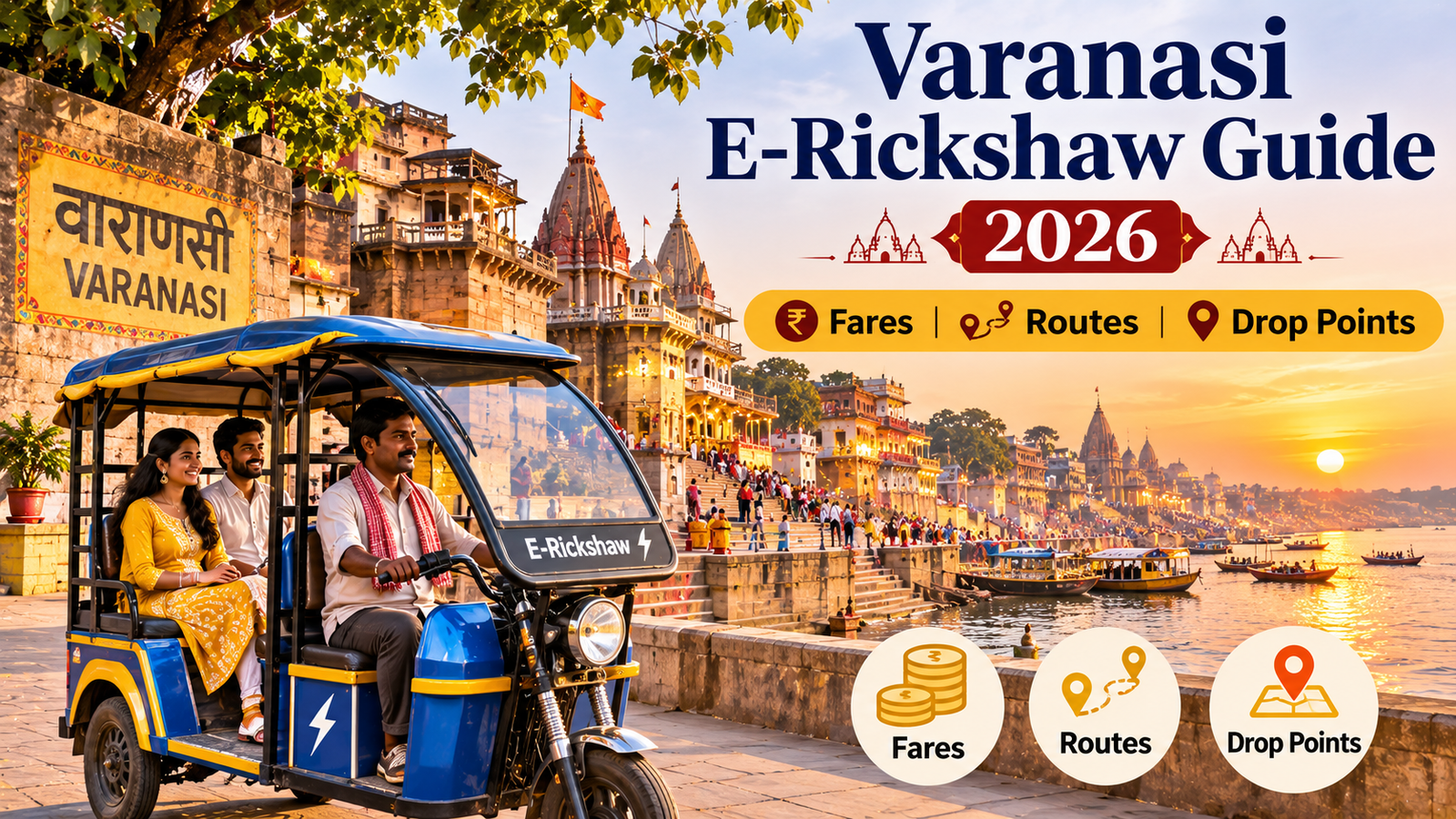
Varanasi E-Rickshaw Guide 2026: Fares, Routes, Drop Points
Varanasi e-rickshaw guide 2026: reported fares, the four colour-coded Kashi zone routes, where e-rickshaws stop near Godowlia, and Dev Deepawali tips.
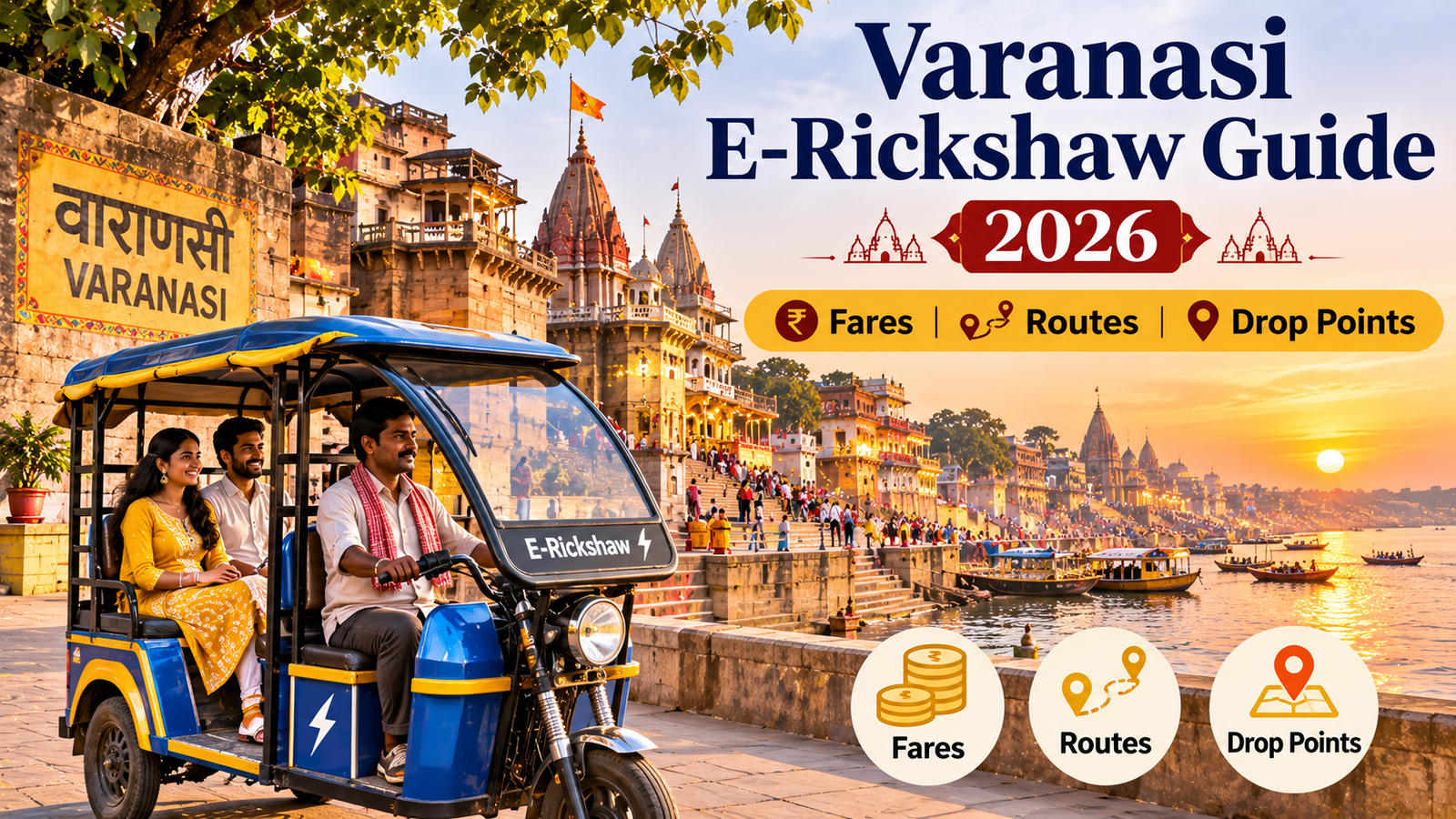
Most visitors to Varanasi use an e-rickshaw at least once, usually between the station, Godowlia and the ghats. Two things catch people out: the fare is rarely the same twice, and the last stretch before the main lanes is closed to vehicles, so the ride never ends where you expect. This guide covers what has been reported on fares, the route system that Varanasi police introduced in 2024, where e-rickshaws stop, and what to plan for during Dev Deepawali on 24 November and Kaal Bhairav Jayanti on 1 December.
Quick Answer
Varanasi has no single published e-rickshaw rate card. Reported shared fares are Rs 30 to 40 per person from Godowlia to Kaal Bhairav and Rs 10 for short hops, with a full vehicle near Rs 150. In the Kashi zone each e-rickshaw is limited to one of four colour-coded routes. Agree the fare first.
E-Rickshaw Fares in Varanasi: What Has Been Reported
I could not find an official fare list for Varanasi e-rickshaws, unlike Ayodhya, where traffic police issued one in 2024. What exists is a newspaper report and a few guide pages. They are shown here with their dates so you can judge them.
| Route or ride | Fare reported | Source and date | Note |
|---|---|---|---|
| Godowlia crossing to Kaal Bhairav Temple | Rs 30 to 40 per passenger (usual) | Amar Ujala, 1 January 2025 | Up to Rs 100 per seat on New Year's Eve; one family of five paid Rs 500 |
| Girjaghar to Benia Park | Rs 10 per passenger (usual) | Amar Ujala, 1 January 2025 | Up to Rs 50 on New Year's Eve |
| Shared auto or e-rickshaw, general | Rs 30 shared; Rs 150 full vehicle | Ayodhya Varanasi Guides, updated June 2026 | Does not say whether the shared figure is per person, and does not separate autos from e-rickshaws |
| Cantt station to Godowlia | About 5 km; no e-rickshaw fare listed | Ayodhya Varanasi Guides, June 2026 | Ask the driver for Godowlia crossing |
Another 2026 guide (TripCosmos, April 2026) lists e-rickshaw pickup points at Godowlia junction, Lahurabir crossing, the Lanka BHU gate and the Varanasi Junction station exit. Several of its fare figures were garbled in the text I could read, so I have not quoted them. The same guide is run by a cab company, so treat its advice with that in mind.
The pattern across sources: short shared hops are in the tens of rupees, longer rides are Rs 30 to 40 per person, and a full vehicle for a trip across the city is in the low hundreds. Prices rise on crowded days. Do not read these as a rate card, and note that I found nothing published for Assi, BHU or Lanka routes that I could verify.
The Four-Route System in the Kashi Zone
Since 10 September 2024, e-rickshaws in the Kashi zone have worked under a route and colour system run by Varanasi traffic police. Amar Ujala reported the plan on 7 September 2024. Each e-rickshaw gets a colour-coded QR code and may run only on the route linked to that colour.
| Route | Colour | Police station areas (as announced 7 Sep 2024) | E-rickshaws registered at launch |
|---|---|---|---|
| Route 1 | Red | Kotwali, Jaitpura, Adampur | 5,071 |
| Route 2 | Yellow | Chetganj, Luxa, Chowk, Dashashwamedh, Sigra | 3,362 |
| Route 3 | Green | Bhelupur | 2,786 |
| Route 4 | Blue | Lanka, Chitaipur | 2,507 |
The system covers 11 police station areas. E-rickshaws registered in the Varuna and Gomti zones may not enter them, and Ramnagar-registered ones can go only as far as Namo Ghat and the bridge area in front of it.
What this means for a visitor
- The core temple and ghat area is the yellow route. Dashashwamedh, Chowk, Chetganj and Luxa all sit on it, according to the 2024 plan. A yellow-coded e-rickshaw is the one that works that area.
- You may need to change. Going from Lanka or Assi (blue) to Godowlia (yellow) can mean two rides if the driver stays on his own route. The reports I read do not say how cross-zone trips are handled, so this is my inference. Ask before you sit.
- Check the QR sticker. A coloured QR code on the vehicle shows that it is registered. It is not a fare guarantee, as no report I read links the code to a fare.
Is the system working?
Only partly, according to the same newspaper. A 3 February 2025 report said drivers wanted the temple area because short trips there pay more, and that 363 e-rickshaws changed their registered address between October 2024 and January 2025, with 150 moving to the Kashi Vishwanath area. Some owners transferred vehicles to relatives to get around the colour rule. On 27 June 2026 the paper reported that traffic police seized 40 autos and e-rickshaws for leaving their routes the previous day, after a May and June drive that had already seized 183. On 4 August 2026 it reported that the QR system had become ineffective, with fake QR codes in use and outside autos entering through Cantt station. That report was about autos, and gave no fare. In practice, you will see e-rickshaws of every colour near Godowlia.
Where E-Rickshaws Stop
- Godowlia crossing: the usual drop point for Kashi Vishwanath and Dashashwamedh Ghat. From there it is about 500 to 600 m on foot, according to Ayodhya Varanasi Guides (June 2026).
- Old city lanes: autos cannot enter the galis, per the same guide. The page does not mention e-rickshaws separately, but they are no narrower than an auto, so expect the same limit.
- Maidagin to Godowlia: on 7 January 2026 Amar Ujala reported that this stretch was declared a no-vehicle zone for the Magh Mela, with barriers at both ends. The report gave no end date or hours and did not mention e-rickshaws. Ask on the day whether it is still closed.
- Kaal Bhairav: e-rickshaws take you towards the temple lanes, but the report on the 28 December 2025 rush said that autos and e-rickshaws dropping people in narrow lanes were blocking Pucca Mahal residents. Expect to be dropped short and walk the last part.
The Kashi ropeway from Cantt station to Godowlia is not running yet. PTI reported on 24 June 2026 that fares were fixed at Rs 50 for the full journey (Rs 40 with a smart pass) for a ride of 15 to 16 minutes, but the project was still under construction and no opening date was given. Do not plan around it.
Dev Deepawali, 24 November 2026
No traffic plan for Dev Deepawali 2026 has been published that I could find as of 12 November. Varanasi police usually issue one days before the event. The only detailed plan I could read is a 2025 guide from a taxi company, which cites no official order. It claims that vehicles are allowed only as far as the Maidagin or Luxa point, and that areas near the ghats become pedestrian-only several hours before the aarti. Parking points it names are Maidagin, Luxa, Sigra and Maldahiya, and Beniabagh. Treat these as the author's view and not confirmed 2026 rules.
- Plan to walk the last 1 to 2 km. An e-rickshaw may stop at Luxa or Maidagin, not at the ghat.
- Reach the Godowlia side before the afternoon. Winter aarti at Dashashwamedh starts around 6 PM, per one guide, and the lanes fill from about 6 to 8 PM.
- Return plan: do not count on finding an e-rickshaw after the lamps. Book a return ride or walk to a main road.
- Read our Dev Deepawali Varanasi 2026 date guide, the boat booking guide, the Ganga aarti ticket guide and the lighting and photography guide for the evening plan.
Kaal Bhairav Jayanti, 1 December 2026
Kaal Bhairav Jayanti falls on Tuesday, 1 December. The temple draws very large crowds on weekends and festivals, and the e-rickshaw fare from Godowlia is the one clearest data point we have: Rs 30 to 40 per passenger in normal times. Plan for a drop short of the temple. Our Kaal Bhairav Jayanti Varanasi guide has the tithi, timings and aarti schedule, and the December festival dates list helps you pick other days.
How to Avoid Being Overcharged
On 1 January 2025 Amar Ujala reported that e-rickshaw, boat and handcart operators overcharged visitors in Kashi. Some e-rickshaw drivers refused single passengers and demanded a full booking. The same report said boat rides that normally cost Rs 200 were quoted at Rs 1,000. Steps that help:
- Ask: "Per person, or the whole vehicle?" and "What is the total to the drop point?"
- Agree the drop point. It will probably not be the temple gate.
- Carry small notes. One guide says UPI signal drops inside the lanes, and recommends keeping about Rs 200 in cash.
- Do not follow a driver who says the temple is closed or the road is blocked and offers another stop. Guides list this as a common line.
- Avoid taking transport offered inside temple complexes, and anyone who sells darshan with the ride.
- If you want a fixed price, book ahead. Our e-rickshaw booking page lists day options, cab hire covers longer trips, and the Varanasi package includes local transport.
For longer trips between cities, see our Varanasi to Ayodhya cab fare guide and the cab guide for Ayodhya and Kashi Vishwanath darshan. If you are also going to Ayodhya, the Ayodhya local transport guide compares cab, auto and e-rickshaw there.
Frequently Asked Questions
What is the e-rickshaw fare in Varanasi?
There is no published rate card. Amar Ujala reported a usual Rs 30 to 40 per passenger from Godowlia to Kaal Bhairav and Rs 10 from Girjaghar to Benia Park (January 2025). A June 2026 guide gives Rs 30 shared and Rs 150 for a full vehicle.
What is the fare from Godowlia to Kaal Bhairav by e-rickshaw?
Usually Rs 30 to 40 per passenger, according to Amar Ujala in January 2025. On New Year's Eve some drivers asked for up to Rs 100 per seat. Agree the fare first.
Is there an official e-rickshaw fare list in Varanasi?
I did not find one. Police introduced a route and QR code system in September 2024, but the reports I read did not mention fares.
What is the colour-coded e-rickshaw system in Varanasi?
From 10 September 2024, Kashi zone e-rickshaws get a red, yellow, green or blue QR code and may run only on the matching route. The system covers 11 police station areas.
Which colour e-rickshaw runs near Dashashwamedh Ghat?
Under the plan announced on 7 September 2024, Dashashwamedh, Chowk, Chetganj, Luxa and Sigra are Route 2, yellow. Later reports say some vehicles do not follow their colour, so you may see others.
Can an e-rickshaw take me to Kashi Vishwanath Temple?
Not all the way. E-rickshaws drop at Godowlia crossing, and you walk about 500 to 600 m through the lanes, according to a June 2026 guide.
Is Maidagin to Godowlia closed to vehicles?
Amar Ujala reported on 7 January 2026 that the stretch was declared a no-vehicle zone for the Magh Mela. It gave no end date and did not mention e-rickshaws. Check on the day.
Can I go from Assi to Godowlia in one e-rickshaw?
Possibly not. Lanka is blue and Dashashwamedh is yellow in the 2024 plan, and each vehicle is meant to stay on its route. The reports do not explain cross-zone trips, so ask the driver.
How far is Cantt station from Godowlia?
About 5 km, via Cantt, Maidagin and Godowlia, according to Ayodhya Varanasi Guides.
Will e-rickshaws run on Dev Deepawali?
Probably, but only up to a drop point. No 2026 traffic plan had been published that I could find on 12 November. Expect to walk the last 1 to 2 km.
Is the Kashi ropeway open?
No. As of 24 June 2026 it was still under construction. Fares of Rs 50 for Cantt to Godowlia were announced, but there was no opening date.
Do drivers refuse single passengers?
Amar Ujala reported this on New Year's Eve 2025, with drivers demanding a full booking. It was reported on a peak day. Be ready to share or pay for the seats.
Can I pay by UPI?
Try, but carry cash. One 2026 guide says UPI signal drops inside the lanes and suggests keeping about Rs 200 in small notes.
Are e-rickshaws safe at night?
I found no safety data for night rides. Stick to main roads, agree the fare before you sit, and keep your return plan ready for after the aarti.
Can I book an e-rickshaw for the day in Varanasi?
Yes. Our booking page lists day options for Varanasi, Ayodhya and Prayagraj. Check what is included before you confirm.
Sources
- Amar Ujala, e-rickshaw routes and QR code, Kashi zone (7 Sep 2024)
- Amar Ujala video, new e-rickshaw system in the Kashi zone (10 Sep 2024)
- Amar Ujala, colour code system and address changes (3 Feb 2025)
- Amar Ujala, vehicles seized for leaving routes (27 Jun 2026)
- Amar Ujala, QR code system ineffective (4 Aug 2026)
- Amar Ujala, overcharging in Kashi on New Year's Eve (1 Jan 2025)
- Amar Ujala, Maidagin to Godowlia no-vehicle zone (7 Jan 2026)
- Amar Ujala, three lakh devotees at Kaal Bhairav (29 Dec 2025)
- ThePrint (PTI), Varanasi ropeway fare fixed at Rs 50 (25 Jun 2026)
- Ayodhya Varanasi Guides, how to commute in Varanasi (updated June 2026)
- TripCosmos, local transport guide Varanasi (April 2026)
- Chiku Cab, Varanasi Dev Deepawali traffic plan (taxi company blog, no official order cited)