Kashi Dev Diwali Lighting Photography 2026: Best Spots, Camera and Phone Settings, Timings & Rules
Kashi Dev Diwali lighting photography guide for 24 November 2026: best spots, blue hour timing, camera and phone settings, boat tips, shot list and drone rules.
Kashi Dev Diwali Lighting Photography 2026: Best Spots, Camera and Phone Settings, Timings & Rules
Last updated: 5 October 2026 | By: Your Travel Partner
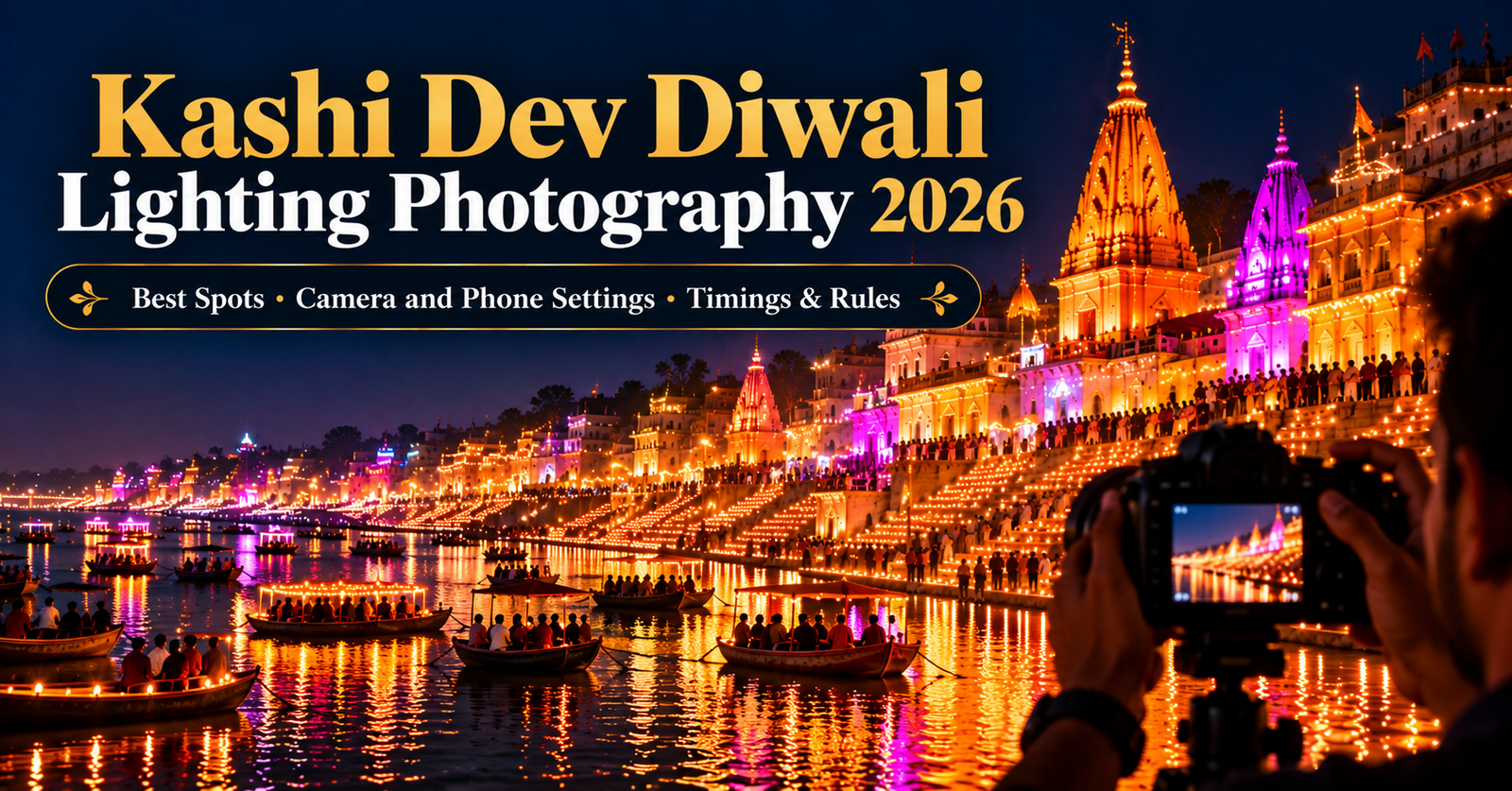
For about thirty minutes on Dev Diwali evening, Kashi offers a photograph that exists nowhere else: a deep blue sky, a full moon rising over the Ganga, and a curve of stone steps several kilometres long glowing with lakhs of small flames. Then the sky goes black, and the picture changes. Most visitors miss that half hour because they are still looking for a place to stand.
This guide is written so that you do not miss it. It tells you what is lit, when the light is best, where to stand, what settings to use on a camera or a phone, and what is not allowed.
Quick Answer
For Kashi Dev Diwali lighting photography, be in position by 4:00 PM on Tuesday, 24 November 2026. The sun sets at about 5:08 PM and the best light is the blue hour that follows, roughly 5:10 PM to 5:40 PM, when the sky still has colour and the diyas are already burning. The widest view of the lit ghats is from a boat on the Ganga. Turn the flash off, keep the shutter fast on a moving boat, reduce exposure slightly so the flames keep their colour, and do not fly a drone: the area is declared a no-fly zone for the festival.
| Date | Tuesday, 24 November 2026 (Kartik Purnima) |
|---|---|
| Sunset in Varanasi | About 5:08 PM |
| Best light (blue hour) | About 5:10 PM to 5:40 PM |
| What is lit | All 84 ghats with earthen diyas, about 25 lakh in 2025 |
| Other light sources | Ganga Maha Aarti flames, laser show at Chet Singh Ghat, green fireworks, full moon |
| Widest view | From a boat on the river |
| Be in position by | 4:00 PM on a boat, 3:00 PM on the ghat steps |
| Drones | Not allowed without permission. A no-fly zone is declared |
| Flash | Keep it off |
Table of Contents
- What Exactly Is Lit on Dev Diwali
- The Light, Hour by Hour
- Best Spots Compared
- Camera Settings for Each Scene
- Phone Photography: 10 Tips That Work
- Shooting From a Boat
- 12 Photographs Worth Planning For
- What to Pack
- Rules and Respect
- Common Mistakes
- A Two-Day Photo Plan
- Plan Your Shoot With Your Travel Partner
- Frequently Asked Questions
What Exactly Is Lit on Dev Diwali
Knowing your light sources is the first step, because each one needs a different approach.
| Light source | Where | Colour and character | What it means for your photo |
|---|---|---|---|
| Earthen diyas | Steps of all 84 ghats, plus kunds and ponds across the city | Warm orange, small and flickering | Beautiful in large numbers; easy to overexpose up close |
| Ganga Maha Aarti | Dashashwamedh Ghat and other aarti ghats | Large moving flames and smoke | Needs a faster shutter to freeze the flame |
| Decorative lighting | Temples, palaces and buildings along the riverfront | Mixed colours, steady | Adds depth behind the diyas in wide shots |
| Laser show | Chet Singh Ghat | Bright, coloured, fast-changing | Best seen from the river, facing the fort wall |
| Green fireworks | Over the river | Bursts of bright light | Long exposure on land; short clips or bursts on a boat |
| Full moon | Rises in the east, over the far bank | Cool white | A natural highlight in the sky at blue hour |
According to All India Radio News, about 25 lakh lamps were lit along the 84 ghats in 2025. Figures quoted by different sources vary from year to year, but in every recent year the count has been well above ten lakh.
The Light, Hour by Hour
One fact about Kashi shapes every photograph: the ghats stand on the western bank and face east. The sun rises over the far bank and sets behind the city. So the ghats are bathed in golden light at sunrise, and they fall into soft shade before sunset. The full moon, like the sun, rises over the far bank, in front of the ghats.
| Time | Light | What to shoot |
|---|---|---|
| About 6:00 to 7:30 AM | Sunrise at about 6:20 AM; warm, direct light on the ghats | Kartik Purnima snan, bathers, boats, temple spires |
| Noon to 3:00 PM | Harsh overhead light | Volunteers arranging diyas in patterns; details and portraits in shade |
| 3:00 to 4:45 PM | Soft, even shade on the ghats | People, preparations, rangoli, faces in the crowd |
| 4:45 to 5:08 PM | Warm sky; moon rising over the far bank | First diyas being lit; moonrise over the river |
| 5:10 to 5:40 PM | Blue hour. Sky and lamps are balanced | Wide views of the lit ghats. The best window of the day |
| 5:45 to 7:00 PM | Dark sky, bright flames | Ganga Maha Aarti, floating diyas, reflections |
| 7:00 PM onwards | Night | Laser show, fireworks, quiet lamp-lit corners |
Why the blue hour matters: after about 5:40 PM, the sky turns black and a camera can no longer hold detail in both the sky and the flames. In the blue hour it can. That is the difference between a postcard and a snapshot.
Best Spots Compared
| Spot | What you get | Difficulty | Best time |
|---|---|---|---|
| Boat in mid-river | The full sweep of lit ghats with reflections | Moving platform; needs a fast shutter | Blue hour and after |
| Dashashwamedh Ghat | Maha Aarti, priests, flames, dense crowd | Very crowded; arrive by 3:00 PM | During the aarti |
| Assi Ghat | Wide steps, devotees lighting diyas, cultural events | Crowded but with room to move | Before and at sunset |
| Chet Singh Ghat | Fort wall with laser show | Best from a boat | After dark |
| Panchganga Ghat | Traditional stone lamp towers covered with diyas | Steep steps, reached through lanes | Dusk |
| Kedar Ghat | Colourful striped steps with a temple above | Moderate | Dusk |
| Namo Ghat | Large folded-hands sculptures, open space | Easier access | Blue hour |
| Rooftop facing the river | View from above; a stable place for a tripod | Needs advance arrangement | Blue hour and fireworks |
| Lanes behind the ghats | Doorways, shrines and homes lit with lamps | Narrow and busy | After 7:00 PM |
The far bank of the river also gives a panoramic view, but access on Dev Diwali depends on the administration's arrangements. Check locally before you plan it.
Camera Settings for Each Scene
These are starting points. Take one test shot, check it on the screen, and adjust.
| Scene | Support | Aperture | Shutter | ISO | Note |
|---|---|---|---|---|---|
| Wide view of ghats at blue hour, from land | Tripod or a wall | f/8 | 1 to 4 seconds | 100 to 400 | Use a 2-second timer to avoid shake |
| Wide view from a moving boat | Handheld | f/1.8 to f/2.8 | 1/60 to 1/125 | 1600 to 6400 | Long exposures do not work on a boat |
| Diyas up close | Handheld | f/2 to f/2.8 | 1/60 to 1/100 | 800 to 1600 | Reduce exposure by 2/3 to 1 stop |
| Aarti flames | Handheld | f/2.8 | 1/125 to 1/250 | 1600 to 3200 | Expose for the flame, not the dark background |
| Portraits by lamp light | Handheld | f/1.8 to f/2 | 1/60 to 1/80 | 1600 to 3200 | Let the diya light the face |
| Laser show | Handheld | f/2.8 | 1/30 to 1/60 | 1600 to 3200 | Shoot in bursts; the patterns change quickly |
| Fireworks from land | Tripod | f/8 to f/11 | 2 to 6 seconds | 100 | Manual focus set to far distance |
| Fireworks from a boat | Handheld | f/2.8 | 1/60 | 3200 | Use burst mode and pick the best frame |
Four settings that apply all evening
- Shoot RAW if your camera allows it. You can recover highlights in the flames later.
- White balance: use Daylight or about 4000K. Auto white balance often removes the warm glow that makes the picture.
- Flash off. It flattens the scene and disturbs the ceremony.
- Stabilisation on when handheld; off when on a tripod.
Phone Photography: 10 Tips That Work
- Clean the lens with a soft cloth. Oil and fingerprints turn lamps into streaks.
- Turn the flash off.
- Tap on the brightest lamps and drag the exposure slider down a little. The flames keep their colour and the sky turns a deeper blue.
- Use Night mode on land, holding the phone against a railing or wall until the capture finishes.
- Switch Night mode off on a moving boat. It blurs. Use the normal photo mode there.
- Use the main lens in low light. The ultra-wide and zoom lenses on most phones are weaker in the dark.
- Do not use digital zoom. Take the wider photo and crop later.
- Hold with both hands, elbows against your body, and breathe out as you press.
- Record short videos of 10 to 20 seconds. For the aarti and fireworks, a clip often tells more than a photo.
- Take your wide shots in the blue hour. No phone setting can replace the right light.
Shooting From a Boat
- Choose your seat. Sit on the side facing the ghats. On a double-decker bajra, the upper deck gives a clear view over other boats.
- Forget the tripod. The boat moves, so a tripod only transfers the movement to the camera. Use a fast lens and a faster shutter.
- Include reflections. Lower your camera towards the water to catch the lamps mirrored in the river.
- Use other boats. A boat in the foreground with the lit ghats behind adds scale.
- Ask about the route. A boat that covers the stretch from Assi to Raj Ghat gives you every major ghat.
- Keep a strap on the camera and a zip pouch for the phone. Things fall into the river every year.
- Wear the life jacket. Do not stand on the edge for a photo.
Boats are limited and are booked weeks ahead. See our Varanasi Dev Diwali boat booking guide for types, prices and questions to ask.
12 Photographs Worth Planning For
- The curve of lit ghats from mid-river in the blue hour
- The full moon rising over the Ganga, seen from the steps
- A single row of diyas leading down the steps, shot from low and close
- Hands lighting a diya, with the face lit from below
- Diyas arranged in patterns, photographed from a higher step
- Priests in a line with raised lamps during the Maha Aarti
- Flame and smoke of the aarti against the dark sky
- A leaf-bowl diya floating on the water
- Lamp towers at Panchganga Ghat
- The laser show on the wall of Chet Singh Ghat, with boats in front
- Fireworks above the lit riverfront
- A quiet lane or doorway lit by a few lamps, after the crowd has passed
What to Pack
| Item | Why |
|---|---|
| Fast prime lens (35mm or 50mm, f/1.8) | The single most useful lens after dark |
| Wide zoom (such as 16–35mm or 24–70mm) | For the sweep of the ghats |
| Two spare batteries | Cold air and long evenings drain them |
| Spare memory card | You will shoot more than you expect |
| Small tripod or monopod | Useful on a rooftop or quiet ghat; not in the dense crowd or on a boat |
| Lens cloth | Oil smoke settles on glass |
| Camera strap and a zip pouch | Protection near water |
| Power bank | For your phone |
| Small torch | For changing settings and walking on dark steps |
| Shoes with a good grip | Steps become oily from the lamps |
| Warm layer | Late November evenings on the river are cold |
Carry one small bag. A large backpack is a burden in the crowd.
Rules and Respect
- No drones. For Dev Diwali 2024, Varanasi Police declared the area a no-fly zone for five days. Drones, kites, balloons, remote-operated microlight aircraft and paragliders were prohibited without prior permission. Expect a similar order in 2026 and check the dates with Varanasi Police before you travel.
- No photography of cremations. At Manikarnika and Harishchandra Ghats, put the camera away. This is a matter of respect for grieving families.
- No cameras or phones inside Shri Kashi Vishwanath Temple. Use the lockers outside.
- Ask before a portrait. A smile and a gesture towards the camera are enough. Respect a no.
- No flash during the aarti.
- Do not move or step on the diyas to improve a composition.
- Do not block devotees. Kneel or sit if you are in front.
- Commercial shoots with crews, lights or models need permission from the local administration.
- Follow police instructions on where you may stand, especially near the aarti platform and VIP areas.
Common Mistakes
- Arriving after sunset. The blue hour is over in thirty minutes.
- Using long exposures on a boat. Every frame comes out blurred.
- Leaving exposure on auto. The camera brightens the dark scene and burns out the flames.
- Using flash. It lights the nearest head and nothing else.
- Staying in one place all evening. If you are on the ghats, plan two or three positions.
- Carrying too much. One camera and two lenses are enough.
- Forgetting the morning. Sunrise on the ghats is the best natural light of the day.
- Watching only through the screen. Put the camera down for a few minutes and take it in.
A Two-Day Photo Plan
| When | Plan |
|---|---|
| 23 November, afternoon | Walk the ghats from Assi towards Dashashwamedh. Note your positions and how long each walk takes |
| 23 November, evening | Photograph the regular Ganga Aarti as a rehearsal. Test your settings |
| 24 November, 5:45 AM | Sunrise boat ride or the Assi Ghat morning aarti. Kartik Purnima snan |
| 24 November, noon | Rest. Charge batteries. Clear memory cards |
| 24 November, 2:00 PM | Leave for the ghat or boarding point |
| 24 November, 4:45 to 5:40 PM | Moonrise, first lamps and the blue hour |
| 24 November, 5:45 PM onwards | Maha Aarti, laser show, fireworks |
| 24 November, after 8:30 PM | Lanes and quiet corners lit by lamps |
For the full festival schedule and muhurat, read Dev Deepawali Varanasi 2026 date and guide. For the aarti itself, see Ganga Aarti on Dev Diwali: tickets, seats and timings.
Plan Your Shoot With Your Travel Partner
A good photograph on Dev Diwali depends on being in the right place at the right minute. We can arrange the travel side so you can concentrate on the pictures.
- Boat seats and private boats for the evening. Tell us you are going for photography and we will suggest a suitable boat type and boarding point
- Hotel within walking distance of the ghats
- Cab from the airport, railway station, Ayodhya, Prayagraj or Lucknow
- Combined trip covering Ayodhya Deepotsav on 7 November and Dev Diwali on 24 November
You get the boat type, boarding point, timing and price in writing before you pay. We book only boats that provide a life jacket for every passenger.
Call or WhatsApp: +91 78811 55800
See also our Varanasi packages and tour packages.
Frequently Asked Questions
1. What is the best time for Kashi Dev Diwali lighting photography?
The blue hour just after sunset, about 5:10 PM to 5:40 PM on 24 November 2026. The sky still has colour and the diyas are already lit.
2. Where is the best place to photograph Dev Diwali in Varanasi?
A boat in mid-river gives the widest view of all the lit ghats. For the Maha Aarti, Dashashwamedh Ghat. For the laser show, Chet Singh Ghat seen from the water.
3. When is Dev Diwali 2026?
Tuesday, 24 November 2026, on Kartik Purnima.
4. Can I fly a drone on Dev Diwali in Varanasi?
No, not without prior permission. In 2024, Varanasi Police declared a no-fly zone covering drones, kites, balloons and similar objects for the festival period.
5. What camera settings should I use for diyas?
Start with f/2 to f/2.8, 1/60 to 1/100 second and ISO 800 to 1600. Reduce exposure by about two-thirds to one stop so the flames keep their colour.
6. Can I use a tripod?
On a rooftop or a quiet ghat, yes. In the dense crowd it is impractical and can trip people. On a moving boat it does not help.
7. How do I take good photos with a phone?
Clean the lens, turn off the flash, tap on the lamps and lower the exposure slightly. Use Night mode only when the phone is held steady on land.
8. Is photography allowed during the Ganga Aarti?
Yes, from your place. Do not use flash and do not stand in front of seated devotees.
9. Can I photograph the cremation ghats?
No. Photography of cremations at Manikarnika and Harishchandra Ghats is not acceptable. Keep your camera away there.
10. Are cameras allowed inside Kashi Vishwanath Temple?
No. Cameras and mobile phones are not allowed inside. Lockers are available outside.
11. How many diyas are lit on Dev Diwali?
About 25 lakh lamps were lit along the 84 ghats in 2025, according to All India Radio News.
12. Is a boat or the ghat better for photos?
A boat is better for wide views and reflections. The ghat is better for people, close-ups of diyas and the aarti up close. If you have two evenings, do both.
13. Which lens is most useful?
A fast 35mm or 50mm lens with an aperture of f/1.8, along with a wide zoom for the sweep of the ghats.
14. Is the morning worth photographing?
Yes. The ghats face east, so sunrise gives warm, direct light on the steps, bathers and temples.
15. Do I need permission for photography?
Personal photography needs no permission. Commercial shoots with crews or equipment, and any drone use, need permission from the local administration.
16. Can Your Travel Partner arrange a boat for photography?
Yes. Call or WhatsApp +91 78811 55800 and tell us it is for photography. You get the boat type, boarding point, timing and price in writing before you pay.
Conclusion
Kashi Dev Diwali lighting photography rewards preparation more than equipment. Know that the ghats face east, be in position before sunset, use the thirty minutes of blue hour well, keep the flash off and the shutter fast on a boat, and respect the rules of the place. Do that, and on 24 November 2026 you will bring home the photograph that most people only see on a postcard.
For Dev Diwali boat booking, hotels and cabs, call or WhatsApp +91 78811 55800. Har Har Mahadev!
Useful Links
- All India Radio News: Dev Deepawali 2025
- Uttar Pradesh Tourism
- District Varanasi
- Shri Kashi Vishwanath Temple
Note: Sunset and twilight times are approximate. Programme details, rules and access for 2026 are decided by the administration and may change. Camera settings are starting points and depend on your equipment. Please check official announcements before travelling. Your Travel Partner is a private travel service.