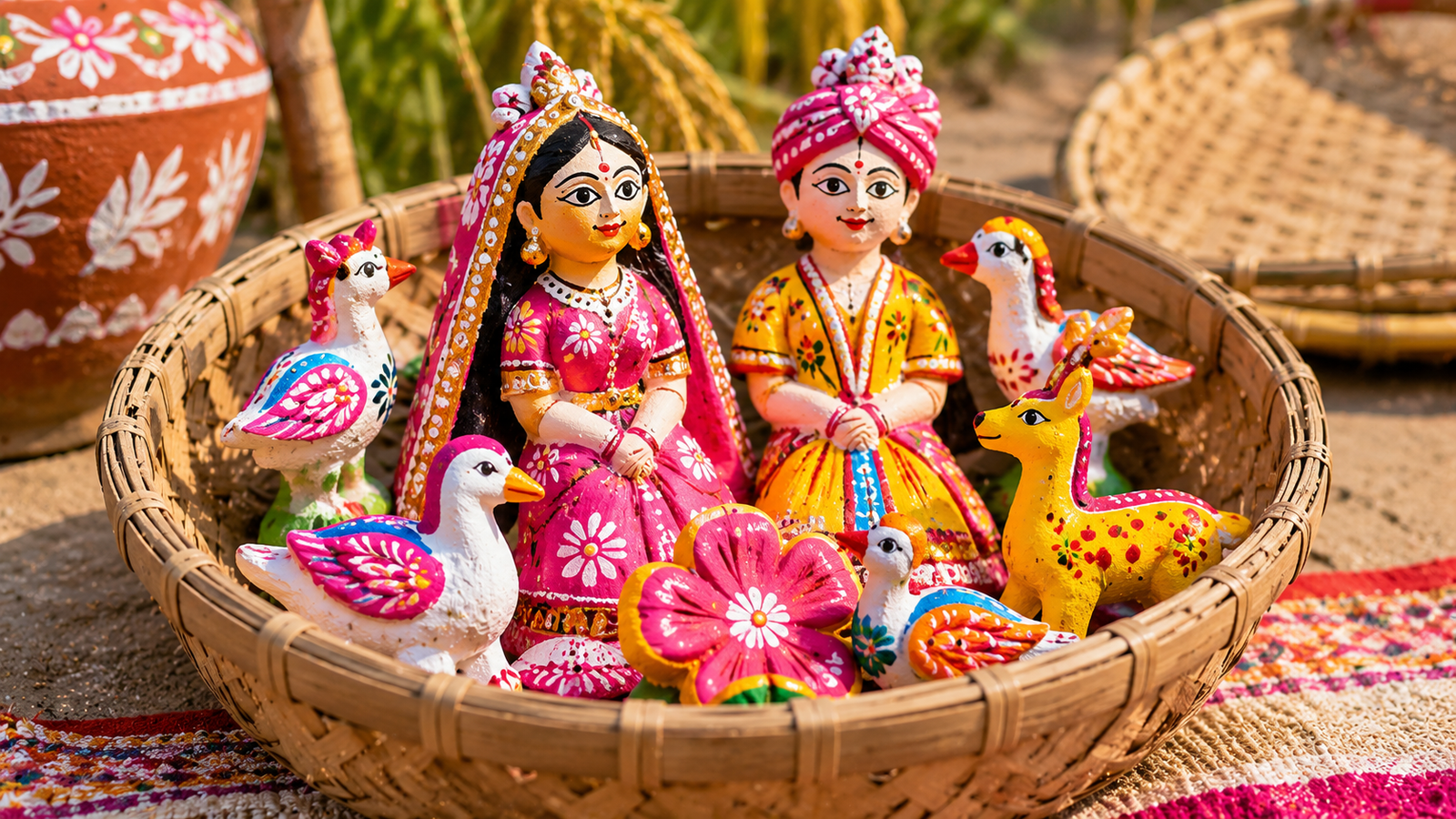
Sama Chakeva 2026: Mithila Festival Dates, Story, Songs
Sama Chakeva 2026 runs from Chhath to Purnima on 24 Nov. See why start dates differ, story versions, clay figures, Maithili songs and where it is held.
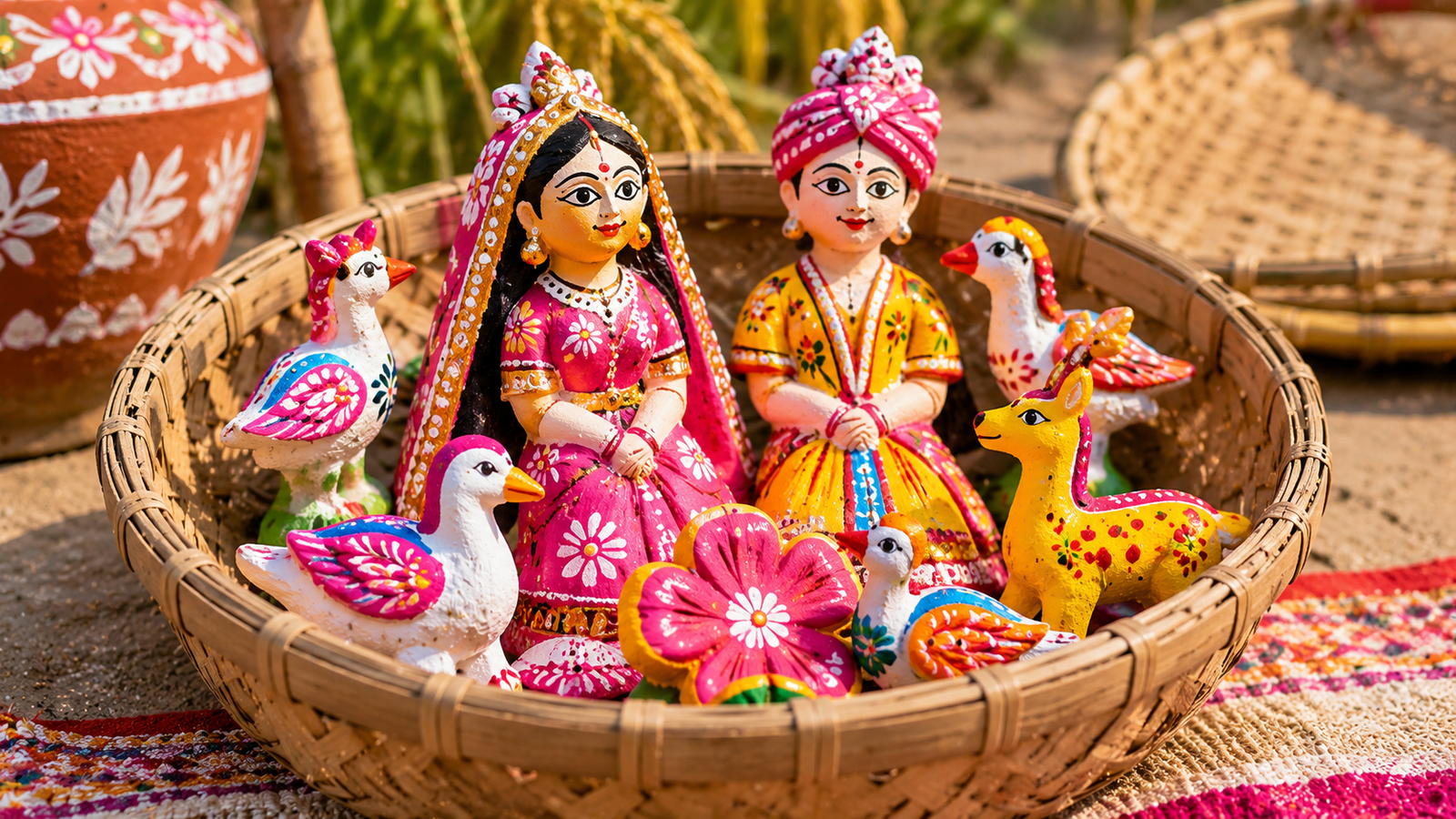
Sama Chakeva (also spelled Sama Chakewa or Sama Chakhewa, and called Samakhel locally) is a folk festival of the Mithila region in which sisters make clay figures, sing through the evenings and pray for their brothers. It is held in Bihar and in the eastern Tarai of Nepal, and it runs from around Chhath to Kartik Purnima. This guide gives the 2026 dates and explains why sources start the count on different days, retells the story and its versions, describes the figures, rituals and songs, and lists the places where it is observed. We checked encyclopaedias, news reports, a museum page and a folklore archive up to 6 November 2026, and we mark every point where sources disagree.
Quick Answer: Sama Chakeva 2026
Sama Chakeva 2026 begins around Chhath, between 14 and 16 November depending on the community and the source, and it ends on Kartik Purnima, Tuesday 24 November. Sisters make clay figures of Sama, Chakeva and Chugla, sing at night, and on the last day burn Chugla's moustache and put the figures in water or break them.
| Item | 2026 | Status |
|---|---|---|
| Kharna of Chhath (Kartik Shukla Panchami) | Saturday 14 Nov | Some reports start the festival here, about 11 days |
| Chhath evening arghya (Shashthi) | Sunday 15 Nov | Wikipedia and Nepal Traveller start the festival on Chhath night, about 10 days |
| Kartik Shukla Saptami | Monday 16 Nov | Bihar Museum counts Saptami to Purnima, nine days |
| Kartik Purnima, the last day | Tuesday 24 Nov | Purnima runs from about 11:45 PM on 23 Nov to 8:25 PM on 24 Nov IST |
| Language of the songs | Maithili | Himalayan Times, Rising Nepal |
| Who observes it | Maithil and Tharu communities | Wikipedia |
Sama Chakeva 2026 Dates: Why the Start Day Differs
Every source agrees on the end. The festival closes on Kartik Purnima, the full moon of Kartik, which is Tuesday 24 November 2026. The start is where they split, and most festival pages do not say so.
| Starting point | Date in 2026 | Length to Purnima | Who says it |
|---|---|---|---|
| Panchami, the day of Kharna in Chhath | Sat 14 Nov | 11 days | Himal Press and myRepublica (Mahottari, Nepal) |
| Night of Chhath | Sun 15 Nov | 10 days | Wikipedia, Nepal Traveller |
| Saptami | Mon 16 Nov | 9 days | Bihar Museum (Mithilanchal, Bihar) |
We checked the tithis with an astronomical library using the Lahiri ayanamsa. Panchami runs from about 8:45 PM on 13 November to 11:27 PM on 14 November IST, so the day of Kharna is 14 November. Shashthi, the main Chhath day with the evening arghya, is 15 November, and Saptami has the sunrise on 16 November. Purnima begins at about 11:45 PM on 23 November and ends at about 8:25 PM on 24 November IST. The day counts in the sources, 11, 10 and 9, match these three starting points exactly, which tells us the sources are not contradicting each other. They are counting from different days.
Some pages are less careful. A Saptari article gives the start as the sixth day of Kartik, "the same day as Kharna", which does not fit the calendar, and a food-brand blog says eight days from Panchami to Purnima. We did not use those counts.
If you are going to a village, ask the women of the household which night their circle begins. Local custom decides it.
| City | Purnima begins | Purnima ends |
|---|---|---|
| Patna, Delhi (IST) | Mon 23 Nov, 11:45 PM | Tue 24 Nov, 8:25 PM |
| Kathmandu, Janakpur | Tue 24 Nov, 12:00 AM | Tue 24 Nov, 8:40 PM |
| London | Mon 23 Nov, 6:15 PM | Tue 24 Nov, 2:55 PM |
| New York, Toronto | Mon 23 Nov, 1:15 PM | Tue 24 Nov, 9:55 AM |
| Dubai | Mon 23 Nov, 10:15 PM | Tue 24 Nov, 6:55 PM |
| Singapore | Tue 24 Nov, 2:15 AM | Tue 24 Nov, 10:55 PM |
| Sydney, Melbourne | Tue 24 Nov, 5:15 AM | Wed 25 Nov, 1:55 AM |
The times for cities outside India are our conversion from the IST values and can differ by a few minutes in other panchangs. Diaspora groups often hold the programme on the nearest weekend.
What Is Sama Chakeva?
Wikipedia describes it as a festival of the Mithila region observed by Maithils and Tharus in India and Nepal, centred on the bond between brothers and sisters. The Bihar Museum, whose Gallery D shows a terracotta recreation of the festival made in 2017, says women make clay figurines of Sama, Chakeva and other characters, place them in bamboo baskets, walk in groups to fields or courtyards while singing for their brothers' well-being, and submerge the figures on the full moon night.
The Ask Me About Nepal article adds that the festival needs no fasting and no formal worship. It is a performance of song, craft and story, led by girls and women.
The Story of Sama and Chakeva
The story has more than one version, and the characters are not always the same in each. We give the main ones and say who tells them.
Version One: The Curse and the Brother
Myrepublica, quoting a teacher from Matihani in Mahottari, tells it this way. Sama is the daughter of Lord Krishna. She and her beloved Chakradhar, called Chakewa, an army commander, are reported to Krishna by a gossip named Chugala, and Krishna curses both to become birds. Krishna's son Samba prays to Lord Shiva, wins a boon, and the couple regain human form and marry. In thanks, Sama sings songs in praise of Samba. Nepal Traveller gives the same outline and says the story appears in the Skanda Purana in the Dwapara era. JhaJi Store, a food-brand blog, names Chakeva as Charuvakra and also cites the Skanda Purana, but gives no chapter or verse, so we treat the Purana link as unverified.
Version Two: The Brother Clears His Sister's Name
The Himalayan Times (2018) and Wikipedia say Sama is falsely accused, turned into a bird, and restored by her brother's love and sacrifice. A Maithili folklore session recorded in Nazirpur in December 2016 and published by the Bucknell Mithila archive, with documentation by Coralynn Davis and Carlos Gomez, tells it differently again. In that telling Sama and Chakeva are sister and brother who go to Vrindavan to play. Chugla slanders them, and Vrindavan, as witness, confirms that their bond is that of brother and sister.
Version Three: The King's Daughter
Ask Me About Nepal records a version set in Garbh, where King Kishan Bhusan Sen's daughter Sama rejects the courtier Churath. He accuses her falsely and her father exiles her. Her brother Samb and Queen Aadambati clear her name, but Sama keeps her father's word and performs penance to become a Chakheva bird.
The common thread is a false rumour, a sister in danger, a brother who defends her and a gossip who is punished. Who Chakeva is, a brother, a husband or a bird, changes with the teller.
The Clay Figures
The figures are the heart of the festival. Reports list them as follows.
- Sama and Chakeva, the two birds or lovers or siblings of the story.
- Chugla or Chugala, the gossip, who is punished at the end.
- Vrindavan, the forest, which acts as a witness in some tellings.
- Saptarshi, the seven sages, and birds and trees, according to myRepublica.
- Other figures in the Bihar Museum recreation: Batgamni, Chaukidar, Satbhaiya and Khidlitch.
Nepal Traveller says a family's sisters make at least four statues from soil that their brothers dug, and Ask Me About Nepal says the dolls are painted once dry. The figures go into a bamboo basket, called a changera, daliya or dala in different reports, with a lamp. In 2020 and 2021 clay sculptures of Sama Chakeva by Mira Devi Dutta, Bijay Kumar Dutta and Priyanka Karna were shown at the Kathmandu Triennale, according to the photo captions in the Ask Me About Nepal article.
Rituals Night by Night
No source gives a fixed day-by-day script, and village customs differ. The usual pattern is below.
- Making the figures. Girls and women shape and paint the clay figures, often a day before the nightly rounds begin, according to Nepal Traveller.
- Evening gathering. Girls gather near the Chhath ghats or in courtyards with baskets, lamps and kohl, Wikipedia says, and sit in a circle to sing and retell the story.
- The procession. Ask Me About Nepal names the nightly parade as Dagar Bullon. Women carry the baskets through neighbourhoods and visit ponds where Chhath was held. The Himalayan Times adds roundabouts, roads and temples.
- Visits home. Married women visit their maternal homes, and women without brothers celebrate with cousins, according to the Himalayan Times. Ask Me About Nepal records a saying that married daughters who visit for Jitiya return to their husbands only after Sama Chakeva.
- Burning Chugla's moustache. On the last evening the moustache or beard on the Chugla figure is burned, and women mime beating it, which sources describe as the punishment of slander.
- The farewell. On Purnima the figures are submerged in a river or pond, or, in the Mahottari account, brothers break the figures and the pieces are left in a forest. The Bihar Museum says the send-off follows the rites of a daughter's departure to her husband's home, with gifts of food, clothes and jewellery.
- The brothers' part. Sisters offer brothers chiura (beaten rice), dahi and jaggery or molasses. Myrepublica says the rice is made from newly harvested paddy, and brothers give clothes, jewellery or cash in return.
Sources differ on whether the figures are submerged or broken and left. Both are reported in different places, so follow the local practice.
Sama Chakeva Songs
The songs are in Maithili, and the Rising Nepal report says singing in Maithili helps keep the language alive. From the sources, the songs fall into these groups:
- Songs praising brothers, their courage, generosity and devotion (myRepublica).
- Songs about each figure, describing Sama, Chakeva and the others (myRepublica).
- Songs scolding Chugla, for breaking the bond between siblings by deceit (Nepal Traveller).
- Songs lamenting Sama's fate (Ask Me About Nepal).
- Farewell songs for the submersion, including Bhagwati songs and Samdaon songs, according to the Bihar Museum.
We do not print the lyrics, because they are folk texts that vary from village to village and the recordings belong to their communities and archives. To hear them, look for recordings by the Bucknell Mithila archive, or listen to the evening circles in a village with the family's permission.
Migratory Birds and the Festival
Wikipedia says the festival begins when birds start migrating from the Himalayas to the plains in November, and it says the clay birds express respect for nature. Ask Me About Nepal adds that ruddy shelducks arrive in the Terai from Siberia in November and links this to the story. JhaJi Store goes further and says locals see the birds as forms of Sama and Chakeva, but it gives no source, so we leave that out. The link between the season and the birds is a reasonable reading, and we state it as one.
Where Sama Chakeva Is Observed
| Region | Reported detail | Source |
|---|---|---|
| Mithilanchal, Bihar | Nine days from Saptami to Purnima; the Bihar Museum recreates the festival in Patna | Bihar Museum |
| Mahottari, Nepal | Women make figures; brothers break them on Purnima | Himal Press, myRepublica |
| Janakpurdham, Dhanusha | Evening lamps on streets, songs and dances at junctions and temples | Rising Nepal (2023) |
| Saptari, Nepal | Terhauta village in Rupani; the Dagar Bullon processions | Ask Me About Nepal |
| Sarlahi, Siraha, Dhanusha, Parsa | Named among the Tarai districts where it is observed | Himalayan Times (2018) |
| Tharu communities | Observed alongside Maithils; Tharu women with clay baskets in Kathmandu in 2025 | Wikipedia, Ask Me About Nepal |
We found no official event schedule or ticketed programme for 2026. The festival is a home and neighbourhood tradition, so visit as a guest of a family or ask local organisers, not as a spectator at a show.
Visiting Mithila for Sama Chakeva
- Ask before you photograph women and girls, and do not interrupt the singing.
- Do not touch the figures or baskets unless you are invited to.
- Travel in November is cool in the mornings and evenings. Carry a light shawl.
- Keep a flexible plan. Start nights, venues and the submersion time vary by village.
- If you cross into Nepal, check the current ID and entry rules for your passport before you travel.
Chhath and Sama Chakeva overlap, so roads and trains to Bihar are crowded between 13 and 16 November. Read our Chhath Puja 2026 guide and the Chhath in Bihar guide before you plan, and see the Chhath travel guide for trains and road tips. Janaki's Janakpur connects to Ayodhya through the Vivah Panchami guide.
For Maithil Families Abroad
Use the city table above to keep Purnima. You can run a small circle at home: girls make a few clay figures, a basket with a lamp, evening songs in Maithili, and on the last night a simple farewell. Sisters can offer brothers chiura and dahi, as in the sources. Check with your local Maithil association, since several hold the programme on the weekend. Read our guides for families coming to India from the USA, Canada and the UK.
Other festivals in the same weeks are covered in our Kartik Maas guide, the Dev Deepawali guide and the Nabanna guide.
Plan Your Trip with Your Travel Partner
Your Travel Partner is a travel company based in Ayodhya that arranges trips across India and abroad. We plan the road, the stay and the timing around a festival, for visitors from every state and from other countries.
- Airport or railway pickup in Patna, Darbhanga or Gorakhpur: airport and railway.
- Road transfers across Bihar and to Janakpur: cab and intercity cab.
- Rooms: hotel booking.
- A trip linking Ayodhya, Janakpur and Bihar: custom package.
- Send your dates, city and group size on WhatsApp or the enquiry form.
We do not sell festival tickets or passes, because the festival has none. See the packages page, our reviews, about us and the cancellation policy.
Common Mistakes
- Assuming one start date. Sources count from Kharna, Chhath night or Saptami.
- Taking the festival for a ticketed event. It is a community tradition.
- Mixing up the characters. Chakeva is a brother in some tellings and a husband in others.
- Quoting the Skanda Purana without a chapter or verse.
- Booking trains late, since Chhath overlaps the first days.
Frequently Asked Questions
When is Sama Chakeva 2026?
It begins around Chhath, between 14 and 16 November depending on the source and community, and ends on Kartik Purnima, Tuesday 24 November 2026.
Why do sources give different start dates?
They count from different days: Kharna (14 Nov), Chhath night (15 Nov) or Saptami (16 Nov). The day counts of 11, 10 and 9 match those three dates.
When is the last day of Sama Chakeva 2026?
Kartik Purnima, 24 November. Purnima runs from about 11:45 PM on 23 November to 8:25 PM on 24 November IST.
How many days does Sama Chakeva last?
Between 9 and 11 days, depending on the starting day. Himal Press and myRepublica say 11, Nepal Traveller says 10, and the Bihar Museum says nine.
What is Sama Chakeva?
A Mithila folk festival in which sisters make clay figures, sing and pray for their brothers' long lives.
Who are Sama, Chakeva and Chugla?
Sama is the daughter of Krishna in the main story. Chakeva is her husband in some tellings and her brother in others. Chugla is the gossip who slanders them.
What is the story of Sama Chakeva?
Chugla spreads a false rumour about Sama. She is cursed to become a bird, and a brother, usually Samba, wins her release. The details vary by teller.
Is the story in the Skanda Purana?
Wikipedia and Nepal Traveller say the legend is from the Puranas, and Nepal Traveller names the Skanda Purana. We found no chapter or verse, so treat it as a traditional attribution.
What happens on the last night?
Chugla's moustache is burned and the figures are submerged in water or, in some places, broken and left in a forest.
Why is Chugla's moustache burned?
It symbolises the punishment of slander, according to Wikipedia, Nepal Traveller and a Maithili folklore session.
In which language are the songs?
Maithili, according to Rising Nepal and the Himalayan Times.
Do you fast or worship during Sama Chakeva?
Ask Me About Nepal says it needs no fasting and no formal worship.
Where is it observed?
In Mithilanchal in Bihar, and in the eastern Tarai of Nepal, including Mahottari, Dhanusha, Saptari, Sarlahi and Siraha, among Maithils and Tharus.
Is there a ticket or entry fee?
No. It is a home and neighbourhood tradition. Do not pay anyone for access.
Can Your Travel Partner arrange my Bihar or Janakpur trip?
Yes. We arrange pickups, cabs and hotels. We do not sell festival passes.
Conclusion
Sama Chakeva 2026 runs from around Chhath, 14 to 16 November depending on where you count from, to Kartik Purnima on Tuesday 24 November. It is a tradition of clay figures, Maithili songs and a sister's prayer for her brother. Ask the family which night their circle starts, respect the singers, and plan trains early because Chhath overlaps. For cabs, hotels and a Bihar or Janakpur plan, message us on WhatsApp.
Sources
- Wikipedia: Sama Chakeva
- Himal Press: Sama Chakhewa festival begins in Mithila region (27 Oct 2025)
- myRepublica: Samachakewa festival begins in Mithila
- The Himalayan Times: Sama-Chakeva festival begins (10 Nov 2018)
- Rising Nepal: Sama-Chakhewa, Janakpurdham (20 Nov 2023)
- Bihar Museum: Sama-Chakeba Folklore
- Nepal Traveller: Sama Chakewa, family, folklore and festival (9 May 2022)
- Ask Me About Nepal: Sama Chakheva (27 Nov 2023)
- Bucknell Mithila archive: Sama Chakeva, a festival tale (recorded Dec 2016)
- JhaJi Store blog (a food brand; used only to compare story versions, unsourced claims left out)