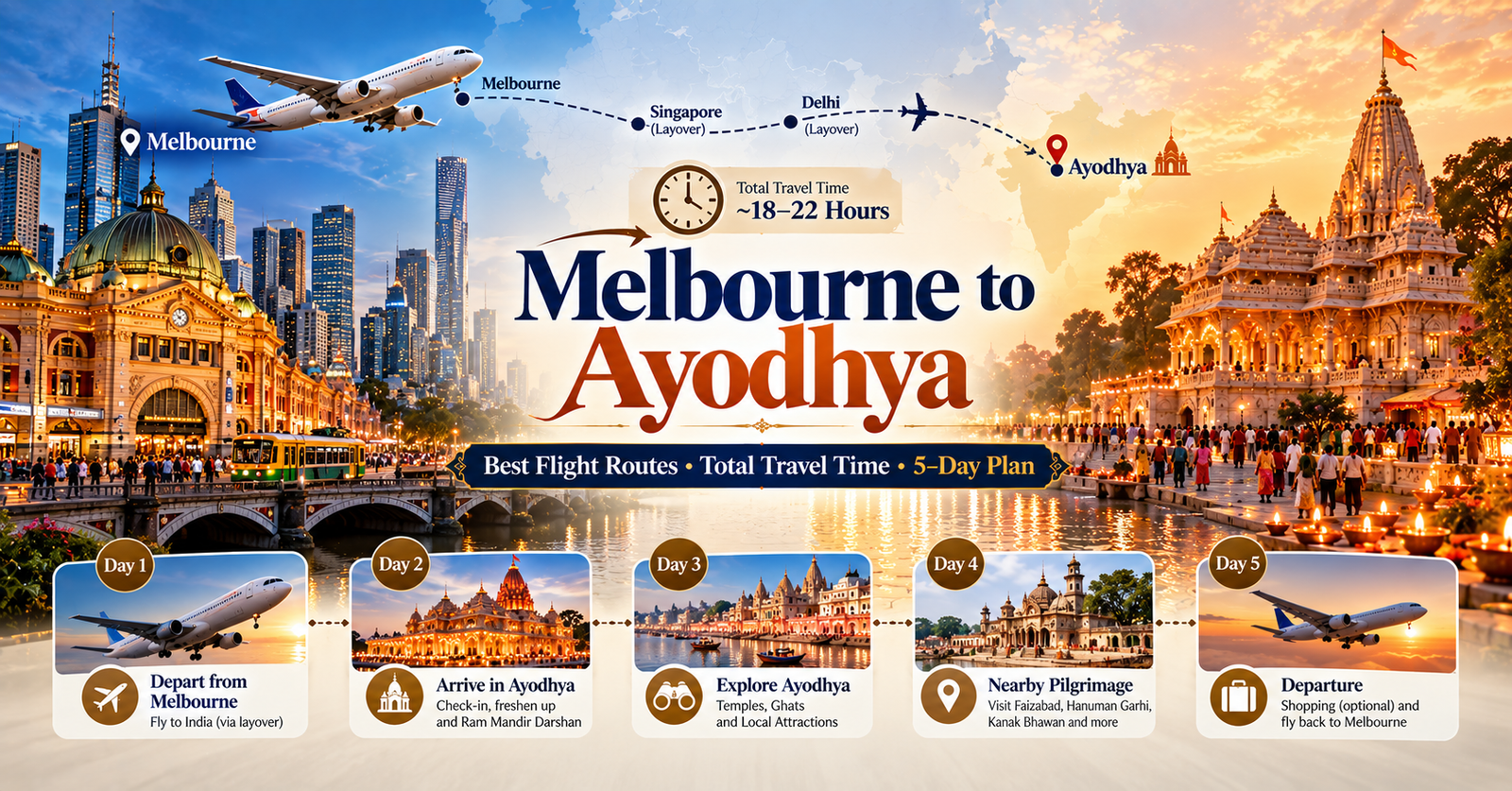
How to Plan an Ayodhya Trip from the USA: Flights, Visa, Days & Cost (2026–27 Guide)
Plan your Ayodhya trip from USA: flights via Delhi, India e-Visa and OCI rules, 6 to 10 day itineraries, Ram Mandir darshan tips and a realistic cost breakdown.

How to Plan an Ayodhya Trip from the USA: Flights, Visa, Days & Cost (2026–27 Guide)
Written by the Your Travel Partner team in Ayodhya. Last updated: October 2026.
If you live in the United States and you've been meaning to see the Ram Mandir, the hardest part isn't the temple. It's everything before it: which airport to fly into, whether you need a visa or your OCI card is enough, how many vacation days to ask for, and what the whole thing is going to cost. Most guides online are written for someone taking a train from Lucknow. This Ayodhya travel guide is written for someone starting in Newark, Dallas, Chicago or the Bay Area, and it covers an Ayodhya trip from USA departure to the flight home.
Quick Answer
There is no direct flight from the USA to Ayodhya. For an Ayodhya trip from USA cities, you fly to Delhi (or Mumbai), then take a short domestic flight to Ayodhya's Maharishi Valmiki International Airport (AYJ), or fly to Lucknow and drive about 84 miles. US citizens need an India e-Visa or a regular visa; OCI cardholders don't need a visa. Plan on 7 days door to door for Ayodhya alone, or 9 to 10 days if you add Varanasi and Prayagraj. Ram Mandir darshan is free, and passes come only from the temple Trust.
| What you need to know | Short answer |
|---|---|
| Direct USA to Ayodhya flight | None. Connect through Delhi, Mumbai or another Indian city. |
| Ayodhya airport code | AYJ (Maharishi Valmiki International Airport) |
| Best international gateway | Delhi (DEL) |
| Closest big airport by road | Lucknow (LKO), about 84 miles (135 km) |
| Visa for US citizens | e-Tourist Visa: 30-day, 1-year or 5-year |
| OCI cardholders | No visa needed; carry OCI card and US passport |
| e-Arrival card | Fill online within 72 hours before landing |
| Time difference | India is 9.5 to 13.5 hours ahead of US time zones |
| Minimum trip length | 6 to 7 days from the US, including flights |
| Best months | October through March |
| Ram Mandir darshan | Free. No paid "VIP" ticket exists. |
Table of Contents
- How to reach Ayodhya from USA: the route in plain English
- Flights: US to India, then India to Ayodhya
- Delhi, Lucknow, Varanasi or Mumbai: which gateway?
- Visa, OCI and the e-Arrival card
- How many days do you need?
- Ayodhya itinerary options: 6, 8 and 10 days
- Best time to visit Ayodhya
- Ram Mandir darshan: timings, passes and rules
- What to see in Ayodhya
- Ayodhya trip cost from the US
- Where to stay
- Money, cards and UPI
- Phone, SIM and power plugs
- Health and travel insurance
- Traveling with parents, kids or a group
- Planning timeline
- Mistakes US travelers make
- How we can help on the ground
- FAQs
How to Reach Ayodhya from USA: The Route in Plain English
People ask how to reach Ayodhya from USA cities as if it were one flight. It's really three legs:
- The long haul. A US airport to a major Indian airport, usually Delhi. Nonstop or one stop.
- The short hop. A domestic flight of about an hour and a half from Delhi to Ayodhya, or a flight to Lucknow.
- The last few miles. A car from the Ayodhya airport to your hotel, or a drive of roughly three hours from Lucknow.
Ayodhya sits in the state of Uttar Pradesh in north India, about 84 miles east of Lucknow and roughly 125 to 135 miles northwest of Varanasi. It's a small city. You won't find a big international terminal with flights from Frankfurt or Dubai. What you will find is a new domestic airport, two rail stations and good highways, all of which make the last leg easy once you're in India.
Time zones: do this math before you book
India runs on one time zone, India Standard Time (UTC+5:30), and doesn't observe daylight saving. That half hour trips people up.
| US time zone | India is ahead by (US daylight time) | India is ahead by (US standard time) |
|---|---|---|
| Eastern | 9.5 hours | 10.5 hours |
| Central | 10.5 hours | 11.5 hours |
| Mountain | 11.5 hours | 12.5 hours |
| Pacific | 12.5 hours | 13.5 hours |
In practice, on any Ayodhya trip from USA time zones you lose a calendar day going east. Leave New York on a Friday night and you land in Delhi late Saturday night. Coming home you get most of it back. Build your vacation request around that.
Flights: US to India, Then India to Ayodhya
Leg 1: USA to India
If you're searching for flights to Ayodhya from USA airports, search for Delhi (DEL) first. Delhi has the most connections onward to Ayodhya, and it's the Indian city with the most nonstop service from the US.
| Option | Typical travel time to Delhi | Good to know |
|---|---|---|
| Nonstop from the US | About 14 to 16 hours | Fewest hassles, usually the highest fare. Routes change, so check what's flying on your dates. |
| One stop in Europe (London, Frankfurt, Paris, Amsterdam) | About 18 to 24 hours | Wide choice of US departure cities |
| One stop in the Gulf (Doha, Dubai, Abu Dhabi) | About 19 to 26 hours | Often the best mix of price and schedule; many Indian arrival cities |
A note on nonstops. Nonstop US to India schedules moved around a lot in 2026. In mid-2026 Air India was flying Delhi to New York (JFK) and Delhi to San Francisco daily and had paused its Delhi to Chicago and Delhi to Newark flights for the summer. US carriers have also flown nonstop to Delhi from the New York area. Don't rely on a route list from a blog, including this one. Check the airline's own site for your exact dates before you plan around a nonstop.
If you'd rather take the train from Delhi, arrange a railway station pickup in Ayodhya so someone meets you on the platform side. One more tip on searching: booking sites that list flights to Ayodhya from USA airports are simply stitching these legs together, and you can often do better by pricing the two legs yourself. Wherever you fly from, try to book the long-haul and the domestic leg with a comfortable gap. International flights into Delhi often land late at night, and a missed domestic connection on a separate ticket is your problem, not the airline's.
Leg 2: India to Ayodhya
The second half of any USA to Ayodhya flight plan is domestic. (You'll see "USA to Ayodhya flight" results on booking sites; every one of them is a connection.) Ayodhya's airport opened at the end of 2023 and handles domestic flights. Delhi has the most daily service, operated by several Indian carriers. There are also flights from other cities such as Mumbai, Bengaluru, Hyderabad and Ahmedabad, though those schedules are thinner and change by season.
| From | How to get to Ayodhya | Approximate time |
|---|---|---|
| Delhi | Nonstop domestic flight to AYJ | About 1 hour 20 to 1 hour 30 minutes in the air |
| Delhi | Vande Bharat or other express train to Ayodhya Dham Junction or Ayodhya Cantt | About 8 to 10 hours |
| Lucknow | Private car on the highway | About 2.5 to 3 hours (84 miles) |
| Varanasi | Private car | About 4 to 5 hours (125 to 135 miles) |
| Prayagraj | Private car | About 3.5 to 4 hours (roughly 100 miles) |
| Mumbai, Bengaluru, Hyderabad, Ahmedabad | Domestic flight where available, or connect through Delhi | About 2 to 2.5 hours nonstop |
The Ayodhya airport is a short drive from the temple area, usually 25 to 35 minutes, longer on festival days when roads are diverted. If you'd like a driver waiting with your name on a board, book an airport pickup ahead of time. After 20-plus hours of travel, you won't want to negotiate at the curb.
Baggage: the detail that catches people
Your international ticket probably allows two checked bags. Indian domestic economy fares usually allow much less, often a single bag of around 15 kg (33 lb). If your Delhi to Ayodhya flight is on a separate ticket, you'll pay excess baggage at the counter. Two ways around it: book the whole trip on one ticket where possible, or leave the big suitcases with family or at your Delhi hotel and take a carry-on to Ayodhya.
Delhi, Lucknow, Varanasi or Mumbai: Which Gateway?
A common question is which is the nearest international airport to Ayodhya. By distance, it's Lucknow. By convenience from the US, it's usually Delhi. Here's how they compare.
| Gateway | Why choose it | Watch out for |
|---|---|---|
| Delhi (DEL) | Most flights from the US; most onward flights to Ayodhya; easy to add Agra or Jaipur | Winter fog can delay flights in late December and January |
| Lucknow (LKO) | The nearest international airport to Ayodhya by road; international service mostly from Gulf hubs | Usually means two stops from the US |
| Varanasi (VNS) | Works well if you want to start in Kashi and end in Ayodhya | Limited international service |
| Mumbai (BOM) | Good if you're visiting family in western or southern India first | Fewer flights to Ayodhya than Delhi; check the schedule |
So when someone asks us how to reach Ayodhya from USA airports with the least stress, the answer is almost always Delhi. Our honest take: if this is your first visit and Ayodhya is the main goal, fly into Delhi, sleep one night, and take a morning flight to Ayodhya. If you have family in Lucknow or Kanpur, fly however you normally do and come by road with a private cab.
Visa, OCI and the e-Arrival Card
No Ayodhya travel guide for Americans is complete without the paperwork, and this section is where a lot of US travelers lose time, so we'll go slowly.
If you hold a US passport and no OCI card
You need a visa. For tourism and pilgrimage, the India e-Visa for US citizens is the simplest route. You apply online on the Government of India portal, indianvisaonline.gov.in, upload a photo and your passport's photo page, pay by card, and receive an electronic travel authorization by email.
| e-Tourist Visa type | Validity | Entries | Government fee for US citizens |
|---|---|---|---|
| 30-day | 30 days from first arrival | Multiple entries within the 30 days (per the official portal) | $10 for arrivals April through June; $25 for July through March |
| 1-year | 365 days from the date of grant | Multiple | $40 |
| 5-year | 5 years from the date of grant | Multiple | $80 |
A small bank processing charge is added at payment. Fees are set by the Indian government and can change, so confirm the amount on the portal's fee page before you pay.
Key rules for the India e-Visa for US citizens, from the official portal:
- Apply at least 4 days before you arrive. The 1-year and 5-year visas can be applied for up to 120 days ahead.
- Your passport needs at least six months of validity and two blank pages.
- The e-Visa is valid for entry at designated airports, which include Delhi, Mumbai, Lucknow and Varanasi. It doesn't work at land borders.
- US citizens on the 1-year and 5-year e-Tourist Visa may stay up to 180 days in a calendar year.
- Print the approval and keep a copy on your phone.
Watch for look-alike websites. Search results for the India e-Visa for US citizens are full of private sites that charge several times the government fee. The official address ends in .gov.in. You can apply on your own in about 20 minutes. If you'd rather have help, use an agent you can actually reach by phone, and ask for the government fee and the service fee to be shown separately. We offer visa assistance on that basis.
If you travel to India often, the 5-year option costs only $40 more than the 1-year and saves you from applying again. The traditional sticker visa, which for US citizens can be valid up to 10 years, is handled through the Indian embassy's outsourced visa centers and takes longer.
If you hold an OCI card
An OCI card (Overseas Citizen of India) is a lifelong visa. You don't need an e-Visa. Carry the OCI card together with your current US passport. If your passport was renewed after the OCI was issued, check the Indian government's current re-issuance and document upload rules for your age group before you fly. Airlines do check at the counter.
If you hold an Indian passport
Indian citizens living in the US on a green card or work visa don't need an Indian visa. Your concern runs the other way: make sure your US visa stamp or green card is valid for re-entry, and don't count on getting a visa appointment at a US consulate in India on short notice.
The e-Arrival card
India has replaced the paper arrival form with a digital e-Arrival card. Foreign passport holders fill it out online within 72 hours before landing, on the Bureau of Immigration website, the visa portal or the Su-Swagatam app, and get a QR code to show at immigration. Reports from April 2026 say OCI cardholders are included and Indian citizens are exempt. It asks for basic details: passport, flight number and your address in India. Have your Ayodhya or Delhi hotel address handy. Do it at the gate before you board and you'll save yourself a slow line on arrival.
| You are | Visa needed? | e-Arrival card? | Carry |
|---|---|---|---|
| US citizen, no OCI | Yes: e-Visa or regular visa | Yes | Passport, e-Visa printout |
| US citizen with OCI card | No | Yes, per current reports; confirm before travel | Passport, OCI card |
| Indian citizen living in the US | No | No | Indian passport, valid US visa or green card |
How Many Days Do You Need?
Every Ayodhya travel guide will tell you the city is small. That's true, and Ayodhya itself takes two full days to see well. The flights are what eat your time off.
| Total days away from home | What fits | Who it suits |
|---|---|---|
| 6 days | Ayodhya only, 2 nights | Tight schedules; people adding a pilgrimage to a work trip |
| 7 to 8 days | Ayodhya and Varanasi | Most first-time visitors |
| 9 to 10 days | Ayodhya, Prayagraj and Varanasi, with a day in Delhi | Families and retirees who want an easier pace |
| 2 to 3 weeks | A hometown visit with a 2- or 3-night Ayodhya side trip | NRIs visiting family |
If you're traveling with parents in their seventies, add a rest day after you land. Jet lag across 10 or more time zones is real, and a 4 a.m. aarti on your first morning sounds better at home than it feels in person.
Ayodhya Itinerary Options: 6, 8 and 10 Days
Each Ayodhya itinerary below counts from the day you leave the US, because that's how your calendar works.
6 days: Ayodhya only
| Day | Plan |
|---|---|
| Day 1 | Depart the US in the evening |
| Day 2 | Land in Delhi at night; hotel near the airport |
| Day 3 | Morning flight to Ayodhya; rest; sunset aarti on the Saryu River |
| Day 4 | Hanuman Garhi, Ram Mandir darshan, Kanak Bhawan, Dashrath Mahal; evening at Ram Ki Paidi |
| Day 5 | Second darshan or Guptar Ghat in the morning; afternoon flight to Delhi; late-night flight home |
| Day 6 | Arrive in the US |
8 days: Ayodhya and Varanasi
| Day | Plan |
|---|---|
| Day 1 | Depart the US |
| Day 2 | Arrive in Delhi; overnight |
| Day 3 | Fly to Ayodhya; Saryu aarti in the evening |
| Day 4 | Full day in Ayodhya: Hanuman Garhi, Ram Mandir, Kanak Bhawan, Ram Ki Paidi |
| Day 5 | Morning drive to Varanasi (4 to 5 hours); evening Ganga aarti at Dashashwamedh Ghat |
| Day 6 | Sunrise boat ride, Kashi Vishwanath Temple, Sarnath |
| Day 7 | Fly Varanasi to Delhi; evening or late-night departure |
| Day 8 | Arrive in the US |
This is the plan we'd suggest to most people. If your flight lands in Lucknow instead, we can start the same route with a Lucknow airport pickup. An Ayodhya and Varanasi tour covers Lord Ram's birthplace and Lord Shiva's city in one loop, and flying out of Varanasi means you never backtrack. If you'd like an Ayodhya and Varanasi tour with the car, hotels and boat ride arranged, that's the route we plan most often.
10 days: Ayodhya, Prayagraj and Varanasi
| Day | Plan |
|---|---|
| Day 1 | Depart the US |
| Day 2 | Arrive in Delhi; overnight |
| Day 3 | Rest day in Delhi; light sightseeing if you feel up to it |
| Day 4 | Fly to Ayodhya; Saryu aarti |
| Day 5 | Ayodhya temples and Ram Mandir darshan |
| Day 6 | Bharat Kund at Nandigram in the morning; drive to Prayagraj (about 100 miles) |
| Day 7 | Boat to the Triveni Sangam; drive to Varanasi (about 75 miles); Ganga aarti |
| Day 8 | Varanasi: sunrise boat, Kashi Vishwanath, Sarnath |
| Day 9 | Fly to Delhi; depart for the US |
| Day 10 | Arrive in the US |
Adding Ayodhya to a family visit
If you're already in India seeing relatives, you don't need a full Ayodhya itinerary, and you can skip the question of flights to Ayodhya from USA cities altogether. Fly in from your home city where a direct flight exists, or connect through Delhi, stay two nights, and fly back. Two nights gives you one evening on the Saryu and one unhurried morning at the temple. We can match the plan to your flights; see our tour packages for the common routes. If you'd rather come overland from a relative's home in Uttar Pradesh, a cab with a driver for two days is usually all you need.
Best Time to Visit Ayodhya
For most people coming from the US, the best time to visit Ayodhya is October through March. The weather is the main reason. Temperatures below are rough averages to help you pack, not a forecast.
| Months | Weather | What it's like |
|---|---|---|
| October to November | Warm days in the 80s°F, pleasant evenings | Festival season. Deepotsav and Diwali draw very large crowds. |
| December to January | Cool; days around 65 to 72°F, nights in the 40s°F | Peak NRI travel season. Morning fog can delay flights and trains in north India. |
| February to March | Mild; 70s to 80s°F | Comfortable and less crowded, except around Ram Navami when it falls in March |
| April to June | Very hot; often above 100°F | Hard on seniors and kids. Go early morning and late evening only. |
| July to September | Monsoon; hot and humid with heavy rain | Green and quieter, but plan for wet days |
Festival dates for 2026–27
| Festival | Date | Planning note |
|---|---|---|
| Deepotsav (lamp festival on the Saryu) | Evening of November 7, 2026 | Book hotels months ahead; roads near the ghats close to vehicles |
| Diwali | November 8, 2026 | High fares and full hotels across north India |
| Christmas and New Year break | Late December 2026 | The busiest weeks for US-based families; fog risk |
| Ram Navami | April 15, 2027 | Lord Ram's birthday. Enormous crowds and heat. |
If the school calendar forces you into late December, that's fine. Just keep a buffer day before your flight home in case fog delays the Ayodhya to Delhi leg. If you can pick any week, the best time to visit Ayodhya for comfort and short lines is mid-November after Diwali, or February.
Ram Mandir Darshan: Timings, Passes and Rules
The temple is run by Shri Ram Janmabhoomi Teerth Kshetra, the Trust set up for it. Ram Lalla was consecrated on January 22, 2024, and the ceremonial flag was raised on the temple's spire on November 25, 2025.
| Darshan and aarti | Time (per the Trust's website) |
|---|---|
| Mangal Aarti | 4:00 a.m. |
| Shringar Aarti | 6:00 a.m. |
| Darshan, morning slots | 7:00 a.m. to 12:00 p.m. |
| Darshan, afternoon and evening slots | 1:00 p.m. to 9:00 p.m. |
| Shayan Aarti | 10:00 p.m. |
Timings shift with the season and on festival days, so check the Trust's site a few days before you go.
What every visitor from abroad should know
- Ram Mandir darshan is free. General darshan needs no ticket at all. You simply join the line.
- Passes are free too. Passes for aarti and for easier-access darshan are issued only by the Trust, on online.srjbtkshetra.org or at its counter. The Trust states that it charges no fee for them.
- Nobody can sell you a darshan. No tour company, guide or hotel is authorized to sell a pass, including us. If someone quotes a price for "VIP darshan," walk away.
- Bring your passport. Passes are tied to a photo ID. For visitors from abroad, that means your passport or OCI card.
- Phones stay outside. Mobile phones and other electronic devices aren't allowed inside the temple premises. Lockers and a cloakroom are provided. Leave smartwatches, key fobs and earbuds at the hotel to keep it simple.
- Dress modestly. Covered shoulders and knees are the safe choice. Traditional Indian clothing is common but not required.
- Shoes come off. Wear something easy to slip on and off, and bring socks in winter; stone floors are cold at 6 a.m.
The rules for Ram Mandir darshan for NRI visitors are the same as for everyone else; the only difference is the ID you show. For questions about Ram Mandir darshan for NRI and foreign visitors, the Trust lists a helpdesk on its official website, srjbtkshetra.org. The same site explains how devotees living abroad can donate. Use only the bank details published there.
How long does darshan take?
On an ordinary weekday, plan on one to two hours from the security check to the exit. On weekends, festival days and during the winter holiday rush it can take much longer. Early morning is usually the calmest. Since you won't have your phone inside, agree on a meeting spot before your group goes in.
What to See in Ayodhya
| Place | Why go | Time needed |
|---|---|---|
| Shri Ram Janmabhoomi Mandir | The reason for the trip: Ram Lalla at his birthplace | 1 to 3 hours |
| Hanuman Garhi | Hilltop Hanuman temple; by tradition, visited before the Ram Mandir. There are steps to climb. | 45 minutes |
| Kanak Bhawan | A graceful temple dedicated to Ram and Sita | 30 minutes |
| Dashrath Mahal | Associated with King Dashrath's palace | 20 minutes |
| Ram Ki Paidi and Naya Ghat | Riverfront steps; the evening Saryu aarti | 1 to 1.5 hours |
| Guptar Ghat | Quiet ghat a few miles upstream | 1 hour |
| Bharat Kund, Nandigram | Where Bharat is believed to have lived during Ram's exile; about 12 miles out | Half a day |
Any Ayodhya travel guide lists the same handful of temples; what matters is the order and the walking. The old town's lanes are narrow, and cars are stopped well short of several temples. The practical way to get around the core is an e-rickshaw, which is cheap, open-air and easier on older knees than walking the whole circuit.
Coming by train from Delhi or Lucknow? Ask for a station pickup; the two Ayodhya stations are a few miles apart and it's easy to book a hotel near the wrong one.
One thing to expect: Ayodhya is a vegetarian town, and you shouldn't plan on finding meat or alcohol in the temple area. The food is simple, fresh and inexpensive. If anyone in your family has a sensitive stomach, stick to busy restaurants, cooked food and sealed bottled water.
Ayodhya Trip Cost from the US
People budgeting an Ayodhya trip from USA cities usually ask for one number. Here's a planning budget per person for a 7- to 8-day trip. These are estimates to help you set expectations, not quotes. Airfare swings the most, and December fares can run well above this range. Check live prices before you commit.
| Item | Budget | Comfortable | Premium |
|---|---|---|---|
| Round-trip airfare, US to Delhi (economy) | $900 to $1,200 | $1,200 to $1,600 | $1,600 and up; business class costs several times more |
| Domestic flights within India | $80 to $120 | $120 to $200 | $200 and up |
| e-Visa (skip if you hold OCI) | $25 | $40 | $80 |
| Hotels, per night | $25 to $45 | $60 to $120 | $150 and up |
| Meals, per day | $10 to $15 | $20 to $30 | $40 and up |
| Private car with driver | Depends on vehicle and route. Ask for a written quote. | ||
| Temple entry and darshan | Free | ||
Put together, a careful traveler can do an Ayodhya trip from USA departure to return for roughly $1,500 to $2,100. A comfortable mid-range trip with a private car and good hotels tends to land between $2,300 and $3,300. For a family of four, multiply the airfare but not the car or, usually, the rooms; that's where traveling together helps.
What drives your Ayodhya trip cost up or down:
- When you fly. Mid-December to early January and the weeks around Diwali cost the most.
- How early you book. Two to four months ahead is a reasonable window for transpacific and transatlantic fares to India.
- Where you sleep. Hotels within walking distance of the temple cost more and sell out first.
- How many cities. Each extra city adds a night and a long drive or a flight.
One way to keep your Ayodhya trip cost predictable is to fix the ground costs in advance. We don't publish package prices here because they change with the season and group size. Send us your dates and we'll reply with a day-by-day plan and one total in writing.
Where to Stay
Ayodhya's hotel scene has grown quickly since 2024, but it's still a small city. Don't expect the range you'd find in Delhi or Jaipur.
| Area | Good for | Trade-off |
|---|---|---|
| Near the Ram Mandir and Hanuman Garhi | Walking to darshan; seniors | Higher prices; vehicle restrictions on busy days |
| Near Naya Ghat and Ram Ki Paidi | Evening aarti and river views | Crowded during festivals |
| Civil Lines and the old Faizabad side | Larger rooms, easier parking, quieter nights | A 15- to 25-minute drive to the temple |
If you want the hotel, car and sightseeing bundled, our Ayodhya packages list the options. What to ask before you book: Is there an elevator? A backup generator? Western-style bathrooms with hot water? Is the kitchen vegetarian only? How far is the walk from where a car can actually drop you? Those five answers matter more than the star rating.
Money, Cards and UPI
- Currency. India uses the rupee. You can't buy much of it in the US at a good rate, so withdraw from an ATM at the Delhi airport or in the city. Tell your bank you're traveling.
- Cards. Visa and Mastercard work at most hotels and larger stores. A card with no foreign transaction fee saves about 3 percent. Small temples, rickshaws and street stalls are cash only.
- Cash. Keep small bills for offerings, rickshaws and tea. Large notes are hard to break.
- UPI. India runs on QR-code payments. Visitors can use a prepaid wallet called UPI One World, loaded from an international card. It needs an Indian mobile number and passport verification, and the easiest place to set it up has been the Delhi airport. NRIs with an NRE or NRO bank account can use their bank's UPI app. It's handy, but don't depend on it; carry cash as a backup.
- Customs. The US State Department notes that currency over $5,000 has to be declared on arrival in India.
- Tipping. It isn't expected the way it is at home, but it's appreciated. A small tip for drivers, hotel staff and guides is normal.
Phone, SIM and Power Plugs
- Roaming. Check your carrier's India day pass before you go. For a week, it's often the least effort.
- Local SIM or eSIM. Indian SIMs are inexpensive and sold at the Delhi airport with your passport and visa. Activation can take a few hours. A travel eSIM for data only is the no-paperwork alternative.
- Why an Indian number helps. Many Indian websites and apps send a one-time passcode by text to an Indian number, including some booking sites.
- Power. India uses 230 volts at 50 Hz, with round-pin outlets (types C, D and M). Phone and laptop chargers marked "100–240V" only need a plug adapter. Hair dryers and curling irons built for 120 volts will burn out without a converter.
- Offline maps. Download Ayodhya and Varanasi in your maps app. Networks slow down badly in festival crowds.
Health and Travel Insurance
- See your doctor a month out. The CDC publishes vaccine and health recommendations for travelers to India. A travel clinic or your primary care doctor can tell you what applies to you.
- Buy travel medical insurance. Most US health plans give limited or no coverage abroad, and Medicare generally doesn't cover care outside the United States. A short-term travel medical policy with emergency evacuation is worth it, especially for parents.
- Carry prescriptions in original bottles, with a copy of the prescription, in your carry-on.
- Water and food. Drink sealed bottled water, skip ice and raw salads from street stalls, and wash your hands often. Bring oral rehydration salts and whatever stomach medicine your doctor recommends.
- Air quality. North India's air can be poor from November through January. If anyone has asthma, pack inhalers and a few N95 masks.
- Safety. The US State Department currently advises travelers to exercise increased caution in India, the same level it assigns to many popular destinations. Ayodhya has a heavy police presence around the temple. The everyday risks are the usual ones: crowds, traffic and pickpockets. You can enroll your trip in the State Department's free STEP program for alerts.
Traveling with Parents, Kids or a Group
With senior parents
- Request wheelchair assistance from the airline for every airport, both directions. It's free and it speeds up immigration lines.
- Ask at the temple's facility center about wheelchairs when you arrive, and confirm availability with the Trust helpdesk beforehand.
- Choose a hotel with an elevator, close to the temple.
- Keep one activity for the morning and one for the evening. Rest through the afternoon.
- Hanuman Garhi involves a steep flight of steps. It's fine to offer prayers from below.
- Book an e-rickshaw for the day so nobody has to walk the lanes between temples.
With children
- Bring snacks they know. Long lines and unfamiliar food are a rough mix.
- Put a card with your hotel name and a phone number in each child's pocket.
- The evening aarti on the Saryu and a boat ride usually win kids over more than temple lines do.
- An e-rickshaw ride through the old town is an easy hit with kids, too.
As a group or a temple community trip
Groups from US temples and cultural associations often travel together in winter. One coordinator, one shared list of names and passport numbers, and one vehicle make a big difference. A tempo traveler (a 12- to 17-seat van) keeps everyone together between cities. Look at our group packages or ask about a custom Ayodhya tour package from USA arrival to departure.
Planning Timeline
- 3 to 4 months out: pick your dates. Check the festival table above and your own leave calendar.
- 3 months out: check documents. Passport valid six months past your trip. OCI card current. If you need a visa, note the earliest date you can apply.
- 2 to 4 months out: book the long-haul flight. Choose your gateway, usually Delhi. Book it yourself or ask us for a fare.
- 2 months out: book domestic flights and hotels. Earlier for Diwali and late December.
- 6 weeks out: arrange ground transport. Airport pickup, intercity car and any guide.
- 1 month out: see your doctor and buy travel insurance.
- 2 to 4 weeks out: apply for the e-Visa on the official .gov.in portal, if you need one.
- 1 to 2 weeks out: check the Trust's website for current darshan timings and pass availability.
- 72 hours out: fill in the e-Arrival card. Save the QR code.
- Day of travel: carry printouts of your visa, tickets, hotel confirmations and insurance.
Mistakes US Travelers Make
- Searching for a nonstop to Ayodhya. There isn't one. Search for Delhi, then add the domestic leg.
- Paying an anonymous look-alike site for the e-Visa. Apply on the government portal, or through an agent you know and can call.
- Booking a tight connection in Delhi on separate tickets. Leave several hours, or stay the night.
- Forgetting the domestic baggage limit.
- Traveling with an expired or mismatched OCI and passport.
- Planning a 4 a.m. aarti on the first morning. Give your body a day.
- Paying anyone for darshan. It's free, always.
- Flying home the same day you leave Ayodhya in January. Fog happens. Keep a buffer.
- Bringing 120-volt appliances without a converter.
- Skipping travel insurance for parents.
How We Can Help on the Ground
Your Travel Partner is a travel company based in Ayodhya. We arrange cars and tours here and across India. We can book your international and domestic flights, help you with the India e-Visa application, and handle everything on the ground, so the whole trip sits with one team. The one thing we don't sell is a darshan pass, because no one legitimately can.
| Service | What it covers |
|---|---|
| International and domestic flights | Round-trip tickets from the US to India and the connecting flight to Ayodhya, quoted in writing before you pay |
| Visa assistance | Help with the India e-Visa application and document check. The visa itself is issued only by the Government of India. |
| Airport transfers | Pickup and drop-off at Ayodhya airport, or Lucknow on request, timed to your flight |
| Private cab with driver | Local sightseeing and intercity drives to Lucknow, Prayagraj and Varanasi |
| E-rickshaw | The temple lanes where cars can't go |
| Railway station transfers | Pickup at Ayodhya Dham Junction or Ayodhya Cantt if you come by train |
| Tour packages | Hotel, car and sightseeing in one plan, for Ayodhya alone or with Varanasi and Prayagraj |
Arriving by rail or by road instead? We also do railway pickups, full-day e-rickshaw hire, outstation cabs and airport drops on their own, and you can see every package on our site.
If you're comparing an Ayodhya tour package from USA-based agencies with a local operator, ask both the same questions: which hotel, which vehicle, what's included, and what's the total. Then decide. To reach us, call or message +91 78811 55800 with your dates, your arrival airport and the number of travelers. Remember we're 9.5 to 13.5 hours ahead, so a message sent in your evening reaches us in our morning.
Frequently Asked Questions
1. Is there a direct flight from the USA to Ayodhya?
No. Ayodhya's airport handles domestic flights. Fly from the US to Delhi or another major Indian city and connect to Ayodhya (AYJ), or fly to Lucknow and drive.
2. What is the nearest international airport to Ayodhya?
Lucknow (LKO) is the nearest international airport to Ayodhya by road, about 84 miles away. From the US, Delhi is usually more convenient because it has far more flights and frequent onward service to Ayodhya.
3. How long does it take to get from the US to Ayodhya?
Door to door, plan on 24 to 32 hours, depending on your US city, the number of stops and your layover in Delhi.
4. Do US citizens need a visa for India?
Yes, unless you hold an OCI card. Most tourists use the e-Tourist Visa from the official portal, indianvisaonline.gov.in.
5. How much does the India e-Visa cost for US citizens?
The government fee for the India e-Visa for US citizens is $10 or $25 for the 30-day visa depending on the season, $40 for one year and $80 for five years, plus a small bank charge. Confirm the current fee on the portal.
6. I have an OCI card. Do I need anything else?
You don't need a visa. Carry your OCI card with your valid US passport, and complete the e-Arrival card online before you land if current rules require it for OCI holders.
7. How many days are enough for Ayodhya?
A two-day Ayodhya itinerary is enough on the ground. Two full days in Ayodhya cover the main temples and the evening aarti. From the US, that means about six days away from home, or eight if you include Varanasi.
8. What is the best time to visit Ayodhya from the US?
October through March. Mid-November and February are comfortable and less crowded. Late December works for school schedules but is busy and sometimes foggy.
9. Is Ram Mandir darshan free for foreigners and NRIs?
Yes. Ram Mandir darshan is free for everyone, and the Trust charges nothing for aarti or darshan passes.
10. How do NRIs book a darshan or aarti pass?
Ram Mandir darshan for NRI devotees works the same way as for residents. Book through the Trust's official portal, online.srjbtkshetra.org, or at its counter in Ayodhya, using your passport or OCI card as ID. Slots are limited, so check early. General darshan doesn't require any booking.
11. Can I take my phone inside the Ram Mandir?
No. Phones and electronic devices aren't permitted inside the temple premises. Use the lockers provided or leave them at your hotel.
12. How much does an Ayodhya trip cost from the US?
As a planning estimate, an economy trip of 7 to 8 days runs roughly $1,500 to $2,100 per person, and a comfortable mid-range trip $2,300 to $3,300. Airfare is the biggest variable.
13. Can I visit Ayodhya and Varanasi in one trip?
Yes. The two cities are a 4- to 5-hour drive apart. An Ayodhya and Varanasi tour fits well into 8 days from the US.
14. Is Ayodhya safe for American tourists?
The temple area is heavily policed and used to large numbers of visitors. Take the normal precautions for crowded places and keep your passport secure.
15. Do people speak English in Ayodhya?
Hindi is the main language. Hotel staff and many drivers understand basic English. If you don't speak Hindi, an English-speaking driver or guide makes the day easier, so ask for one when you book.
16. Is the food vegetarian?
Yes, Ayodhya is a vegetarian town. If you need Jain or no-onion, no-garlic meals, tell your hotel ahead of time.
17. Can I use my US credit card?
At hotels and larger shops, yes. For rickshaws, small temples and street food you'll need cash.
18. Should I take the train or fly from Delhi to Ayodhya?
Fly if you're short on time or traveling with seniors. The train is a comfortable daytime option if you'd like to see the countryside, but setting up an Indian Railways booking account from abroad takes some patience. Either way, a pre-booked station or airport transfer saves time on arrival.
19. Can I donate to the temple from the US?
The Trust says devotees living abroad can contribute. Use only the methods and account details listed on its official website.
20. Is there an Ayodhya tour package from USA departure cities?
Yes. If you search for an Ayodhya tour package from USA cities, you'll find that some US-based agencies sell packages that include airfare. We can do the same from Ayodhya: flights, visa assistance, hotel, car and sightseeing in one plan. If you prefer to book your own flights, we'll handle only the India side.
21. What should I wear?
Modest, comfortable clothes that cover shoulders and knees, and shoes that slip off easily. Bring a jacket from December through February.
22. Will my US phone work?
Yes, with your carrier's international plan or an eSIM. A local Indian SIM is cheaper for longer stays.
Conclusion
An Ayodhya trip from USA soil looks complicated until you break it into steps: get your visa or OCI in order, fly to Delhi, take the short flight to Ayodhya, and give yourself two calm days in the city. Set aside about a week, travel between October and March if you can, and remember that the darshan itself doesn't cost a cent. Sort out the paperwork early, keep the plan simple, and the journey is very manageable, even with parents and kids along.
When you have your flight dates, send them over. We'll handle the Ayodhya end.

Ayodhya-based travel writer and Ministry of Tourism (India) certified guide. 12+ years guiding pilgrims across the Ayodhya–Varanasi–Prayagraj Holy Triangle. Every guide is fact-checked against current temple timings and local transport before publishing.