Chhath Puja Samagri 2026: Complete Samagri List, Prasad, Fruits, Basket Items & Thekua Recipe
Chhath Puja Samagri list 2026: full day-wise checklist, basket items, fruits list, Prasad list, offerings, special food and a step-by-step Chhath Thekua recipe.
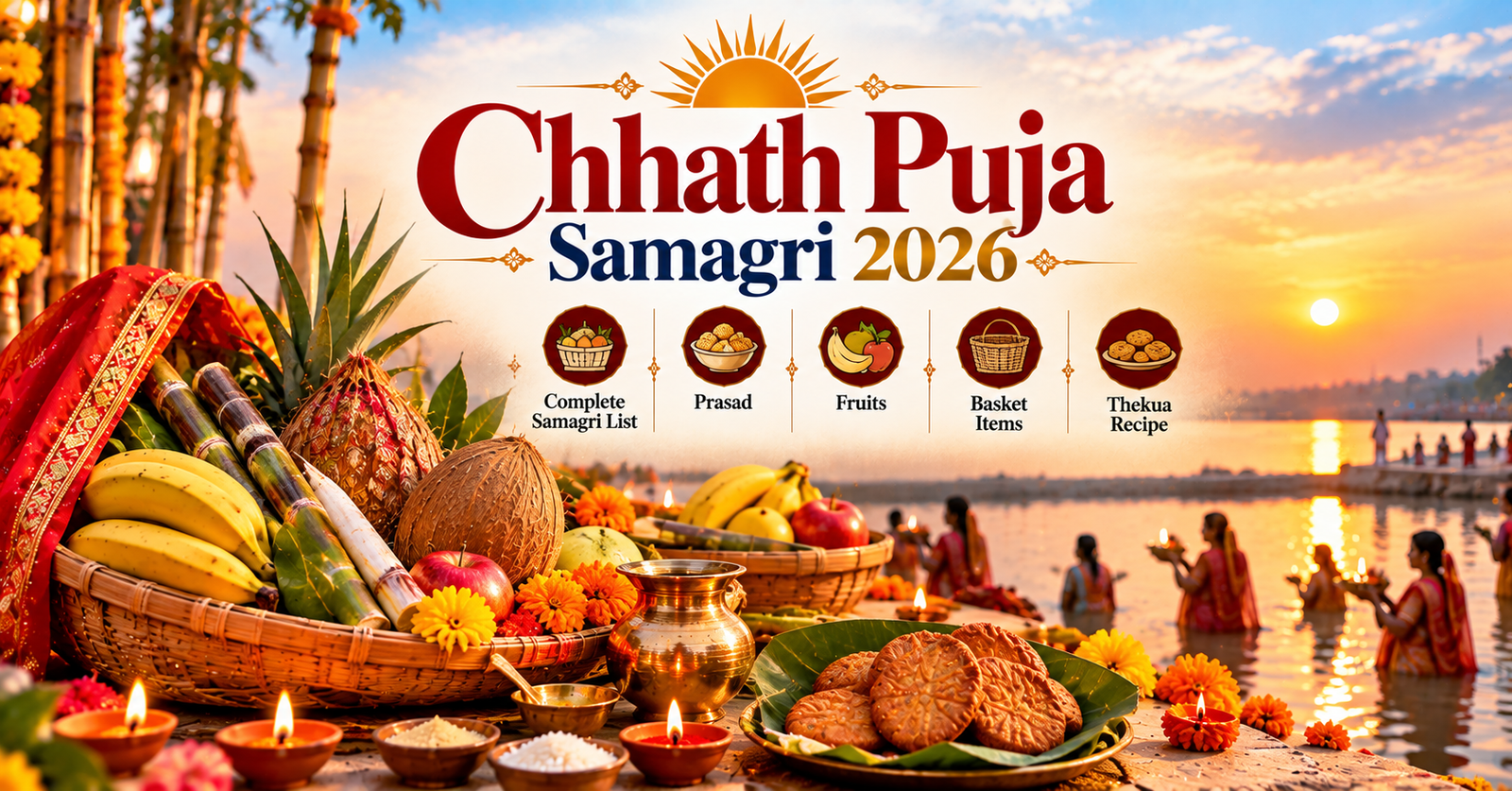
Chhath Puja Samagri 2026: Complete Samagri List, Prasad, Fruits, Basket Items & Thekua Recipe
Last updated: 6 October 2026 | Written by: Your Travel Partner, Ayodhya | Reading time: about 16 minutes
The hardest part of preparing for Chhath is not forgetting anything. One missing soop or an untied bundle of sugarcane is noticed only at the ghat, when it is too late. This guide is a working checklist of Chhath Puja Samagri for 2026: what to buy, how much, on which day each item is used, what goes into the basket, which fruits are offered, what prasad is cooked, and how to make thekua step by step. It is meant to be kept open while you shop and while you pack.
The method of the vrat, the stories, the ghats and travel are covered in our other Chhath guides, linked at the end. This page is only about the things you need.
Quick Answer: Chhath Puja Mein Kya Kya Chahiye?
Chhath Puja mein kya kya chahiye? You need bamboo soops and a daura (basket), a brass or copper lota, thekua and rice laddu as prasad, whole sugarcane with leaves, a coconut with water, bananas, a large citron (dabh nimbu), seasonal fruits, sweet potato and suthni, water chestnut, radish, fresh turmeric and ginger plants, earthen lamps with ghee, milk and Gangajal for the Arghya, sindoor, rice, paan and supari, and new clothes for the vrati. For the kitchen you need wheat flour, jaggery, ghee, arwa rice, chana dal, lauki and rock salt.
Key Facts at a Glance
| Detail | Information |
|---|---|
| Chhath Puja 2026 dates | 13 to 16 November 2026 |
| Days on which the basket is offered | Sunday, 15 November (evening) and Monday, 16 November (morning) |
| Main containers | Soop (bamboo winnowing tray) and daura or dala (bamboo basket) |
| Main prasad | Thekua |
| Other prasad | Kasar (rice laddu), Kharna kheer (rasiya) with roti or puri |
| Essential produce | Sugarcane, coconut, banana, dabh nimbu, seasonal fruits and roots |
| Not used | Onion, garlic, ordinary salt in prasad, cut or tasted fruit, plastic trays |
| Thekua base recipe | 2 cups wheat flour, half to three-quarters cup jaggery, ghee, fennel |
| Thekua keeps for | About 10 to 15 days in an airtight container |
What This Guide Covers
- Nine common Chhath questions, answered in one line each
- Chhath Puja Samagri list: the master checklist
- Day-wise samagri for the four days
- Chhath Puja basket items: soop and daura
- Chhath Puja fruits list
- Chhath Puja offerings: what is offered and what is not
- Chhath Puja Prasad list
- Chhath Thekua recipe, step by step
- Kharna kheer and kasar laddu
- Chhath Puja special food, day by day
- Extra samagri for Kosi, substitutes and purity steps
- Shopping timeline for 2026
- Frequently asked questions
Nine Common Chhath Questions, Answered in One Line Each
These are the questions people ask most before they start shopping. Each has a short answer here and a full guide elsewhere on our site.
| Question | Short answer |
|---|---|
| Chhath Puja kab hai? | Chhath Puja 2026 is from Friday, 13 November to Monday, 16 November 2026. |
| Chhath Puja ke 4 din kaun se hain? | Nahay Khay, Kharna, Sandhya Arghya and Usha Arghya. |
| Nahay Khay kya hota hai? | The first day, when the vrati takes a holy bath and eats one pure meal. |
| Kharna kya hota hai? | The second day, a day-long fast broken after sunset with jaggery kheer and roti. |
| Sandhya Arghya kya hota hai? | The offering of the soop with water or milk to the setting Sun on the third evening. |
| Usha Arghya kya hota hai? | The offering to the rising Sun on the fourth morning, after which the fast is broken. |
| Chhathi Maiya kaun hain? | Shashthi Devi, the goddess who protects children, worshipped together with the Sun. |
| Chhath Puja mein kya chadhate hain? | Thekua, rice laddu, sugarcane, coconut, banana, dabh nimbu, seasonal fruits and roots, with milk and water. |
| Chhath Puja kyun hoti hai? | To thank the Sun for life and the harvest and to pray for the health of children and family. |
Dates and Arghya times are in our Chhath Puja 2026 guide. The meaning, the stories and the method are in Chhath Puja kya hai.
Chhath Puja Samagri List: The Master Checklist
The question behind every shopping trip is "Chhath Puja mein kya kya chahiye". This Chhath Puja Samagri list brings together the items named in the lists published by Sri Mandir, Navbharat and Zee News. Items that appear in all of them are marked essential. Customs differ between families, so add anything your elders ask for.
A. Containers and Vessels
| Item | Local name | Use | Essential? |
|---|---|---|---|
| Bamboo winnowing tray | Soop | Holds the offering lifted to the Sun | Yes |
| Large bamboo basket | Daura, dala, tokri | Carries all soops and prasad to the ghat. Two are listed in most sources | Yes |
| Brass or copper pot | Lota | Pours water and milk for the Arghya | Yes |
| Brass soop | Pital ka soop | Used by some families in place of or along with bamboo | Optional |
| Plate and glass | Thali, gilas | For puja items, milk and water | Yes |
| Earthen lamps | Diya | Lit on the soop and at the ghat | Yes |
| New earthen pots | Mitti ke bartan | Cooking on Nahay Khay and Kharna, and for Kosi | As per custom |
| Earthen stove and mango wood | Chulha, aam ki lakdi | Traditional fuel for cooking prasad | As per custom |
B. Fruits, Roots and Plants
| Item | Local name | Essential? |
|---|---|---|
| Sugarcane with leaves | Ganna, ikh | Yes |
| Coconut with water | Pani wala nariyal | Yes |
| Banana, whole hand | Kela ka ghaud | Yes |
| Large citron or pomelo | Dabh nimbu, gagal | Yes |
| Sweet potato | Shakarkand | Yes |
| Lesser yam | Suthni | Yes |
| Water chestnut | Singhara | Yes |
| Radish with leaves | Mooli | Yes |
| Fresh turmeric plant | Haldi ka paudha | Yes |
| Fresh ginger plant | Adrak ka paudha | Yes |
| Custard apple | Sharifa | Common |
| Pear, apple, orange, other seasonal fruit | Nashpati, seb, santra | Common |
C. Puja Items
| Item | Local name | Use |
|---|---|---|
| Ganga water | Gangajal | Purification and Arghya |
| Raw milk | Kaccha doodh | Arghya |
| Vermilion | Sindoor | Applied on the soop and by the vrati |
| Unbroken rice | Akshat | Puja |
| Betel leaf and nut | Paan, supari | Placed in the soop |
| Sandalwood, roli | Chandan, roli | Tilak |
| Flowers and garland | Phool, mala | Decoration and offering |
| Incense, camphor | Dhoop, agarbatti, kapoor | Aarti |
| Ghee and cotton wicks | Ghee, batti | For the lamps |
| Honey | Shahad | Listed in several sources |
| Sacred thread | Kalava | Tied on vessels |
| Red or yellow cloth | Lal ya pila kapda | Covers the daura |
D. Kitchen Ingredients
| Ingredient | Used for |
|---|---|
| Whole wheat, washed and ground | Thekua, roti, puri |
| Jaggery | Thekua, kheer, kasar, Parana |
| Cow's ghee | Cooking, frying, lamps |
| Arwa rice (raw, not parboiled) | Nahay Khay meal, kheer, kasar |
| Chana dal | Nahay Khay meal |
| Bottle gourd | Nahay Khay sabzi |
| Rock salt | Nahay Khay meal only |
| Milk | Kheer and Arghya |
| Fennel seeds, cardamom, dry coconut | Flavouring for thekua |
| Fresh ginger | Parana |
E. For the Vrati and the Ghat
| Item | Note |
|---|---|
| New clothes | Cotton sari for women, dhoti for men. Usually yellow, red or orange |
| Mat or blanket | The vrati sleeps on the floor |
| Wooden thekua mould | Sancha, for pressing the design |
| Banana leaves | For serving Kharna prasad |
| Torch, matchbox, extra wicks | For the pre-dawn Arghya |
| Towel and a dry set of clothes | For the vrati after coming out of the water |
| Cloth bags | To carry waste back |
If someone at home asks "Chhath Puja mein kya kya chahiye", sections A to E above are the full answer. Print them or save a screenshot before you go to the market. A written Chhath Puja Samagri list saves a second trip.
Day-Wise Samagri for the Four Days
Chhath Puja mein kya kya chahiye also depends on the day. Not everything is needed at once. This day-wise Chhath Puja Samagri list follows the grouping used by Zee News, with the 2026 dates added.
| Day and date | What you need ready |
|---|---|
| Day 1, Nahay Khay Fri, 13 Nov 2026 | Gangajal or clean water, new earthen or cleaned vessels, arwa rice, chana dal, bottle gourd, rock salt, ghee |
| Day 2, Kharna Sat, 14 Nov 2026 | Rice, milk, jaggery, wheat flour, ghee, bananas, banana leaves, earthen stove and mango wood where used, a lamp and incense |
| Day 3, evening Arghya Sun, 15 Nov 2026 | Soops and daura, thekua, rice laddu, coconut, bananas, sugarcane, dabh nimbu, seasonal fruits and roots, paan and supari, sindoor, lamps, flowers, lota with water and milk, cloth to cover the daura |
| Day 4, morning Arghya Mon, 16 Nov 2026 | The same daura refilled with fresh prasad and fruit, milk and water, lamps, torch, dry clothes for the vrati, ginger and jaggery for Parana |
Chhath Puja Basket Items: What Goes in the Soop and the Daura
Once the shopping is done, the next job is arranging the Chhath Puja basket items. The Chhath Puja basket items are arranged in two layers. The soop is the tray actually lifted to the Sun. The daura is the big basket that carries the soops and the rest.
Chhath Puja Basket Items in One Soop
| Item in each soop | How it is placed |
|---|---|
| Thekua | A small stack in the centre |
| Rice laddu (kasar) | Beside the thekua |
| Coconut with water | Whole, with a sindoor mark |
| Bananas | A few from the hand, unpeeled |
| Sugarcane | A short piece. The long stalks are carried separately |
| Dabh nimbu | Whole |
| Seasonal fruits | Whole, washed, uncut |
| Sweet potato, suthni, water chestnut, radish | Whole, washed |
| Turmeric and ginger plant | With leaves, laid along the edge |
| Paan and supari | One set |
| Rice, sindoor, flowers | A pinch and a few petals |
| Earthen lamp | Lit at the ghat, placed at the front |
The soop is, in effect, the answer to "Chhath Puja mein kya chadhaya jata hai" laid out on one tray.
How to Pack the Daura: Step by Step
- Wash and sun-dry the soops and the daura a day earlier.
- Wash every fruit and root and let it dry. Do not cut or peel anything.
- Line the daura with a clean cloth.
- Place the heavier items first: coconuts, the banana hand, sweet potatoes.
- Stand the filled soops on top, one over another, with a cloth between them.
- Keep thekua and laddu in a covered vessel inside the daura so they do not break.
- Put the puja items, lamps, wicks and matchbox in a small separate bag.
- Cover the daura with a red or yellow cloth.
- Tie the sugarcane stalks together and carry them by hand.
- Carry the lota, milk and Gangajal separately and upright.
Quantity Planner: Multiply by the Number of Soops
| Item | Usual practice for each soop |
|---|---|
| Coconut | One |
| Dabh nimbu | One |
| Bananas | A few from the hand, with one whole hand kept in the daura |
| Thekua and laddu | A small stack of each |
| Each root and fruit | One or two pieces |
| Lamp | One |
| Paan and supari | One set |
This is the usual practice. Families differ, so let the eldest vrati in your home confirm the numbers.
How many soops? Families prepare one soop for each vow or for each relative who has sent an offering, so the number differs from home to home. Decide the number first, because every other quantity in the Chhath Puja basket items follows from it.
Chhath Puja Fruits List
Fruit sellers in Bihar keep a ready Chhath Puja fruits list in their heads, because the same items are bought every year. The Chhath Puja fruits list is built around what is in season in the region in early winter. The meanings in the last column are popular beliefs as reported by Curly Tales and are given as such.
| Fruit or produce | Local name | Status | Popular meaning |
|---|---|---|---|
| Banana | Kela | Essential | Health and protection |
| Sugarcane | Ganna | Essential | Joy and prosperity |
| Coconut | Nariyal | Essential | Purity |
| Large citron or pomelo | Dabh nimbu | Essential | Blessings and health |
| Water chestnut | Singhara | Essential | Wealth and well-being |
| Sweet potato | Shakarkand | Essential | Seasonal root of the harvest |
| Suthni | Suthni | Essential | Seasonal root |
| Radish | Mooli | Essential | Seasonal produce |
| Custard apple | Sharifa | Common | Seasonal fruit |
| Pear | Nashpati | Common | Seasonal fruit |
| Apple, orange, guava, pomegranate | Seb, santra, amrud, anar | Optional | Whatever is fresh and whole |
How to Choose From the Chhath Puja Fruits List
- Every fruit must be whole, unbroken and unblemished.
- Fruit that a bird or animal has pecked is not used.
- Bananas are bought as a whole hand, not loose.
- The coconut must have water inside. Shake it before buying.
- Sugarcane is bought with its leaves on.
- Nobody tastes any fruit before the morning Arghya is over.
If a traditional item on the Chhath Puja fruits list is not sold where you live, use another whole seasonal fruit. The rule is freshness and wholeness, and no single optional fruit is compulsory.
Chhath Puja Offerings: What Is Offered and What Is Not
Chhath Puja mein kya chadhaya jata hai? The table gives the answer for each stage of the festival, because Chhath Puja offerings change from day to day.
| Stage | Chhath Puja offerings | Offered to |
|---|---|---|
| Nahay Khay | The cooked meal of rice, chana dal and lauki | Surya Dev, before the vrati eats |
| Kharna | Jaggery kheer, roti or puri, banana | Chhathi Maiya |
| Evening Arghya | The filled soop, with water or milk poured from the lota | The setting Sun |
| Kosi (for a fulfilled vow) | Lamps and prasad under a canopy of sugarcane | Chhathi Maiya |
| Morning Arghya | The refilled soop, with milk and water | The rising Sun |
Chhath Puja Mein Kya Chadhaya Jata Hai, Aur Kya Nahin
Knowing what is left out of Chhath Puja offerings is as useful as knowing what goes in.
| Not used | Reason |
|---|---|
| Onion and garlic | Not part of sattvik food |
| Ordinary salt in prasad | Thekua, kheer and laddu are made without salt. Rock salt is used only in the Nahay Khay meal |
| Cut, peeled or tasted fruit | Offerings must be whole and untouched |
| Shop-made sweets in place of home prasad | The prasad is cooked at home in a purified kitchen |
| Plastic or thermocol trays | Bamboo, brass and clay are traditional and do not pollute the water |
| Stale or leftover food | Everything is freshly made |
So when a child asks "Chhath Puja mein kya chadhaya jata hai", the simple answer is this: whatever the field, the pond and the home kitchen give in this season, offered whole and clean. That is why Chhath Puja offerings look the same in a village and in a city. Elders answer "Chhath Puja mein kya chadhaya jata hai" with one word: the harvest.
Chhath Puja Prasad List
Compared with other festivals, the Chhath Puja Prasad list is short. Every item is made at home from wheat, rice, jaggery, milk and ghee.
| Prasad | Made from | Day | Salt? |
|---|---|---|---|
| Thekua (also called khajuria or tikri) | Wheat flour, jaggery, ghee, fennel or cardamom, sometimes coconut | Made on Day 3, offered at both Arghyas | No |
| Kasar (rice laddu) | Coarse rice flour, jaggery, ghee, fennel | Made on Day 3, offered at both Arghyas | No |
| Rasiya (Kharna kheer) | Rice, milk, jaggery | Day 2, after sunset | No |
| Roti or puri | Wheat flour, ghee | Day 2, with the kheer | No |
| Fruits and roots | Whole seasonal produce | Both Arghyas | Not applicable |
| Ginger and jaggery | Raw ginger, a piece of jaggery | Day 4, for Parana | No |
Everything on this Chhath Puja Prasad list can be made in an ordinary home kitchen once it has been cleaned for the purpose.
Rules for Making Chhath Puja Prasad
- Bathe and wear clean clothes before you begin.
- Cook in a cleaned space set apart for the purpose.
- Use vessels kept only for Chhath, or new ones.
- Do not taste or smell the food while cooking.
- Keep the finished prasad covered and off the floor.
- Chhath Puja Prasad is first offered and only then shared, after the morning Arghya.
Of the Chhath Puja Prasad list, thekua and kasar travel well, while kheer is eaten fresh on Kharna night. Sharing is part of the rule. Chhath Puja Prasad is given to everyone who asks at the ghat, known or unknown, and it is accepted with both hands.
Chhath Thekua Recipe, Step by Step
Chhath Puja Thekua is the one prasad no soop goes without. This Chhath Thekua recipe uses the proportions given by The Tastes of India and India TV, which agree closely.
Chhath Thekua Recipe: Ingredients (Makes About 12 Pieces)
| Ingredient | Quantity | Note |
|---|---|---|
| Whole wheat flour | 2 cups | For Chhath, from wheat washed and dried at home |
| Jaggery, grated or powdered | Half to three-quarters cup | More gives a sweeter, darker thekua |
| Ghee for the dough | 2 tablespoons to a quarter cup | More ghee gives a softer bite |
| Fennel seeds | Half tablespoon | Or half teaspoon cardamom powder |
| Grated dry coconut | 2 tablespoons | Optional |
| Water | A quarter to half cup | To melt the jaggery |
| Ghee or oil | For deep frying | Ghee is traditional for prasad |
Method
- Melt the jaggery. Heat the jaggery with the water on a low flame until it dissolves. Strain it and let it cool a little.
- Rub in the ghee. Put the flour in a wide bowl. Add the ghee, fennel and coconut. Rub with your fingers until the flour looks like coarse crumbs.
- Make a stiff dough. Add the jaggery syrup a little at a time and knead into a firm, tight dough. It should be much stiffer than roti dough.
- Rest. Cover and leave for 10 to 15 minutes.
- Shape. Take lemon-sized balls. Press each on a wooden mould (sancha) dusted with flour, to about half an inch thick. Without a mould, flatten by hand and mark with a fork.
- Heat the ghee. Keep the flame at low to medium.
- Fry. Slide in 3 to 5 pieces at a time. Fry slowly, turning once, until both sides are deep golden brown.
- Cool. Lift out and cool completely. Thekua becomes crisp as it cools.
- Store. Keep in an airtight steel or glass container.
Scaling the Chhath Thekua Recipe
| Wheat flour | Jaggery | Ghee in dough | Approximate pieces |
|---|---|---|---|
| 2 cups | Half to three-quarters cup | 2 tbsp to a quarter cup | 12 |
| 4 cups | 1 to 1.5 cups | 4 tbsp to half cup | 24 |
| 8 cups | 2 to 3 cups | Half cup to 1 cup | 48 |
The piece counts are simple multiples of the base recipe and will change with the size of your mould.
For a large family, make the Chhath Thekua recipe in batches of 2 or 4 cups of flour. Small batches are easier to knead to the right stiffness.
What Went Wrong? A Thekua Troubleshooting Table
| Problem | Likely cause | Fix |
|---|---|---|
| Brown outside, raw inside | Flame too high | Fry on low to medium heat |
| Soaks up ghee | Dough too soft | Add a little flour and knead a tighter dough |
| Cracks while shaping | Dough too dry or too hard | Add a spoon of syrup or water and knead again |
| Breaks in the ghee | Too many pieces at once, or turned too early | Fry a few at a time and turn only when set |
| Sticks to the mould | Mould not dusted | Dust the mould lightly with flour |
| Soft after storing | Stored while warm | Cool fully before closing the container |
Notes on Chhath Puja Thekua as Prasad
- For prasad, the wheat is washed, dried in the sun, guarded from birds and ground separately. This is what sets Chhath Puja Thekua apart from thekua made on ordinary days.
- No salt goes into it.
- It is made on the morning of the third day, after the vrati and helpers have bathed.
- Properly cooled and stored, it stays good for about 10 to 15 days, which is why families carry Chhath Puja Thekua back to relatives in other cities.
- Some homes use sugar in place of jaggery. Jaggery is the older practice.
Kharna Kheer and Kasar Laddu
After thekua, these are the two remaining cooked items on the Chhath Puja Prasad list. Both are part of Chhath Puja special food and are made without salt.
Kharna Kheer (Rasiya)
These quantities are from India TV's Kharna prasad guide.
| Ingredient | Quantity |
|---|---|
| Full-fat milk | 1 litre |
| Short-grain rice, washed | One-third cup (about 60 g) |
| Jaggery, grated | Three-quarters to 1 cup (90 to 120 g) |
| Water for the jaggery | 4 to 5 tablespoons |
- Boil the milk. Add the drained rice and simmer on a low flame for about 18 to 22 minutes, stirring often, until the rice is soft and the milk has thickened.
- Separately, melt the jaggery with the water and bring it briefly to a boil.
- Take the kheer off the heat and let it cool for 3 to 4 minutes.
- Stir in the warm jaggery syrup a little at a time. Adding jaggery straight into boiling milk can make it curdle.
- Rest for 5 minutes before offering.
Roti for Kharna
- Knead about one and a half cups of whole wheat flour with water into a soft dough, without salt or oil.
- Rest for 10 minutes, roll medium-thin and cook on a tawa.
- Brush with ghee if your family custom allows. Some homes make puri in ghee.
Kasar (Rice Laddu)
- Made from coarsely ground rice flour, jaggery, ghee and fennel seeds, pressed into firm balls.
- Some families use wheat flour, and some add dry fruits.
- Proportions are handed down in each home, so follow the elder who makes it in yours.
Chhath Puja Special Food, Day by Day
What is cooked in the house matters as much as what is offered. Chhath Puja special food is plain by design. Nothing is fried in spices, and most of it has no salt at all.
| Day | What the vrati eats | What the family eats |
|---|---|---|
| Day 1, Nahay Khay | One meal of arwa rice, chana dal and lauki sabzi in ghee with rock salt. Also called kaddu bhaat | The same meal, after the vrati |
| Day 2, Kharna | Nothing during the day. Kheer, roti or puri and banana after sunset | Kharna prasad, and sattvik meals |
| Day 3 | Nothing | Sattvik meals without onion and garlic |
| Day 4, after the Arghya | Ginger and jaggery or prasad with water, then a light meal | Prasad, then a regular sattvik meal |
- Green chana cooked in ghee and puri are also named among Chhath Puja special food in several lists.
- For the whole household, onion, garlic and non-vegetarian food stop from Nahay Khay.
- After about 36 hours without water, the first meal should be light. People with medical conditions should follow their doctor's advice on fasting.
Seen together, Chhath Puja special food uses only a handful of ingredients: rice, wheat, lentil, gourd, milk, jaggery and ghee. Its simplicity is the point.
Extra Samagri for Kosi Bharai
People also ask "Chhath Puja mein kya chadhaya jata hai" for Kosi, since it is a separate thanksgiving.
Kosi is done only by families whose wish has been fulfilled, on the night between the two Arghyas. It needs a few items beyond the regular Chhath Puja Samagri list.
| Item | Use |
|---|---|
| Sugarcane stalks with leaves, five or more | Tied at the top to form the canopy |
| Earthen pot for Kosi, often shaped with an elephant | Placed under the canopy |
| Earthen lamps, ghee and wicks | Lit around the pot |
| Thekua, fruits and other prasad | Arranged around the pot |
| A clean cloth or new sari | Tied at the top of the canopy in some families |
| Sindoor, rice, flowers | For the puja |
If Something Is Not Available: Accepted Substitutes
People living far from Bihar and eastern Uttar Pradesh often cannot find every item. The table shows what families commonly use in such cases. Ask your own elders before you substitute.
| Traditional item | If not available |
|---|---|
| Bamboo soop | Brass soop, which can be reused every year |
| River or pond | A clean tub or small pool on a terrace or in a courtyard |
| Earthen stove with mango wood | A thoroughly cleaned gas stove kept only for prasad |
| Dabh nimbu | Pomelo or another large whole citrus fruit |
| Suthni | Another whole seasonal root, such as sweet potato |
| Gangajal | Clean water with a few drops of stored Gangajal |
| Wooden thekua mould | Shape by hand and mark with a fork |
Keeping the Samagri Pure: Step by Step
- Wash new soops and the daura and dry them in the sun.
- Wash brass and copper vessels until they shine.
- Store all Chhath Puja Samagri in one clean corner, off the floor and away from daily kitchen items.
- Wash hands and feet before touching the samagri. Those cooking prasad bathe first.
- Keep children and pets away from the fruit and the prasad.
- Wash fruits and roots on the morning of the third day and let them dry before arranging the soops.
- After the morning Arghya, bring every item back. Leave nothing in the water except the milk and water of the Arghya.
Shopping Timeline for Chhath 2026
| When | What to buy or do |
|---|---|
| By Sunday, 8 November (Diwali) | Wheat, jaggery, ghee, arwa rice, chana dal. Wash and dry the wheat |
| Mon 9 to Wed 11 November | Soops, daura, lota, lamps, wicks, thekua mould, new clothes, cloth for the daura. Get the wheat ground |
| Thursday, 12 November | Bottle gourd, rock salt, vessels for Nahay Khay. Clean the kitchen |
| Friday, 13 November | Milk and bananas for Kharna, banana leaves |
| Saturday, 14 November | All fruits, roots, sugarcane, coconut, turmeric and ginger plants, flowers, paan and supari |
| Sunday, 15 November morning | Fresh milk for the Arghya. Make thekua and kasar |
| Monday, 16 November before dawn | Refill the soops. Carry ginger and jaggery for Parana |
Buying Tips
- Bamboo items and fruit become costlier in the last two days. Buy the non-perishable Chhath Puja Samagri early.
- Sources differ on sugarcane. One list says five stalks and another says seven. Follow your family's number.
- Ready-made Chhath kits with about 40 items are sold online. Check the contents against the master checklist, because fresh items are not included.
- Shopping in Ayodhya? An e-rickshaw is handy for bringing soops, sugarcane and fruit home from the market.
- Outside Bihar and Uttar Pradesh, look for suthni, dabh nimbu and soops in markets that serve the Purvanchal community, which stock them for the season.
Carrying Samagri on a Journey
- Pack soops flat and the daura upright. Do not put weight on them.
- Carry thekua in a steel container in hand baggage.
- Buy fruit, sugarcane and milk at your destination.
- Arriving in Ayodhya with baskets and luggage? Pre-book the station transfer or airport transfer, and ask for a larger cab. Darshan plans are on the packages page.
- If your journey home passes through Ayodhya, we can arrange a cab with space for baskets and sugarcane, a railway station pickup or an airport transfer. Within the city, an e-rickshaw can take the family and the daura close to the Saryu ghats.
- Families who add Ram Lalla's darshan to the trip can see our Ayodhya tour packages.
When you call, tell us how much samagri you are carrying, so that we can suggest the right vehicle from our cab service. Guests arriving by air can book the airport pickup, and those arriving by train the station pickup. Both can be combined with an e-rickshaw for the temple zone or one of our packages.
Call or WhatsApp Your Travel Partner on +91 78811 55800.
Common Mistakes With Samagri
- Counting soops last. Decide the number of soops first.
- Buying a dry coconut. It must have water.
- Buying loose bananas. A whole hand is offered.
- Adding salt to thekua. Prasad is made without salt.
- Adding jaggery to boiling milk. The kheer can curdle.
- Frying thekua on a high flame. It stays raw inside.
- Forgetting the torch and matchbox. The morning Arghya begins in the dark.
- Using plastic trays. They are neither traditional nor good for the river.
Frequently Asked Questions
1. Chhath Puja kab hai?
Chhath Puja 2026 is from Friday, 13 November to Monday, 16 November 2026. The evening Arghya is on 15 November and the morning Arghya is on 16 November.
2. Chhath Puja ke 4 din kaun se hain?
The four days are Nahay Khay, Kharna, Sandhya Arghya and Usha Arghya.
3. Nahay Khay kya hota hai?
Nahay Khay is the first day. The vrati takes a holy bath and eats one meal of arwa rice, chana dal and lauki sabzi cooked with rock salt.
4. Kharna kya hota hai?
Kharna is the second day. The vrati fasts through the day and after sunset eats jaggery kheer with roti or puri, after which the long waterless fast begins.
5. Sandhya Arghya kya hota hai?
Sandhya Arghya is the evening offering on the third day, when the vrati stands in water and offers the filled soop to the setting Sun.
6. Usha Arghya kya hota hai?
Usha Arghya is the morning offering on the fourth day to the rising Sun. The fast is broken after it.
7. Chhathi Maiya kaun hain?
Chhathi Maiya is Shashthi Devi, the goddess who protects children. She is worshipped together with Surya Dev during Chhath.
8. Chhath Puja mein kya chadhate hain?
Thekua, rice laddu, sugarcane, coconut, banana, dabh nimbu, seasonal fruits, sweet potato, suthni, water chestnut and radish are offered in a bamboo soop, with milk and water as Arghya.
9. Chhath Puja kyun hoti hai?
Chhath Puja is kept to thank the Sun for life and the harvest and to pray to Chhathi Maiya for the health and long life of children and the well-being of the family.
10. Chhath Puja mein kya kya chahiye, in short?
Soop and daura, a lota, thekua and rice laddu, sugarcane, coconut, banana, dabh nimbu, seasonal fruits and roots, lamps, milk and Gangajal, sindoor, and new clothes for the vrati.
11. Which Chhath Puja basket items can never be left out?
The bamboo soop and daura, thekua, sugarcane, coconut and banana are the items no family leaves out.
12. How many soops are needed?
There is no fixed number. Families prepare one for each vow or for each relative who has sent an offering.
13. How many sugarcane stalks are needed?
Published lists mention five or seven stalks with leaves. Follow your family custom.
14. Can I use a brass soop in place of bamboo?
Yes. Many families use brass soops, which are kept and reused. Bamboo remains the traditional choice.
15. Which items on the Chhath Puja fruits list are compulsory?
Banana, coconut, sugarcane and dabh nimbu are treated as essential, along with seasonal roots such as sweet potato and suthni. Other fruits depend on what is fresh.
16. Is salt used in Chhath Puja Prasad?
No. Thekua, kheer and laddu are made without salt. Rock salt is used only in the Nahay Khay meal.
17. How long does Chhath Puja Thekua stay fresh?
About 10 to 15 days in an airtight container, if it is cooled completely before storing.
18. Can thekua be made with sugar?
Some families use sugar. Jaggery is the traditional sweetener.
19. Can the Chhath Thekua recipe be baked?
One recipe source gives baking at 375°F for 20 to 25 minutes as an alternative. For prasad, families traditionally fry it in ghee.
20. Why does jaggery kheer curdle?
Adding jaggery directly to boiling milk can curdle it. Melt the jaggery separately and stir it into the kheer after taking it off the heat for a few minutes.
21. When should I buy the fruits?
Buy fruits, roots and sugarcane on Saturday, 14 November 2026, the day before the evening Arghya, so that they are fresh.
22. What are the main Chhath Puja offerings at the ghat?
The filled soop is lifted towards the Sun while water or milk is poured from a lota in front of it, with a lamp lit on the soop. Whether milk or water is used for each Arghya depends on family custom.
23. Are ready-made Chhath Puja kits useful?
They cover puja items and sometimes the soop, but not fresh fruit, milk or home-made prasad. Check the contents against a full list.
Conclusion
Good preparation for Chhath is a matter of lists. Decide the number of soops, buy the lasting Chhath Puja Samagri in the week after Diwali, buy fruit on 14 November, make Chhath Puja Thekua on the morning of 15 November, and pack the Chhath Puja basket items in the order given above. Keep everything whole, fresh and clean, and keep the torch and matchbox where you can find them at four in the morning.
If Ayodhya is part of your Chhath journey, call or WhatsApp Your Travel Partner on +91 78811 55800 for a cab, a station transfer, an airport transfer, an e-rickshaw or a darshan package. Jai Chhathi Maiya.
Our Other Chhath Guides
- Chhath Puja 2026: date, calendar and Arghya time
- Chhath Puja kya hai: meaning, history, vidhi and niyam
- Chhath Puja in Bihar 2026: ghats and famous places
- Chhath Puja travel guide 2026: trains, flights and cabs
- Our services: tour packages, cab, e-rickshaw, airport transfer, railway transfer
Official and Useful Links
- Bihar Tourism
- Government of Bihar
- Food Safety and Standards Authority of India
- Ministry of Culture, Government of India
- Uttar Pradesh Tourism
Disclaimer: Samagri and recipes vary between families and regions. The lists and quantities here are compiled from the published sources named in the article. Please follow your own family tradition where it differs. This article is for general information and is not medical advice.