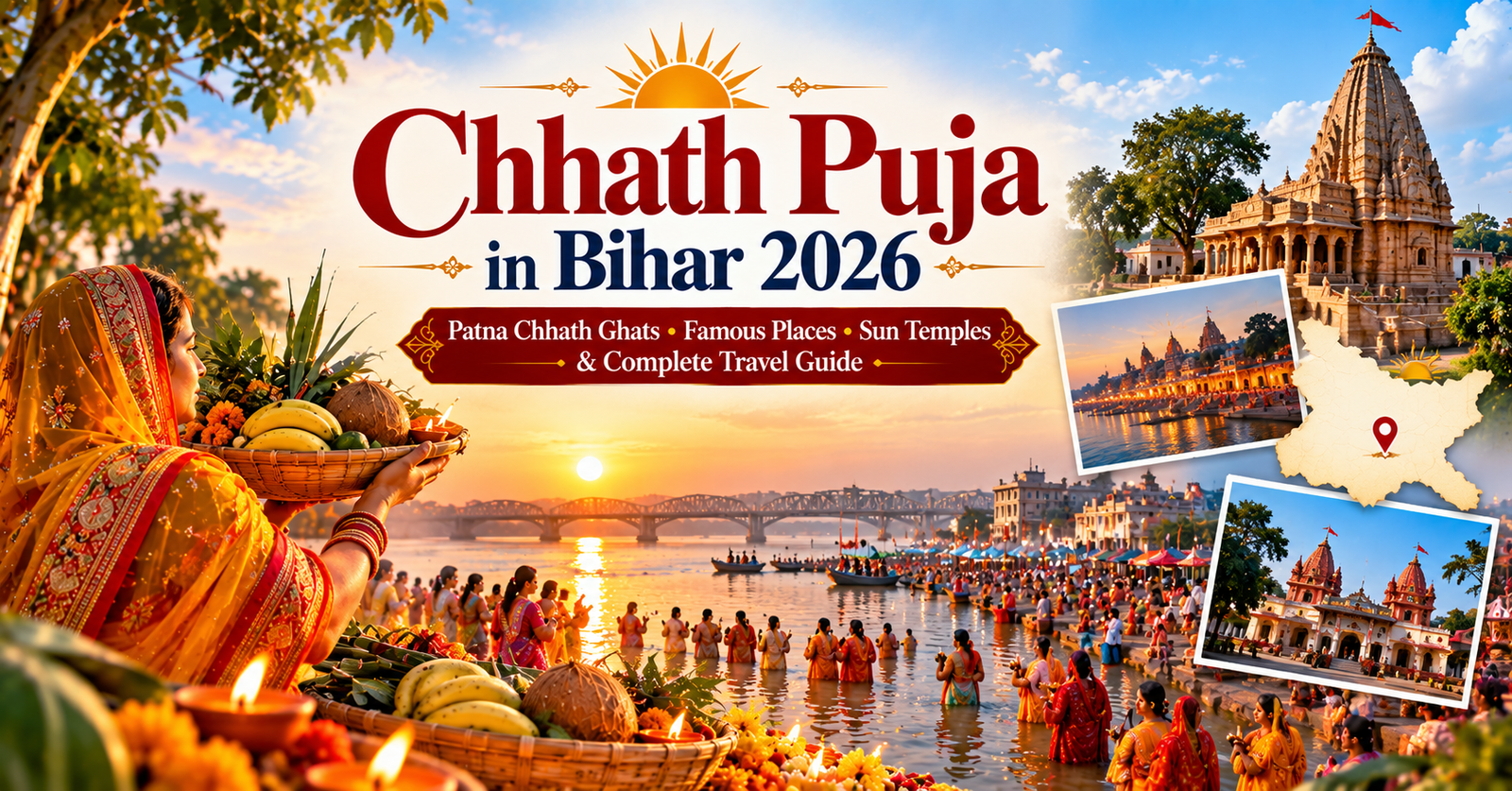
Chhath Puja Kya Hai? Meaning, History, Story, Vidhi, Niyam & 4 Days Rituals Explained
Chhath Puja kya hai aur kyun manaya jata hai? Know its mahatva, history, story of Chhathi Maiya and Surya Dev, the step-by-step vidhi, niyam and 4 days rituals.
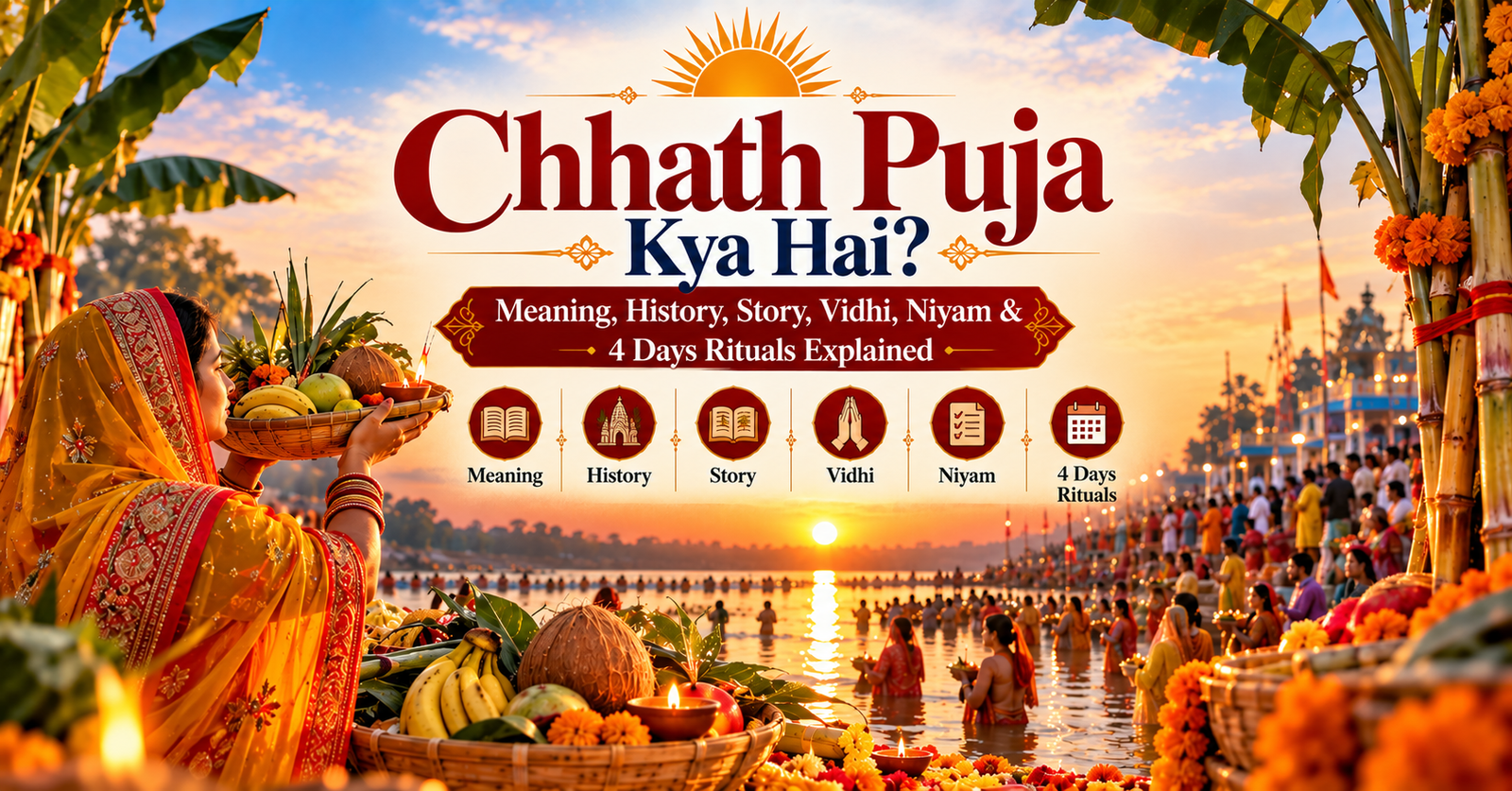
Chhath Puja Kya Hai? Meaning, History, Story, Vidhi, Niyam & 4 Days Rituals Explained
Last updated: 6 October 2026 | Written by: Your Travel Partner, Ayodhya | Reading time: about 18 minutes
Every year, a week after Diwali, millions of people stand in rivers and ponds at dusk and again at dawn, holding bamboo trays of fruit towards the Sun. If you have seen this and wondered Chhath Puja kya hai, why it is kept so strictly and how exactly it is done, this guide explains everything in order: the meaning, the reasons, the importance, the history, the stories, who Chhathi Maiya is, why Surya Dev is worshipped, and then the complete vidhi, niyam and the rituals of all four days, step by step.
Quick Answer: Chhath Puja Kya Hai?
Chhath Puja is a four-day Hindu festival dedicated to Surya Dev (the Sun god) and Chhathi Maiya (Shashthi Devi), observed mainly in Bihar, Jharkhand, eastern Uttar Pradesh and the Terai of Nepal. It falls on the sixth day (Shashthi) of the bright half of the month of Kartik, a few days after Diwali. The person keeping the fast, called the vrati, bathes and eats a pure meal on day one, takes kheer after sunset on day two, then fasts without food or water for about 36 hours, offering Arghya to the setting Sun on day three and to the rising Sun on day four. It is kept for the health and long life of children and the well-being of the family.
Key Facts at a Glance
| Question | Answer |
|---|---|
| What is it? | A four-day festival of Sun worship with a strict fast |
| Other names | Chhath Parv, Chhath Mahaparv, Surya Shashthi, Dala Chhath, Chhathi |
| Meaning of "Chhath" | "Sixth", from Shashthi, the sixth lunar day |
| Deities | Surya Dev and Chhathi Maiya (Shashthi Devi) |
| When | Kartik Shukla Chaturthi to Saptami (October or November). A smaller Chaiti Chhath is kept in Chaitra (March or April) |
| The four days | Nahay Khay, Kharna, Sandhya Arghya, Usha Arghya |
| Length of the waterless fast | About 36 hours |
| Who keeps it | Women and men, of any caste or community |
| Priest needed? | No. The vrati performs everything |
| Main prasad | Thekua, rice laddu, sugarcane, coconut, banana, seasonal fruit |
| Purpose | Thanks to the Sun, health and long life of children, family well-being, fulfilment of a vow |
| Dates in 2026 | 13 to 16 November 2026 |
For this year's exact dates and the Arghya time for each city, see our Chhath Puja 2026 date, calendar and Arghya time guide. This article explains the meaning and the method, which do not change from year to year.
What This Guide Covers
- Chhath Puja kya hai: the full meaning
- Chhath Puja kyun manaya jata hai: seven reasons
- Chhath Puja ka mahatva
- Chhath Puja history: a timeline
- Chhath Puja story: the five kathas
- Who is Chhathi Maiya?
- Surya Dev and Chhath Puja
- Chhath Puja kaise hoti hai: the whole process at a glance
- Chhath Puja 4 days rituals, day by day
- Chhath Puja vidhi: how to offer Arghya
- Samagri and prasad
- Chhath Puja ke niyam
- Myths and facts
- Frequently asked questions
Chhath Puja Kya Hai: The Full Meaning
To answer "Chhath Puja kya hai" properly, it helps to break the name into its parts.
- Chhath comes from "Shashthi", the sixth day of the lunar fortnight. The main worship happens on the sixth day after the new moon of Kartik.
- Puja here is not a temple ceremony. It is a vow (vrat) of purity and fasting, completed by offering water or milk, called Arghya, directly to the Sun.
So Chhath is, at its heart, a thanksgiving to the Sun kept through personal discipline. It has features that set it apart from almost every other Hindu festival.
| Feature | Most festivals | Chhath Puja |
|---|---|---|
| Who conducts the worship | Usually a priest | The vrati and the family |
| What is worshipped | An idol or image | The visible Sun and the water |
| Place | Temple or home shrine | Riverbank, pond, or a pool at home |
| Time of worship | Usually the rising Sun | Both the setting and the rising Sun |
| Offerings | Often bought sweets | Home-made prasad and the season's own produce |
| Social rule | Varies | Everyone stands in the same water with the same bamboo tray |
Words You Will Hear
| Word | Meaning |
|---|---|
| Vrati or Parvaitin | The person keeping the fast |
| Arghya | Offering of water or milk to the Sun |
| Soop | Bamboo winnowing tray that holds the offering |
| Daura or Dala | Large bamboo basket carried to the ghat |
| Thekua | The main prasad, made of wheat flour, jaggery and ghee |
| Kosi | Thanksgiving ritual with lamps under a sugarcane canopy |
| Parana or Paran | Breaking of the fast on the fourth morning |
| Ghat | Steps or bank leading to the water |
Chhath Puja Kyun Manaya Jata Hai: Seven Reasons
People ask Chhath Puja kyun manaya jata hai because the fast is so hard that there must be a strong reason behind it. There are several, and families usually hold more than one of them together. Ask ten vratis "Chhath Puja kyun manaya jata hai" and you will hear these seven answers in different words.
- To thank the Sun. The Sun gives light, warmth and the harvest. Chhath comes right after the paddy is cut, and the first produce of the season is offered back.
- For the health and long life of children. Chhathi Maiya is the protector of children. Most vratis keep the fast for their sons and daughters.
- To ask for a child. Couples who wish for a child take a vow before Chhathi Maiya, following the story of King Priyavrat.
- To fulfil a vow (mannat). When a wish is granted, such as a recovery from illness, a job or a marriage, the family keeps Chhath in gratitude, often with the Kosi ritual.
- For the well-being and prosperity of the whole family. The vrati fasts on behalf of everyone in the home.
- For inner cleansing. Four days of pure food, silence, simple living and fasting are seen as a discipline for body and mind.
- To keep a family tradition alive. The vrat is handed from mother-in-law to daughter-in-law or from parent to child. Keeping it is a way of honouring one's elders.
In one line, the answer to "Chhath Puja kyun manaya jata hai" is this: to thank Surya Dev for life and to seek the blessing of Chhathi Maiya for one's children and family.
Chhath Puja Ka Mahatva: Why It Matters So Much
Chhath Puja ka mahatva can be understood on five levels.
| Level | Importance |
|---|---|
| Religious | Worship of Surya, called the visible god (pratyaksha devta), together with Shashthi Devi. Both the evening and morning forms of the Sun are honoured. |
| Family | The fast is kept for children and for the family line. The whole household takes part in cleaning, cooking and carrying the daura. |
| Social | No priest, no ticket, no special place for the wealthy. People of every background share one ghat, and prasad is given to strangers. |
| Nature | Rivers and ponds are cleaned before the festival. Offerings are bamboo, clay, fruit and leaves, all of which return to the earth. |
| Personal | The vrat teaches restraint, cleanliness, patience and gratitude. |
A Careful Note on "Scientific Benefits"
Many articles say that Chhath gives vitamin D, removes toxins or cures diseases. We do not repeat those claims as facts, because we have not found reliable medical evidence that the ritual itself produces them. What can be said honestly is that gentle morning and evening sunlight, clean food, time near water and a strong sense of community are widely felt to be good for people. A 36-hour waterless fast, on the other hand, is demanding, and people with health conditions should take a doctor's advice. Chhath Puja ka mahatva rests on faith and gratitude, and it does not need medical claims to support it.
Seen this way, Chhath Puja ka mahatva is that it joins faith, family, society and nature in one act. Another part of Chhath Puja ka mahatva is emotional. For people from Bihar and Purvanchal who live far from home, Chhath is the one time of year when the whole family gathers. Those passing through Ayodhya on the way can pre-book a station pickup, an airport transfer or an outstation cab with us. That is why trains run full and why the festival is called the Mahaparv, the great festival.
Chhath Puja History: A Timeline
The exact year in which Chhath began is not recorded anywhere. Chhath Puja history is best understood as layers that built up over a very long time. The table separates what texts actually say from what tradition holds.
| Period or source | What it contributes | How firm is it? |
|---|---|---|
| Vedic period | The Rigveda contains hymns to Surya and to Usha, the dawn. Offering water to the Sun is an ancient practice. | Sun worship is well attested. The Vedas do not name Chhath itself. |
| Ramayana tradition | Mata Sita and Shri Ram are said to have fasted and worshipped the Sun on Kartik Shukla Shashthi after returning to Ayodhya. | A popular tradition, widely told. |
| Mahabharata tradition | Karna, son of Surya, is remembered for daily worship of the Sun while standing in water. Draupadi is said to have kept the vrat. | Karna's Sun worship is part of the epic. The link to Chhath is traditional. |
| Puranas | The Brahma Vaivarta Purana and the Devi Bhagavata Purana tell the story of Shashthi Devi and King Priyavrat. | Found in the texts. This is the scriptural basis for Chhathi Maiya. |
| Sun temples of old Magadh | Bihar has old Sun temples such as Deo (Aurangabad), Ular near Patna and Badgaon near Nalanda, which are major Chhath centres even today. | The temples exist and show a long regional tradition of Sun worship. Their exact ages are debated. |
| Folk tradition | Chhath was carried forward mainly by women through songs and household practice, without written manuals. | This is why customs differ a little between families. |
| 19th century onwards | Workers from Bihar and eastern Uttar Pradesh took Chhath to Mauritius, Fiji, the Caribbean and elsewhere. | Chhath is observed in these communities today. |
| Recent years | Chhath is now seen in every large Indian city. In 2026, ETV Bharat reported that INTACH's Bihar chapter had prepared a dossier seeking a place for Chhath on UNESCO's Intangible Cultural Heritage list. | Reported in the press. The outcome is awaited. |
Compared with most festivals, Chhath Puja history has very few kings, dates or inscriptions in it. Two points about Chhath Puja history are worth remembering. First, Chhath is a living folk tradition, so its history is carried more in practice and song than in dated documents. Second, any website that gives a precise founding year for Chhath is guessing. An honest account of Chhath Puja history says that Sun worship is extremely old and that the present four-day form took shape in the Magadh and Mithila regions over many centuries.
Chhath Puja Story: The Five Kathas
There is no single Chhath Puja story. Five kathas are told, and each explains a different side of the festival.
1. King Priyavrat and Shashthi Devi
King Priyavrat and Queen Malini had no child. On the advice of Sage Kashyap they performed a yajna, and the queen gave birth to a son, but the baby was lifeless. As the grieving king prepared to give up his own life, a radiant goddess appeared. She said she was Shashthi, the sixth part of Prakriti and the protector of children. She touched the baby and he came to life. She asked the king to worship her on the sixth day and to spread her worship among the people. This is the main Chhath Puja story behind the worship of Chhathi Maiya, and it is found in the Brahma Vaivarta Purana and the Devi Bhagavata Purana.
2. Mata Sita and Shri Ram in Ayodhya
After fourteen years of exile and the victory over Ravan, Shri Ram and Mata Sita returned to Ayodhya. Tradition says that on Kartik Shukla Shashthi they kept a fast and worshipped Surya Dev, who is the ancestral deity of Ram's solar dynasty (Suryavansh), and completed the worship at sunrise the next day. This Chhath Puja story is especially dear to us in Ayodhya, where vratis still offer Arghya on the Saryu. Visitors who wish to see the ghats and the Ram Mandir together can look at our Ayodhya tour packages.
3. Mata Sita at Munger
A local tradition in Munger, Bihar, says that Mata Sita performed Chhath at the ashram of Sage Mudgal on the bank of the Ganga. The Sita Charan temple there is connected with this belief. It is a regional tradition and is told with devotion in that area.
4. Karna, the Son of Surya
Karna was born to Kunti through the blessing of Surya Dev. As the king of Anga, a region in present-day eastern Bihar, he is remembered for standing in water every day and offering Arghya to the Sun, and for never refusing a gift to anyone who asked at that hour. Many people see the posture of the Chhath vrati, standing in water with folded hands, as a memory of Karna's worship.
A correction: some websites write that Karna performed Chhath after reuniting with Kunti once the Mahabharata war was over. That cannot be right, because Karna dies during the war.
5. Draupadi and the Pandavas
When the Pandavas had lost their kingdom, Draupadi is said to have kept the Chhath vrat on the advice of Sage Dhaumya, praying to the Sun for the return of their fortune. The Pandavas later regained their kingdom. This Chhath Puja story is told to show that the vrat is kept in times of difficulty as well as in thanksgiving.
| Katha | What it explains |
|---|---|
| Priyavrat and Shashthi Devi | Why Chhathi Maiya is worshipped, and why the vrat is kept for children |
| Sita and Ram in Ayodhya | Why it falls on Kartik Shukla Shashthi, and why Arghya is completed at sunrise |
| Sita at Munger | The deep roots of Chhath in Bihar |
| Karna | Why Arghya is offered standing in water |
| Draupadi | Why the vrat is kept to overcome hardship |
These are accounts of faith. They are told a little differently from region to region, and every Chhath Puja story above should be read in that spirit.
Who Is Chhathi Maiya?
Chhathi Maiya is the loving folk name of Shashthi Devi. "Chhathi" means "the sixth", and "Maiya" means "mother".
| Aspect | What tradition says about Chhathi Maiya |
|---|---|
| Name in scripture | Shashthi Devi, also called Devasena |
| Why "sixth" | She is described as the sixth part of Prakriti, the primal nature |
| Role | Protector of newborns and children, giver of children to the childless |
| Relation to Surya | In the folk belief of Bihar and Purvanchal she is regarded as the sister of Surya Dev |
| Relation to Kartikeya | In the Puranas, as Devasena, she is the consort of Kartikeya (Skanda) |
| Other identification | Popular accounts also describe her as a manas putri (mind-born daughter) of Brahma and link her with Maa Katyayani |
| Where else she is worshipped | On the sixth day after a child's birth, in the "Chhathi" ceremony kept in many Indian homes |
- Chhathi Maiya has no fixed idol in Chhath. She is invoked through songs, the lamp and the offerings.
- The Arghya is poured to the Sun, while the prayer for the children is addressed to Chhathi Maiya. The two are worshipped together.
- These descriptions come from different texts and folk traditions, which is why you will hear more than one account of who she is. They do not contradict the faith. They show how widely Chhathi Maiya is loved.
Surya Dev and Chhath Puja: Why the Sun Is Worshipped
The pairing of Surya Dev Chhath Puja is natural. The Sun is the one deity everyone can see, every day, without a temple.
- Visible god. Surya is called pratyaksha devta, the god who is directly seen.
- Source of life. Crops, seasons, light and warmth depend on him. The festival is timed to the harvest.
- Health. In tradition Surya is associated with health and vitality, and people pray to him for freedom from illness.
- Family deity of the solar line. Shri Ram belongs to the Suryavansh, which is one reason the Surya Dev Chhath Puja tradition is close to Ayodhya.
Why Both the Setting and the Rising Sun?
| Arghya | When | Meaning | Traditional link |
|---|---|---|---|
| Sandhya Arghya | Sunset on Shashthi | Gratitude for the day that has passed. Respect for what is ending. | Pratyusha, the last ray of evening |
| Usha Arghya | Sunrise on Saptami | Welcome to a new beginning, hope and renewal. | Usha, the first ray of dawn |
This double offering is what makes Surya Dev Chhath Puja unlike any other form of Sun worship in India. The message is often put like this: the world bows to the rising Sun, but Chhath teaches us to bow to the setting Sun as well. In life, this means honouring those whose time of strength has passed, such as our elders.
Surya Arghya Mantra for Surya Dev Chhath Puja
Chhath is a folk festival, and most vratis offer Arghya with songs and a silent prayer. Mantras are optional. Those who wish to chant commonly use:
- Om Suryaya Namah
- Om Ghrini Suryaya Namah
- Ehi Surya Sahasransho Tejorashe Jagatpate, Anukampaya Mam Bhaktya Grihanarghyam Divakara
The last is a traditional Arghya mantra that asks the thousand-rayed Sun, lord of the world, to accept the offering with compassion. In Surya Dev Chhath Puja, sincerity matters more than recitation.
Chhath Puja Kaise Hoti Hai: The Whole Process at a Glance
If you are new and want to know Chhath Puja kaise hoti hai, start with the overall flow. The Chhath Puja process has three stages: preparation, the four days, and the close.
Elders explain Chhath Puja kaise hoti hai to a new vrati in exactly this sequence, so that no step is missed.
Stage 1: Preparation (From Diwali to Nahay Khay)
| When | What is done |
|---|---|
| Right after Diwali | The home is cleaned thoroughly. Non-vegetarian food, onion and garlic stop in the household. |
| 4 to 5 days before | Wheat is washed, dried in the sun and guarded, then ground separately for thekua. |
| 3 to 4 days before | Soop, daura, earthen lamps, earthen stove and new clothes are bought. |
| 2 to 3 days before | The ghat is chosen and cleaned. A spot is marked for the family. |
| 1 day before | Fruits, sugarcane, coconut and vegetables are bought fresh. |
Stage 2: The Four Days of the Chhath Puja Process
| Day | Tithi | Name | Core act | Fast |
|---|---|---|---|---|
| 1 | Chaturthi | Nahay Khay | Holy bath and one pure meal | One meal |
| 2 | Panchami | Kharna (Lohanda) | Day fast, kheer after sunset | Nothing till evening |
| 3 | Shashthi | Sandhya Arghya | Arghya to the setting Sun | No food, no water |
| 4 | Saptami | Usha Arghya | Arghya to the rising Sun, Parana | Fast ends |
Stage 3: The Close
- Parana: the vrati breaks the fast after the morning Arghya.
- Prasad is shared with family, neighbours and anyone who asks.
- Soops and baskets are cleaned and kept, and the ghat is left clean.
That is the short answer to "Chhath Puja kaise hoti hai". The Chhath Puja process never changes its order: purify, fast, offer at sunset, offer at sunrise, break the fast. Whether it is done on the Ganga in Patna or on a terrace in Mumbai, the Chhath Puja process and the Chhath Puja rituals are the same. The next section goes through each day in detail.
Chhath Puja 4 Days Rituals, Day by Day
This is the core of the guide. The Chhath Puja 4 days rituals are given below in the exact order in which they are performed. Clock times are typical for mid-November in Bihar and eastern Uttar Pradesh. The fixed points are always the local sunset and sunrise.
Day 1: Nahay Khay (Bathe and Eat)
- Wake before sunrise. Trim nails and wash hair.
- Bathe in a river or pond. If that is not possible, bathe at home with a little Gangajal in the water.
- Wear clean clothes. Clean the kitchen and the puja space again.
- Cook the meal: arwa (raw) rice, chana dal and lauki sabzi, in ghee, with rock salt only, without onion or garlic. Many homes cook on an earthen stove with mango wood.
- Offer the food to Surya Dev.
- The vrati eats first and eats only this one meal. The family eats afterwards.
- From tonight the vrati sleeps on the floor on a mat or blanket.
Day 2: Kharna or Lohanda
- The vrati fasts from sunrise, without food and traditionally without water.
- In the evening the vrati bathes and wears clean clothes.
- After sunset, prepare rasiya (kheer of rice, milk and jaggery) and roti or puri in ghee, without salt.
- Place the prasad with bananas on a banana leaf or clean plate. Light a lamp and offer it to Chhathi Maiya.
- The vrati eats the prasad alone, in a quiet room.
- The prasad is then shared with family and neighbours.
- From this moment the waterless fast of about 36 hours begins.
Day 3: Sandhya Arghya (Evening Offering)
- In the morning, make thekua and rice laddu in the purified kitchen. Nobody tastes anything.
- Wash all fruits. Arrange each soop with thekua, banana, coconut, sugarcane pieces, seasonal fruit, a lamp and sindoor.
- Pack the soops in the daura and cover it with a clean yellow or red cloth.
- In the afternoon, walk to the ghat. A family member carries the daura on the head, usually barefoot, without putting it down on the way.
- At the ghat, clean the spot, fix the sugarcane and light the lamps.
- The vrati enters the water and faces west.
- As the Sun sets, the vrati lifts each soop towards the Sun while family members pour water and milk in front of it. This is the Sandhya Arghya.
- Return home with the prasad untouched. Families who have vowed it perform Kosi Bharai at night.
Day 4: Usha Arghya (Morning Offering) and Parana
- Wake around 3 AM. Refill the soops with fresh prasad.
- Reach the same ghat well before dawn and light lamps at the water's edge.
- The vrati enters the water and faces east, waiting with folded hands.
- As the Sun rises, offer each soop with water and milk. This is the Usha Arghya.
- Pray to Chhathi Maiya for the children and the family.
- The vrati applies sindoor to married women and blesses the younger ones.
- Distribute prasad at the ghat.
- Parana: the vrati breaks the fast with ginger and jaggery or with prasad and water, as the family custom is.
Typical Time Table of the Four Days
| Day | Time (typical, mid-November) | Activity |
|---|---|---|
| Day 1 | 5:30 to 7:00 AM | Holy bath |
| 9:00 to 11:00 AM | Cooking the Nahay Khay meal | |
| 11:00 AM to 1:00 PM | Offering and meal | |
| Day 2 | Sunrise to sunset | Day fast |
| After sunset | Cooking kheer and roti, Kharna puja | |
| Evening to night | Vrati eats, prasad shared, long fast begins | |
| Day 3 | Morning to 1:00 PM | Making thekua, arranging soops |
| 2:30 to 3:30 PM | Leaving for the ghat | |
| About 30 to 45 minutes before sunset | Vrati enters the water | |
| At sunset | Sandhya Arghya | |
| Day 4 | 3:00 to 4:30 AM | Leaving for the ghat |
| About 30 to 45 minutes before sunrise | Vrati enters the water | |
| At sunrise | Usha Arghya | |
| After the Arghya | Prasad and Parana |
Read together, the steps above are the complete Chhath Puja process from the first bath to the Parana. In 2026 the Chhath Puja 4 days rituals fall on 13, 14, 15 and 16 November. City-wise sunset and sunrise are in our Chhath Puja 2026 guide.
Chhath Puja Vidhi: How to Offer Arghya Correctly
Of all the Chhath Puja rituals, one matters most. The central act of the Chhath Puja vidhi is the Arghya. Here is the method, written so that a first-time family can follow it.
- Prepare the soop. Place thekua, a banana, a coconut, a piece of sugarcane, fruit, a small lamp, a little rice and sindoor in each soop.
- Take a sankalp. Before stepping into the water, fold your hands and silently state for whom you are keeping the vrat.
- Enter the water. Stand where the water is knee-deep to waist-deep and safe. Face west in the evening and east in the morning.
- Hold the soop. Raise it in both hands at chest height towards the Sun.
- Pour the Arghya. A family member pours water, or milk mixed with water, from a lota in a thin stream in front of the soop so that it falls into the river. In the evening many families offer water and in the morning milk, though customs vary.
- Turn in place. Many vratis turn around slowly on the same spot, three or five times, after the offering.
- Repeat for each soop. Relatives who have sent a soop have it offered in their name.
- Pray. Bow to Surya Dev and Chhathi Maiya, then come out of the water carefully.
Chhath Puja Vidhi at Home
- Use a terrace, courtyard or balcony from which the Sun can be seen.
- Fill a clean tub or an inflatable pool with water and add a little Gangajal.
- Stand in the water and follow the same Chhath Puja vidhi as at a ghat.
- Afterwards, pour the water at the root of a plant or tree. Do not let it flow into a drain.
Kosi Bharai Vidhi
- Done on the night of Sandhya Arghya by families whose wish has been fulfilled.
- Five or more sugarcane stalks are tied at the top to form a canopy.
- Under it, an earthen pot, often shaped with an elephant, is placed with prasad around it, and earthen lamps are lit.
- Women sing Chhath songs around it. It is repeated at the ghat before the morning Arghya in many families.
Samagri and the Meaning of the Prasad
Every item used in the Chhath Puja rituals comes from the field, the pond or the home kitchen. Nothing is bought ready-made as prasad.
| Item | Use in the Chhath Puja rituals | What it stands for |
|---|---|---|
| Bamboo soop and daura | Hold and carry the offering | Simplicity, nature's own material |
| Thekua | Main prasad | The new wheat and jaggery of the season |
| Rice laddu (kasar) | Second prasad | The new rice |
| Sugarcane | Offered whole, used for Kosi | Sweetness and the new harvest |
| Coconut | In every soop | Purity and a complete offering |
| Banana | Whole bunch offered | Abundance |
| Dabh nimbu, sweet potato, radish, water chestnut, turmeric and ginger plants | Seasonal produce | Thanks for what the earth and water give |
| Earthen lamps | Lit at the ghat | Light offered back to the source of light |
| Milk, water, Gangajal | For the Arghya | Purity |
| Brass or copper lota | For pouring | Traditional vessel for Sun worship |
Chhath Puja Ke Niyam: Rules of the Vrat
Chhath Puja ke niyam are strict because the whole festival is built on purity. They fall into four groups.
Rules for the Vrati
- Eat only once on Nahay Khay and only the Kharna prasad on the second evening.
- Take no food and no water from the Kharna prasad until Parana.
- Sleep on the floor on a mat or blanket, not on a bed.
- Wear clean, simple clothes. Many families prefer unstitched cotton, such as a sari or dhoti.
- Keep the mind calm. Avoid anger, harsh words and quarrels.
- Do not break the fast before the morning Arghya.
Rules for the Kitchen and Prasad
- Cook prasad in a separate, freshly cleaned place.
- Use rock salt only on Nahay Khay. Kharna prasad and thekua have no salt.
- No onion, garlic or non-vegetarian food in the house during the festival.
- Bathe before cooking. Do not taste, smell or step over the prasad.
- Use new or thoroughly purified vessels. Many use bronze, brass or clay.
- Fruits must be whole and unblemished.
Rules for the Family
- Everyone in the home eats sattvik food and avoids alcohol and tobacco.
- Do not touch the prasad or soop without bathing.
- Help the vrati. Carrying the daura and pouring the Arghya are the family's service.
- Accept prasad with both hands and do not waste it.
Rules at the Ghat
- Plan how the vrati will reach and leave the ghat. In Ayodhya, families often keep an e-rickshaw or a cab ready for both Arghyas.
- Use only safe, permitted ghats and stay within the barricades.
- Do not use plastic, thermocol or soap in the water.
- Take back your waste. Leave the ghat cleaner than you found it.
- Keep children with an adult at all times.
Special Situations
| Situation | What families usually do |
|---|---|
| First-time vrati | Begins with the guidance of an elder who has kept the vrat. Many start with a vow for a set number of years. |
| Vrati falls ill or is too old | The vrat is passed to a daughter-in-law, son or other family member, or the family sends a soop through another vrati. |
| Death or birth in the family | Many families do not keep the vrat that year and resume the next year. |
| Pregnancy or medical condition | A doctor's advice comes first. The person can support another vrati instead of fasting. |
| Living far from a river | Arghya is offered at home in a tub or pool. |
Elders often say that the Chhath Puja 4 days rituals are easy to list and hard to live, and the niyam are the reason. Chhath Puja ke niyam differ slightly between families and regions. When in doubt, follow the eldest vrati in your own family. The spirit of Chhath Puja ke niyam is cleanliness, truthfulness and devotion, and no rule asks anyone to risk their life.
Myths and Facts
| Myth | Fact |
|---|---|
| Only married women can keep Chhath. | Men and unmarried people keep it too. |
| Chhath is only for sons. | The vrat is for the well-being of all children, daughters and sons alike. |
| A priest is required. | No priest is needed. The vrati performs the worship. |
| It must be done in the Ganga. | Any clean water body, or a pool at home, is accepted. |
| Chhath is only a festival of Bihar. | It is also kept in Jharkhand, Uttar Pradesh, West Bengal, Nepal and by communities worldwide. |
| The fast ends after the evening Arghya. | It ends only after the next morning's Arghya. |
| Chhath is mentioned by name in the Vedas. | The Vedas praise the Sun and the dawn. The festival as we know it comes from later tradition. |
Chhath Songs: The Voice of the Festival
- Chhath has its own folk songs in Bhojpuri, Maithili and Magahi, sung by women while cooking, walking to the ghat and waiting for the Sun.
- The songs describe the daura, the banana and sugarcane, the vrati's prayer for her children and her call to the Sun to rise quickly.
- The late Sharda Sinha is the singer most closely associated with these songs, and her recordings are heard in almost every home during the festival.
- Because few families use written manuals, these songs are how the Chhath Puja rituals have been taught from one generation to the next.
Chhath in Ayodhya: Where the Story Meets the River
Ayodhya has a special place in the story of Chhath, because tradition says Mata Sita and Shri Ram worshipped the Sun here. Each year vratis gather on the Saryu at Naya Ghat, Ram Ki Paidi and Guptar Ghat for both Arghyas. Many families from Bihar and Purvanchal also stop in Ayodhya for Ram Lalla's darshan on the way home for Chhath or on the way back. We arrange the airport pickup, station pickup and local e-rickshaw for such short halts, and the packages page lists one-day and two-day plans.
- Darshan at the Ram Mandir is free, and all passes are issued free by the Trust through its official portal.
- Coming by train? Fix a railway station pickup and drop in advance, since stations are very crowded in Chhath week.
- Coming by flight? Use our Ayodhya airport transfer.
- For the ghats and temples, a cab in Ayodhya or an e-rickshaw saves elders a long walk.
- Staying near the temple zone? An e-rickshaw is the easiest way to move between Naya Ghat, Ram Ki Paidi and the temples.
- Short darshan plans are on our Ayodhya tour packages page.
For travel help around Chhath, call or WhatsApp Your Travel Partner on +91 78811 55800. Share your dates and group size, and we will confirm availability and charges before you book.
Frequently Asked Questions
1. Chhath Puja kya hai?
Chhath Puja is a four-day Hindu festival of Sun worship kept with a strict fast. The vrati offers Arghya to the setting Sun and the rising Sun and prays to Chhathi Maiya for the health of the children and the family.
2. Chhath Puja kyun manaya jata hai?
It is kept to thank Surya Dev for life and the harvest, to seek Chhathi Maiya's blessing for children, to ask for a child, and to fulfil a vow after a wish is granted.
3. Why is it called Chhath?
Chhath means sixth. The main worship is on Shashthi, the sixth day of the bright half of the month of Kartik.
4. Who is Chhathi Maiya?
Chhathi Maiya is Shashthi Devi, the goddess who protects children. In folk belief she is the sister of Surya Dev, and in the Puranas she is also known as Devasena.
5. Why is the Sun worshipped in Surya Dev Chhath Puja?
Surya is the visible source of light, life and the harvest, and tradition associates him with health. Chhath is a direct thanksgiving to him.
6. What is the main Chhath Puja story?
The main story is of King Priyavrat, whose lifeless newborn was revived by Shashthi Devi. Other stories link the vrat with Mata Sita, Karna and Draupadi.
7. How old is Chhath Puja?
No exact date is recorded. Sun worship goes back to the Vedic period, and the four-day folk form of Chhath developed over many centuries in the Magadh and Mithila regions.
8. Chhath Puja kaise hoti hai?
The Chhath Puja process is done in four steps over four days: a holy bath and pure meal, a day fast ending with kheer, Arghya to the setting Sun, and Arghya to the rising Sun followed by breaking the fast.
9. What are the Chhath Puja 4 days rituals called?
They are Nahay Khay, Kharna or Lohanda, Sandhya Arghya and Usha Arghya. The fast is broken with Parana on the fourth morning.
10. What is the correct Chhath Puja vidhi for Arghya?
Stand in water facing the Sun, hold the soop in both hands, and have a family member pour water or milk in a thin stream in front of it as the Sun sets or rises. Then bow and pray.
11. What are the main Chhath Puja ke niyam?
Complete cleanliness, sattvik food without onion and garlic, a separate kitchen for prasad, sleeping on the floor, no food or water during the 36-hour fast, and not breaking the fast before the morning Arghya.
12. How long is the Chhath fast?
The waterless fast is about 36 hours, from the Kharna prasad on the second evening to the Parana after sunrise on the fourth day.
13. Can men keep Chhath?
Yes. Both men and women keep the vrat.
14. Can Chhath be done at home?
Yes. Arghya can be offered on a terrace or in a courtyard while standing in a clean tub or pool of water, facing the Sun.
15. Is a priest or mantra necessary?
No. The vrati performs the worship. Mantras such as Om Suryaya Namah may be chanted, but they are optional.
16. Why is the setting Sun worshipped?
The evening Arghya expresses gratitude for the day that has passed and respect for what is ending. Chhath honours both sunset and sunrise.
17. What is thekua and why is it offered?
Thekua is a sweet of wheat flour, jaggery and ghee. It is made from the season's new grain and is the main prasad of Chhath.
18. What is the difference between Kartik Chhath and Chaiti Chhath?
Kartik Chhath is kept after Diwali and is the main one. Chaiti Chhath is kept in the month of Chaitra in spring. The rituals are the same.
19. Do the Chhath Puja rituals change from place to place?
The four days and their order are the same everywhere. Small details, such as the fruits offered, the songs and whether milk or water is used for a particular Arghya, differ between families and regions.
20. What happens if the vrat cannot be continued?
The vrat is usually handed over to another family member, or a soop is sent through another vrati. Families follow their own elders in this.
21. When is Chhath Puja in 2026?
Chhath Puja 2026 is from 13 to 16 November. Sandhya Arghya is on Sunday, 15 November and Usha Arghya is on Monday, 16 November 2026.
Conclusion
So, Chhath Puja kya hai, aur Chhath Puja kyun manaya jata hai? It is four days of purity, a fast of about 36 hours, and two offerings of water to the Sun, one at dusk and one at dawn, made by ordinary people standing in a river with the fruits of their own harvest. It is kept to thank Surya Dev and to ask Chhathi Maiya to protect the children. Its history is ancient, its stories come from the Puranas and the epics, and its rules are simple to state and hard to keep: be clean, be truthful, be grateful.
If your Chhath journey brings you through Ayodhya, we would be glad to help with a cab, a station pickup, an airport transfer or a short darshan package. Call or WhatsApp Your Travel Partner on +91 78811 55800. Jai Chhathi Maiya. Jai Surya Dev.
Official and Useful Links
- Bihar Tourism
- Government of Bihar
- Ministry of Culture, Government of India
- Incredible India
- Uttar Pradesh Tourism
- Shri Ram Janmabhoomi Teerth Kshetra Trust
Related Guides
- Chhath Puja 2026: date, calendar, Arghya time and Parana time
- Saryu aarti time and best place in Ayodhya
- Dev Deepawali Varanasi 2026 date
- Ayodhya Deepotsav 2026
- Our services: tour packages, cab service, e-rickshaw, airport transfer, railway transfer
Disclaimer: The stories in this article are traditional accounts of faith and are told differently in different regions. Customs vary between families, so follow your own family tradition. This article is for general information and is not medical advice.