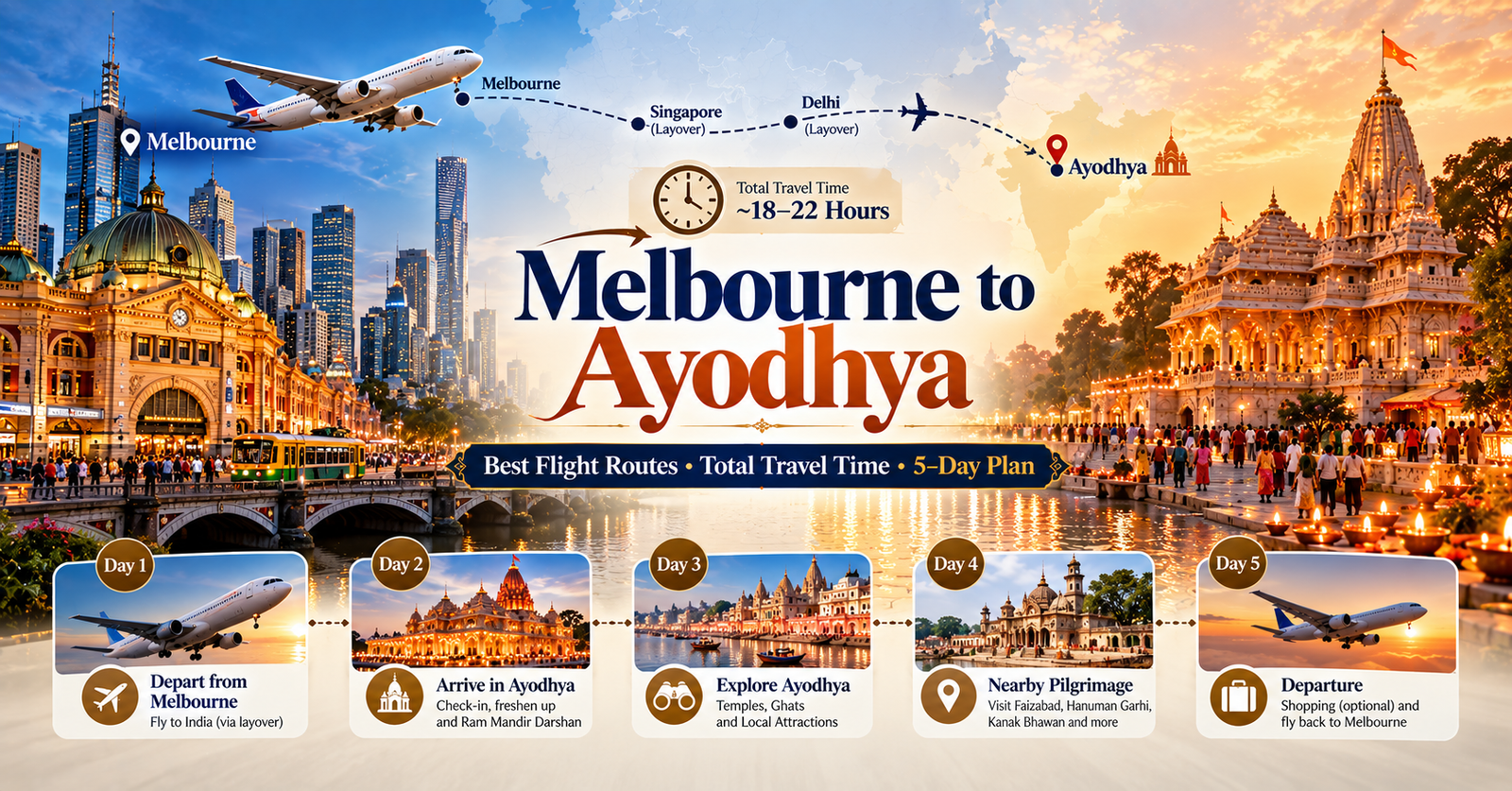
Sydney to Ayodhya and Varanasi: A Complete Pilgrimage Guide for Indian-Australians
Sydney to Ayodhya and Varanasi made simple: flights via Delhi, the best loop, Ram Mandir and Kashi Vishwanath rules, carrying ashes, 8–10 day plans, AUD costs.
Sydney to Ayodhya and Varanasi: A Complete Pilgrimage Guide for Indian-Australians
By the Your Travel Partner team, Ayodhya. Last updated: October 2026.
For a lot of families in Parramatta, Harris Park, Blacktown and the Hills, this trip has been talked about for years. Parents want to see the new Ram Mandir. Someone has promised a grandmother a dip in the Ganga. Sometimes there's an urn of ashes waiting at home for the right time. Ayodhya and Varanasi sit about four hours apart by road, and together they make one of the most meaningful journeys a Hindu family can take. This guide is written for Indian-Australians planning that trip from Sydney: the flights, the order to do things in, the temple rules in each city, the paperwork, and what it all costs in Australian dollars.
Quick Answer
The simplest route from Sydney to Ayodhya and Varanasi is a loop: fly Sydney to Delhi nonstop (about 13 hours), take a domestic flight to Ayodhya, drive about 200 to 220 km to Varanasi, then fly Varanasi back to Delhi for your flight home. Allow 8 days for the two cities, or 10 if you add Prayagraj. Australian passport holders need an India e-Visa unless they hold an OCI card. Ram Mandir darshan is free. At Kashi Vishwanath, general darshan is free and the temple trust also sells official tickets for faster entry and aartis.
| Key fact | Detail |
|---|---|
| Direct flight to Ayodhya or Varanasi from Australia | None |
| Sydney to Delhi nonstop | About 13 hours |
| Delhi to Ayodhya (AYJ) | About 1.5 hours by air |
| Ayodhya to Varanasi | About 200 to 220 km, 4 to 5 hours by road |
| Varanasi airport (VNS) | About 26 km from the city; flights to Delhi, Mumbai and other cities |
| Time difference | Sydney is 5.5 hours ahead of India in daylight saving, 4.5 hours otherwise |
| Ideal length | 8 days (two cities) or 10 days (with Prayagraj) |
| Best months | October to March |
Table of Contents
- Why Ayodhya and Varanasi belong together
- Flights from Sydney
- The best way to loop the two cities
- Visa, OCI and the e-Arrival card
- Day-by-day pilgrimage plans
- In Ayodhya: Ram Mandir and the Saryu
- In Varanasi: Kashi Vishwanath and the ghats
- Temple rules side by side
- Carrying ashes from Australia for asthi visarjan
- Pilgrimage calendar 2026–27
- Where to stay in each city
- Costs in AUD
- What to pack for a pilgrimage
- Travelling with parents and grandparents
- Money, phone, health and insurance
- Planning checklist
- Mistakes we see often
- How we can help
- FAQs
Why Ayodhya and Varanasi Belong Together
Ayodhya is the birthplace of Lord Ram, and the Ram Mandir has drawn huge numbers of pilgrims since Ram Lalla was consecrated on 22 January 2024. Varanasi, or Kashi, is Lord Shiva's city, one of the oldest living cities in the world and home to Kashi Vishwanath, one of the twelve jyotirlingas. For many families the two go naturally together: the temple of Ram, then the city of Shiva, with Prayagraj and the Sangam sitting between them if you have time.
They also suit very different moods. Ayodhya is calm and orderly, with a new airport, wide roads and a temple complex built for big crowds. Varanasi is ancient and intense, with narrow lanes, ghats running for kilometres along the river, cremation fires that never go out, and an evening aarti that people remember for the rest of their lives. Doing both in one trip gives you the full range.
| Ayodhya | Varanasi | |
|---|---|---|
| Main deity | Lord Ram | Lord Shiva (Kashi Vishwanath) |
| River | Saryu | Ganga |
| Feel | New, orderly, spacious | Ancient, crowded, intense |
| Main temple entry | Free; passes from the Trust are also free | General darshan free; paid official tickets available |
| Evening ritual | Saryu aarti at Naya Ghat | Ganga aarti at Dashashwamedh Ghat |
| Getting around | Car plus e-rickshaw near the temples | Car to the edge of the old city, then on foot, rickshaw or boat |
| Days needed | 2 | 2 to 3 |
Flights from Sydney
There's no flight from Sydney to Ayodhya or from Sydney to Varanasi without a change of plane. Planning Sydney to Ayodhya and Varanasi as one trip means choosing an arrival city and a departure city. Your trip has a long international leg and one or two short domestic ones.
Option 1: the Sydney to Delhi direct flight
Air India flies a Sydney to Delhi direct flight most days of the week, taking roughly 13 hours. This is the route most families end up on, because Delhi has the most domestic connections to both Ayodhya and Varanasi. Schedules shifted during 2026, so check the current timetable for your dates before you lock in leave.
Option 2: one stop in Southeast Asia
Singapore, Kuala Lumpur and Bangkok all have frequent flights from Sydney and onward flights to Delhi. Expect 17 to 21 hours to Delhi including the layover. The main reasons to choose this are price, more departure times, and a break in the middle for elderly parents.
For anyone whose main destination is Kashi, one Sydney to Varanasi route is worth knowing about: Varanasi has an international service to Bangkok on Air India Express. If it's running on your dates, Sydney to Bangkok to Varanasi avoids Delhi altogether on one leg of the trip. Check the schedule and whether the two flights can be booked together; if not, leave a generous gap.
Option 3: through Bengaluru or another Indian city
Qantas has operated a nonstop Sydney to Bengaluru service. If you have family in the south, you can visit them first and then fly from Bengaluru to Ayodhya or Varanasi, where direct flights are scheduled. Check current routes, as domestic schedules change by season.
| Route | Time to India | Good for |
|---|---|---|
| Sydney to Delhi nonstop | About 13 hours | Most pilgrims; simplest connections to both cities |
| Sydney via Singapore, Kuala Lumpur or Bangkok to Delhi | 17 to 21 hours | Lower fares; splitting the journey |
| Sydney via Bangkok to Varanasi | Varies with the connection | Starting or ending the trip in Varanasi |
| Sydney to Bengaluru, then domestic | About 12 hours to Bengaluru | Families visiting relatives in south India |
Book an open-jaw ticket
This is the single most useful booking tip for this trip. Instead of a simple return to Delhi, ask for Sydney to Delhi to Ayodhya on the way out, and Varanasi to Delhi to Sydney on the way back, all on one ticket if the airline sells it. You drive between Ayodhya and Varanasi in the middle. You never retrace your steps, your bags are checked through, and if a domestic flight runs late, the airline has to rebook your international connection.
Door-to-door timeline
Here's what the journey from western Sydney to the ghats actually looks like on the nonstop route, with a night in Delhi.
| Stage | Approximate time |
|---|---|
| Home to Sydney Airport, check-in and security | 3 to 3.5 hours |
| Sydney to Delhi | About 13 hours |
| Immigration, bags, airport hotel | 1.5 hours |
| Overnight in Delhi | 8 to 12 hours, depending on arrival time |
| Delhi to Ayodhya, including check-in | About 3.5 hours |
| Ayodhya airport to hotel | 30 to 45 minutes |
Flying time from Sydney to Ayodhya is about 14.5 hours. Door to door, with a proper night's sleep in Delhi, it's a day and a half. Because India is only 4.5 to 5.5 hours behind Sydney, jet lag is mild, and most people feel normal by the second morning. The return from Sydney to Varanasi and back works the same way in reverse.
The Best Way to Loop the Two Cities
There are two sensible directions. Both work; the choice depends on your flights and on who's travelling.
| Direction | Route | Why choose it |
|---|---|---|
| Ayodhya first | Delhi → fly to Ayodhya → drive to Varanasi → fly to Delhi | Calm start in an orderly city; Varanasi's intensity comes when everyone has adjusted. Our usual recommendation. |
| Varanasi first | Delhi → fly to Varanasi → drive to Ayodhya → fly to Delhi | Suits trips timed for a Varanasi festival, or where the main purpose is asthi visarjan at the start |
The drive between Ayodhya and Varanasi takes four to five hours on a normal day. Leave after breakfast and you'll be in Varanasi by mid-afternoon, with time to rest before the evening Ganga aarti. Book one private car with a driver for the whole transfer, with room for luggage.
Adding Prayagraj? It sits neatly in between. Ayodhya to Prayagraj is about 165 km, and Prayagraj to Varanasi about 120 km, so you split one long drive into two short ones and gain a morning at the Triveni Sangam.
Visa, OCI and the e-Arrival Card
Australian passport holders
You'll need an India e-Visa before you fly. The India e-Visa for Australians is applied for online in about 20 minutes. The High Commission of India in Canberra sends applicants to the official Government of India portal, indianvisaonline.gov.in, and nowhere else.
| e-Tourist Visa | Reported fee for Australians | Best for |
|---|---|---|
| 30-day | US$10 (April to June arrivals) or US$25 (July to March) | A single pilgrimage |
| 1-year | US$40 | Two trips in a year |
| 5-year | US$80 | Regular family visits |
These are the fees commonly reported for the India e-Visa for Australians. A bank charge of about 2.5% is added. Check the fee on the portal before you pay, as fees can change. Apply at least four days before arrival; two to three weeks is more comfortable. Your passport needs six months' validity and two blank pages. Delhi, Mumbai, Lucknow and Varanasi are all designated e-Visa entry airports.
Lots of private websites copy the look of the official portal and charge several times the fee. The genuine site ends in .gov.in. If you'd rather have help, we offer visa assistance and show the government fee and our service fee separately.
OCI cardholders
With an OCI card, you don't need a visa. Carry it with your current Australian passport. If you've renewed your passport since the OCI was issued, check the current rules on updating your OCI details before you fly.
Indian citizens living in Sydney
No visa is needed for India. Make sure your Australian visa or permanent residency lets you back in. Permanent residents need a current travel facility; once it lapses after five years, you'll need a Resident Return Visa.
e-Arrival card
India now uses an online e-Arrival card instead of the paper form. Foreign passport holders complete it within 72 hours before landing on the Bureau of Immigration site, the visa portal or the Su-Swagatam app, and receive a QR code. According to reports from April 2026, OCI cardholders are included and Indian citizens are exempt.
Day-by-Day Pilgrimage Plans
8 days: Ayodhya and Varanasi
| Day | Plan |
|---|---|
| 1 | Fly Sydney to Delhi; evening arrival; airport hotel |
| 2 | Morning flight to Ayodhya; rest; Hanuman Garhi and Kanak Bhawan in the late afternoon; Saryu aarti at Naya Ghat |
| 3 | Early Ram Mandir darshan; Dashrath Mahal; Guptar Ghat in the afternoon; Ram Ki Paidi at night |
| 4 | Drive to Varanasi after breakfast (4 to 5 hours); rest; Ganga aarti at Dashashwamedh Ghat |
| 5 | Kashi Vishwanath darshan early; Annapurna temple nearby; afternoon rest; evening walk along the ghats |
| 6 | Sunrise boat from Assi Ghat to Manikarnika; Sankat Mochan Hanuman temple; Sarnath in the afternoon |
| 7 | Fly Varanasi to Delhi; connect to the flight to Sydney |
| 8 | Arrive in Sydney |
10 days: Ayodhya, Prayagraj and Varanasi
| Day | Plan |
|---|---|
| 1 | Sydney to Delhi |
| 2 | Fly to Ayodhya; Saryu aarti |
| 3 | Ram Mandir and the Ayodhya temples |
| 4 | Bharat Kund at Nandigram in the morning; drive to Prayagraj (about 165 km) |
| 5 | Boat to the Triveni Sangam; asthi visarjan if you're carrying ashes; Hanuman temple near the Sangam |
| 6 | Drive to Varanasi (about 120 km); evening Ganga aarti |
| 7 | Kashi Vishwanath darshan; ghats on foot |
| 8 | Sunrise boat; Sarnath; free evening |
| 9 | Fly to Delhi; flight home |
| 10 | Arrive in Sydney |
Adding Gaya for pind daan
Some families combine this pilgrimage with pind daan at Gaya in Bihar. Varanasi to Gaya is a long road day of roughly 250 km, or a few hours by train. Add at least two days. Our guides to the cost of pind daan in Gaya and the main vedis of Gaya explain what's involved.
In Ayodhya: Ram Mandir and the Saryu
The Ram Mandir is run by Shri Ram Janmabhoomi Teerth Kshetra, the Trust responsible for the temple.
| Aarti or darshan | Time listed by the Trust |
|---|---|
| Mangal Aarti | 4:00 a.m. |
| Shringar Aarti | 6:00 a.m. |
| Darshan | 7:00 a.m. to noon, and 1:00 p.m. to 9:00 p.m. |
| Shayan Aarti | 10:00 p.m. |
- Ram Mandir darshan is free. General darshan needs no ticket.
- Passes are free too and are issued only by the Trust on online.srjbtkshetra.org or at its counter. No tour company can sell one.
- Phones and electronic devices stay outside. Lockers and a cloakroom are provided.
- Carry your passport or OCI card as photo ID for any pass.
- Timings change by season and on festival days, so check the Trust's site, srjbtkshetra.org, a few days ahead.
Pilgrims traditionally visit Hanuman Garhi first, then go for Ram Mandir darshan. For Indian-Australian families with young children, an early morning slot is usually the calmest. Kanak Bhawan and Dashrath Mahal are a short ride away. In the evening, the aarti on the Saryu at Naya Ghat is gentle and unhurried, a nice contrast to what's coming in Varanasi. Cars are stopped short of many temples, so an e-rickshaw is the easiest way around. If you arrive by train instead of flying, we'll meet you with a station pickup at Ayodhya Dham Junction or Ayodhya Cantt.
In Varanasi: Kashi Vishwanath and the Ghats
Kashi Vishwanath darshan
Kashi Vishwanath is managed by the Shri Kashi Vishwanath Temple Trust. The temple is now connected to the river by the Kashi Vishwanath Corridor, which makes the walk from the ghats far easier than it used to be.
Kashi Vishwanath darshan works differently from Ayodhya, and this catches visitors out. General darshan is free. The Trust also sells official tickets for Sugam Darshan (a faster, escorted queue) and for the main aartis. Book these only on the official site, shrikashivishwanath.org, or the temple's official app.
| Ticket or aarti | Reported price | Notes |
|---|---|---|
| General darshan | Free | Queues can be long, especially on Mondays and festival days |
| Sugam Darshan | About ₹250 per person | Not available during aartis or on special days. Foreign nationals have been asked to book at the temple desk with passport and visa copies. |
| Mangala Aarti (pre-dawn) | About ₹500 | Entry very early in the morning; book well ahead |
| Bhog, Saptarishi and Shringar Aartis | About ₹300 each | Book through the official site or app |
These prices come from recent travel guides, not from the Trust's own price list, and they do change. Confirm on the Trust's website or helpline before you go. The Trust lists a helpline and WhatsApp number, +91 6393 131 608.
Inside the temple, phones, cameras, pens and bags aren't allowed. Use a locker or leave them at the hotel, and carry a printed copy of any ticket. There's no formal dress code for general darshan, but modest clothing is expected.
A day in Varanasi, hour by hour
| Time | Plan |
|---|---|
| 5:30 a.m. | Walk or drive to Assi Ghat; sunrise boat downstream |
| 7:00 a.m. | Step off near the Kashi Vishwanath Corridor; leave phones at the hotel or in a locker |
| 7:30 a.m. | Kashi Vishwanath darshan (general queue, or Sugam Darshan booked earlier) |
| 9:30 a.m. | Annapurna temple; breakfast of kachori and jalebi in the lanes |
| 11:00 a.m. | Back to the hotel; rest through the heat of the day |
| 3:30 p.m. | Car to Sankat Mochan, or out to Sarnath |
| 5:30 p.m. | Dashashwamedh Ghat for the Ganga aarti |
| 8:00 p.m. | Dinner; early night |
Your driver can drop you at the edge of the old city and wait. If you're flying out the next day, book the Varanasi airport transfer in advance; the airport is about 26 km out and traffic can be slow.
The Ganga aarti
The evening Ganga aarti at Dashashwamedh Ghat is free to watch. Arrive at least 45 minutes early for a spot on the steps, or watch from a boat on the river. Boats fill up fast in the high season, so agree on the price and the time before you step aboard.
The ghats, Manikarnika and Sarnath
- A sunrise boat ride from Assi Ghat downstream to Manikarnika shows you the whole riverfront in about an hour.
- Manikarnika Ghat is the main cremation ghat. It's a sacred place for grieving families. Watch quietly from a distance and don't take photos.
- Sankat Mochan is the city's best-loved Hanuman temple.
- Sarnath, about 10 km out, is where the Buddha gave his first sermon. It's peaceful and green, and a welcome break for older travellers.
Getting around Varanasi
Cars can't enter most of the old city near the ghats. Your driver will usually drop you at the nearest point, often around Godowlia, and you'll continue on foot, by cycle-rickshaw or by boat. If you're staying on the ghats, ask the hotel in advance about porters for your luggage. It's normal and saves a lot of trouble.
Temple Rules Side by Side
| Ram Mandir, Ayodhya | Kashi Vishwanath, Varanasi | |
|---|---|---|
| General darshan | Free | Free |
| Faster entry | Free passes from the Trust only | Paid Sugam Darshan from the Trust only |
| Aarti entry | Free passes from the Trust | Paid tickets for most aartis, from the Trust |
| Phones | Not allowed; lockers provided | Not allowed; use lockers |
| ID | Passport or OCI for passes | Passport and visa copies for foreign nationals at the desk |
| Official website | srjbtkshetra.org | shrikashivishwanath.org |
The rule that applies to both: buy nothing from touts. At Ayodhya nothing is for sale at all. At Varanasi, tickets are sold only by the Trust. Anyone offering a "VIP darshan" privately is not selling anything official.
Carrying Ashes from Australia for Asthi Visarjan
Many Indian-Australian families make this pilgrimage to immerse a parent's ashes in the Ganga, usually at Varanasi or at the Sangam in Prayagraj. This is the part of the trip people find most stressful, and the part least covered elsewhere. Here's how it generally works for asthi visarjan from Australia, step by step. Start at least six to eight weeks before you fly.
Step 1: get a certificate from the Indian mission
The High Commission of India lists a Certificate for transporting body or ashes to India among its consular services. For NSW residents, the application goes to the Consulate General of India in Sydney. For ashes, the documents listed include:
- The deceased's passport (for cancellation)
- The original death certificate with a DFAT apostille, plus a photocopy
- The original cremation certificate with a DFAT apostille, plus a photocopy
- Details and itinerary of the person carrying the ashes
- The Miscellaneous Service Form in Death Cases
This consular certificate is the key document for asthi visarjan from Australia. The apostille comes from the Department of Foreign Affairs and Trade, so allow time for that before you approach the consulate. Check the High Commission's current requirements and fee before you apply, as these lists are updated from time to time. ACT residents apply in Canberra; Victoria and Tasmania in Melbourne; Queensland in Brisbane; Western Australia and the Northern Territory in Perth.
Step 2: choose the right container
Airport security must be able to see inside the urn on X-ray. Wood, plastic, cardboard or unlined ceramic usually screen well. Metal, stone and marble often don't. Many families use a simple temporary container for the flight and buy a traditional urn in India.
Step 3: tell the airline
Check your airline's policy before you fly and tell them you're carrying cremated remains in a sealed container. Air India's published rules allow ashes in cabin or checked baggage, provided the container can be X-rayed. Most families prefer to keep the urn in their cabin bag. If you have a connecting flight on another airline, check that airline's rules too.
Step 4: the ritual in India
At Varanasi or Prayagraj, the ritual is performed with a priest at the ghat or from a boat on the river. Agree on the dakshina in advance, and keep the certificates with you until the ritual is done. If you'd like, we can arrange the boat and the transport and introduce you to a local priest; the ritual itself is between your family and the priest.
This section is general guidance, not legal advice. Requirements are set by the Indian mission, DFAT, the airline and Australian authorities, and they change. Confirm with each before you travel.
Pilgrimage Calendar 2026–27
| Event | Where | Date | Note |
|---|---|---|---|
| Deepotsav | Ayodhya | Evening of 7 November 2026 | Lamps along the Saryu; enormous crowds |
| Diwali | Both | 8 November 2026 | Book months ahead |
| Dev Deepawali | Varanasi | 24 November 2026 | The ghats lit with diyas; boats sell out |
| Magh Mela | Prayagraj | January to February 2027 | Bathing festival at the Sangam |
| Maha Shivaratri | Varanasi | Early March 2027 | Very long queues at Kashi Vishwanath |
| Ram Navami | Ayodhya | 15 April 2027 | Lord Ram's birthday; huge crowds and heat |
If you'd like to see the lit ghats of Varanasi on Dev Deepawali, a trip from mid to late November covers it, with Ayodhya after Diwali when the crowds have eased. For a quieter pilgrimage, February is hard to beat. Festival dates follow the Hindu calendar, so confirm them closer to the time.
Weather
| Months | Conditions (approximate) | Verdict |
|---|---|---|
| October to November | Warm days, about 27 to 32°C | Excellent; festival season |
| December to January | Cold mornings, about 6 to 10°C; fog | Good, but pack warm and expect flight delays |
| February to March | Mild to warm | Excellent |
| April to June | Often above 40°C | Hard on elders |
| July to September | Monsoon; high river levels | Some ghats and boat rides restricted when the Ganga is high |
Where to Stay in Each City
| City | Area | Good for | Keep in mind |
|---|---|---|---|
| Ayodhya | Near Ram Mandir and Hanuman Garhi | Walking to darshan | Higher prices; vehicle restrictions |
| Ayodhya | Civil Lines and the Faizabad side | Bigger rooms, easy parking | 15 to 25 minutes' drive to the temple |
| Varanasi | On the ghats (Dashashwamedh to Assi) | River views, walking to the aarti | No car access; steps and lanes; porters needed |
| Varanasi | Cantonment and the newer city | Seniors, larger hotels, car access | 20 to 30 minutes to the ghats in traffic |
For a family with grandparents, we usually suggest a hotel with car access in Varanasi and day trips to the ghats, rather than a riverfront guesthouse up three flights of stairs. Ask any hotel about a lift, hot water, a generator and vegetarian food. If you'd rather not pick hotels from Sydney, our pilgrimage packages include stays in both cities.
Costs in AUD
A per-person planning budget for the 8-day trip. These are our estimates, not quotes. Airfare moves the most, and December and January fares are often well above these ranges.
| Item | Careful | Comfortable |
|---|---|---|
| Return airfare, Sydney to Delhi, economy | A$1,200 to A$1,600 | A$1,600 to A$2,100 |
| Domestic flights (Delhi to Ayodhya, Varanasi to Delhi) | A$120 to A$180 | A$180 to A$280 |
| e-Visa (not needed with OCI) | About A$40 | About A$62 to A$125 |
| Hotels, per room per night | A$40 to A$65 | A$90 to A$180 |
| Meals, per day | A$15 to A$22 | A$28 to A$45 |
| Car for the Ayodhya–Varanasi transfer and local trips | Depends on vehicle and days; get a written quote | |
| Kashi Vishwanath tickets (optional) | Roughly ₹250 to ₹500 per ticket | |
| Boat rides, guide, puja, dakshina | Varies; agree in advance | |
| Travel insurance | Varies with age and cover | |
All up, a careful pilgrim will spend roughly A$2,300 to A$3,000 per person on the 8-day loop. A comfortable trip with better hotels and a private car throughout is more like A$3,400 to A$4,600. Couples and families sharing rooms and one vehicle spend less per head.
If you'd prefer one price for everything, an Ayodhya Varanasi tour package from Australia can bundle flights, hotels and the car; see our packages. We don't publish package prices, because they change with the season and the size of the group. Send us your dates and the number of travellers, and we'll come back with a written total.
What to Pack for a Pilgrimage
| Category | Items |
|---|---|
| Documents | Passports, e-Visa printouts or OCI cards, e-Arrival QR codes, printed tickets for temples and flights, insurance policy |
| For darshan | Slip-on shoes, socks for cold stone floors, a small cloth bag for footwear, a printed copy of any temple ticket |
| For puja | Anything your family priest has asked you to bring; most puja items are easy to buy near the ghats |
| If carrying ashes | The sealed, X-ray-clearable container, all apostilled certificates and the consulate's certificate, in your cabin bag |
| Clothes | Modest, comfortable outfits; a warm jacket and shawl from December to February; a spare set for after the holy dip |
| Health | Regular medicines, oral rehydration salts, hand sanitiser, insect repellent, a few P2 masks |
| Practical | Round-pin plug adapter, power bank, small towel, torch for the lanes at night |
Leave space for prasad, sweets from Varanasi and gifts for the relatives who couldn't come.
Travelling with Parents and Grandparents
On this trip, more than any other, the pace has to suit the oldest person in the group.
- Book airline wheelchair assistance for every airport, both ways, when you buy the tickets.
- Take the nonstop from Sydney, and sleep in Delhi on the first night.
- Do one temple visit a day. Mornings for darshan, afternoons for rest, evenings for the aarti.
- Choose hotels with lifts and car access, especially in Varanasi.
- Ask both temple trusts about wheelchair access and facilities for elderly devotees before you go.
- Use an e-rickshaw in Ayodhya and a boat in Varanasi instead of long walks.
- Consider the train between cities only if your elders find long car journeys hard; ask us for a station transfer at each end.
- Pack their medicines in the cabin bag, with prescriptions and a written list of conditions.
- Plan meals around their routine. Fasting on darshan days is common, so keep fruit and water handy.
One car and driver for the whole stay keeps luggage, medicines and snacks in one place. Pre-booked airport transfers at Ayodhya and Varanasi mean nobody stands at the kerb negotiating after a long flight.
Money, Phone, Health and Insurance
- Cash: visitors can't bring Indian rupees in. Use an ATM at Delhi airport. Temples, boats, rickshaws and priests are cash only; keep plenty of small notes for offerings and dakshina.
- Cards: fine at hotels and bigger shops. A card with no international transaction fee saves around 3%.
- UPI: visitors can use a prepaid UPI One World wallet funded from an international card. It needs an Indian number and passport verification. Handy, but don't rely on it alone.
- Phone: an Australian roaming day pass, a travel eSIM or an Indian SIM. Download offline maps of both cities; networks slow down in festival crowds.
- Power: India runs on 230 volts, like Australia, so appliances work. You only need an adapter for the round-pin sockets.
- Insurance: Medicare doesn't cover you overseas. Smartraveller's advice is that if you can't afford travel insurance, you can't afford to travel. Make sure the policy covers evacuation and the ages of everyone travelling.
- Health: see your GP or a travel doctor at least eight weeks before you go. Drink sealed bottled water and eat freshly cooked food. North India's air can be poor from October to February.
- Official advice: the Australian Government advises a high degree of caution in India overall. Read the latest on smartraveller.gov.au.
- Leave at home: satellite phones and satellite messengers, vapes and drones.
Planning Checklist
- Choose your dates using the calendar and weather tables.
- Decide the loop: Ayodhya first or Varanasi first, with or without Prayagraj.
- Check passports, OCI cards and Australian visa status for every traveller.
- If carrying ashes, get the DFAT apostille and apply to the Indian consulate early.
- Book an open-jaw ticket: Sydney to Ayodhya via Delhi, and Varanasi to Sydney via Delhi.
- Book hotels with lifts and car access if elders are travelling.
- Arrange ground transport: airport pickups, the intercity car and an e-rickshaw in Ayodhya.
- See your GP and buy travel insurance.
- Apply for e-Visas two to three weeks before departure.
- Book any Kashi Vishwanath tickets on the official site, and check Ram Mandir timings on the Trust's site.
- Complete the e-Arrival card within 72 hours of landing.
Mistakes We See Often
- Booking a simple return to Delhi and then flying back and forth to each city.
- Trying to fit both cities and Prayagraj into six days.
- Assuming Kashi Vishwanath works like Ram Mandir. One is entirely free; the other sells official tickets.
- Buying "VIP darshan" from someone on the street.
- Booking a ghat-side guesthouse with steep stairs for elderly parents.
- Leaving the ashes paperwork to the last fortnight.
- Packing a metal or stone urn that airport X-ray can't see through.
- Photographing cremations at Manikarnika.
- Planning the drive between cities at night.
- Travelling without insurance that covers older family members.
How We Can Help
Your Travel Partner is based in Ayodhya and arranges travel across India. For families coming from Sydney, we can take care of the whole pilgrimage or only the part in India.
| Service | What it covers |
|---|---|
| International and domestic flights | Open-jaw tickets from Sydney and the domestic legs, quoted in writing before you pay |
| Visa assistance | Help with the e-Visa application; the visa itself is issued only by the Government of India |
| Airport transfers | Ayodhya, Varanasi and Lucknow airports |
| Private cars | The Ayodhya–Prayagraj–Varanasi drive and local sightseeing |
| E-rickshaws | Temple lanes in Ayodhya |
| Railway transfers | Ayodhya and Varanasi stations |
| Pilgrimage packages | Hotels, car and sightseeing across both cities |
For a single service, book an e-rickshaw for the Ayodhya temples, a railway pickup, or one of our Ayodhya and Varanasi packages. We don't sell darshan passes or temple tickets. Ram Mandir passes are free from the Trust, and Kashi Vishwanath tickets are sold only by its own Trust. Call or message +91 78811 55800 with your dates, number of travellers and any special needs. We're about five hours behind Sydney, so your afternoon is our morning. Coming from Melbourne instead? See our Melbourne to Ayodhya guide.
Frequently Asked Questions
1. Is there a direct flight from Sydney to Ayodhya or Varanasi?
No. Fly Sydney to Delhi, then take a domestic flight. Varanasi also has some international connections, including Bangkok, which can be combined with a flight from Sydney.
2. How long is the Sydney to Delhi direct flight?
About 13 hours. Air India operates the route most days of the week; check the schedule for your dates.
3. How many days do I need for Ayodhya and Varanasi?
Eight days from Sydney covers both cities comfortably. Ten days lets you add Prayagraj.
4. Which city should I visit first?
We usually suggest Ayodhya first, then Varanasi. If the main purpose is asthi visarjan or a Varanasi festival, start in Varanasi.
5. How far is Ayodhya from Varanasi?
About 200 to 220 km by road, four to five hours by car.
6. Is Ram Mandir darshan free?
Yes. Darshan is free, and the Trust doesn't charge for aarti or darshan passes.
7. Is Kashi Vishwanath darshan free?
General darshan is free. The temple trust also sells official Sugam Darshan and aarti tickets for faster entry. Buy only from the official website or app.
8. Can foreigners and OCI holders enter Kashi Vishwanath?
Yes. Foreign nationals have been asked to show their passport and visa copies at the darshan desk for ticketed entry. Confirm current procedure with the temple helpline.
9. Do Australians need a visa for India?
Yes, unless you hold an OCI card. Apply for an e-Visa on indianvisaonline.gov.in.
10. Can I carry my parent's ashes from Australia to India?
Yes, with the right paperwork. You'll need apostilled death and cremation certificates and the Indian mission's certificate for transporting ashes, plus an X-ray-clearable container and airline approval.
11. Where is the best place for asthi visarjan?
Many families choose the Ganga at Varanasi or the Triveni Sangam at Prayagraj. Your family priest's guidance and your family's tradition should decide.
12. When is the best time to go?
October to March. February and late November are the most comfortable. Dev Deepawali in Varanasi is on 24 November 2026.
13. Is it suitable for elderly parents?
Yes, with the right pace. Use wheelchair assistance, choose hotels with car access, and keep afternoons free.
14. Can I take photos at the ghats?
At most ghats, yes. At Manikarnika, the cremation ghat, please don't photograph cremations.
15. How much does the trip cost from Sydney?
As a planning estimate, A$2,300 to A$3,000 per person for a careful 8-day trip and A$3,400 to A$4,600 for a comfortable one.
16. Should I use an open-jaw ticket?
Yes. Fly into Ayodhya and out of Varanasi, both via Delhi, so you never double back.
17. Is there an Ayodhya Varanasi tour package from Australia?
Yes. We arrange an Ayodhya Varanasi tour package from Australia with flights, visa assistance, hotels and transport, or only the India part if you book your own flights.
18. What should I wear?
Modest clothes that cover shoulders and knees, and shoes that slip off easily. A warm layer from December to February.
19. Can we add Gaya for pind daan?
Yes. Add at least two days. Gaya is roughly 250 km from Varanasi by road, or a few hours by train.
20. Is Varanasi safe?
It's crowded and chaotic but used to pilgrims. Watch your belongings in the lanes, agree on boat and rickshaw prices first, and read Smartraveller's advice before you travel.
21. Do I need to book the Ganga aarti?
No. Watching from the ghat steps is free. Boats for the aarti are worth arranging earlier in the day in busy periods.
22. How long does the trip from Sydney to Varanasi take?
About 13 hours to Delhi and 1.5 hours to Varanasi, plus connection time. With a night in Delhi, plan on a day and a half door to door.
23. How early should I start the ashes paperwork?
Six to eight weeks before departure. The DFAT apostille and the consulate's certificate both take time.
24. Will my Australian appliances work?
Yes. The voltage is the same; you just need a round-pin plug adapter.
Conclusion
For Indian-Australians, getting from Sydney to Ayodhya and Varanasi is one long flight to Delhi, a short hop to Ayodhya, a drive across the plains to Kashi and a flight home. It's straightforward once you see it as a loop. Give it eight days, or ten with Prayagraj. Sort out visas, and the ashes paperwork if you need it, well before you fly. Remember that the Ram Mandir charges nothing while Kashi Vishwanath sells its own official tickets. Most of all, set a pace that works for the eldest person in your group.
When your dates are set, send them through and we'll plan the India side around your flights.
Ayodhya-based travel writer and Ministry of Tourism (India) certified guide. 12+ years guiding pilgrims across the Ayodhya–Varanasi–Prayagraj Holy Triangle. Every guide is fact-checked against current temple timings and local transport before publishing.